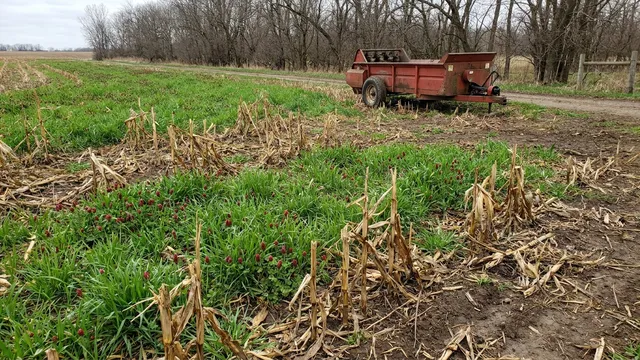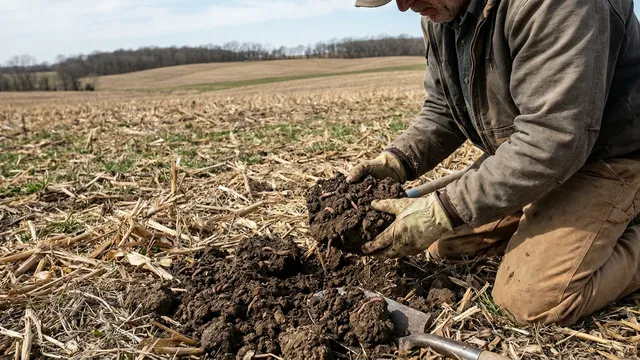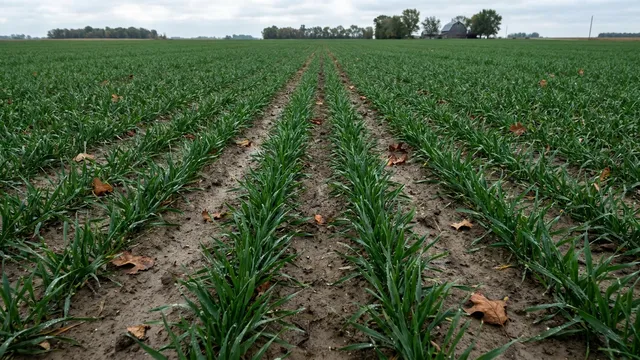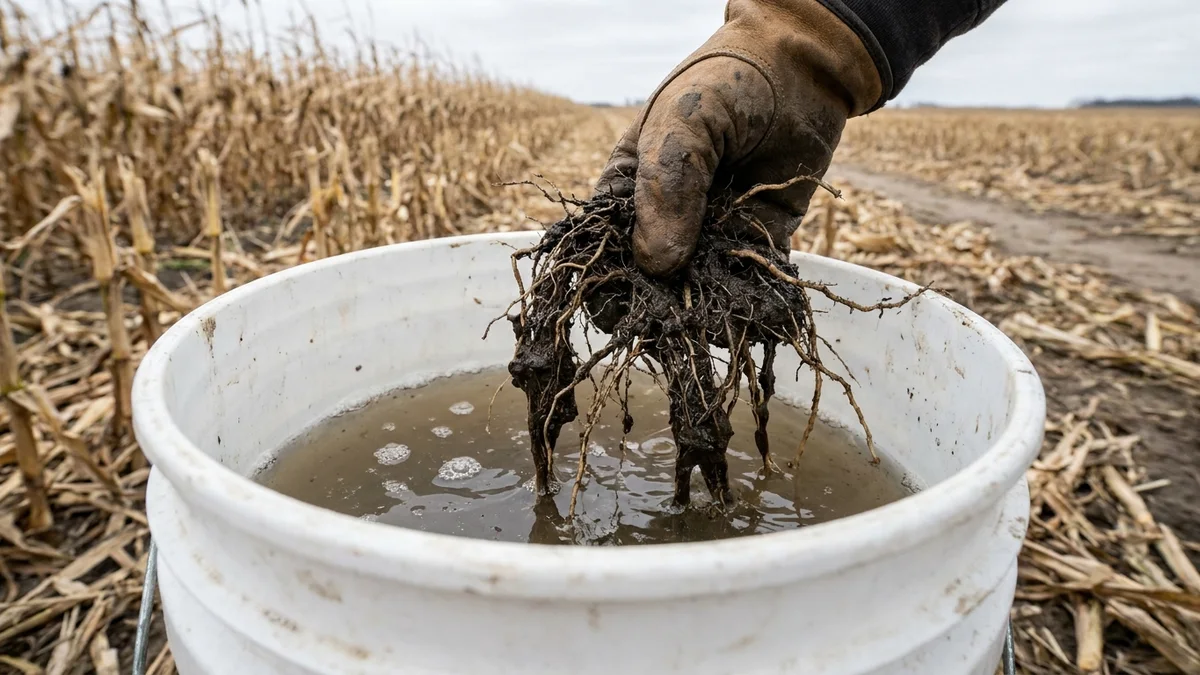
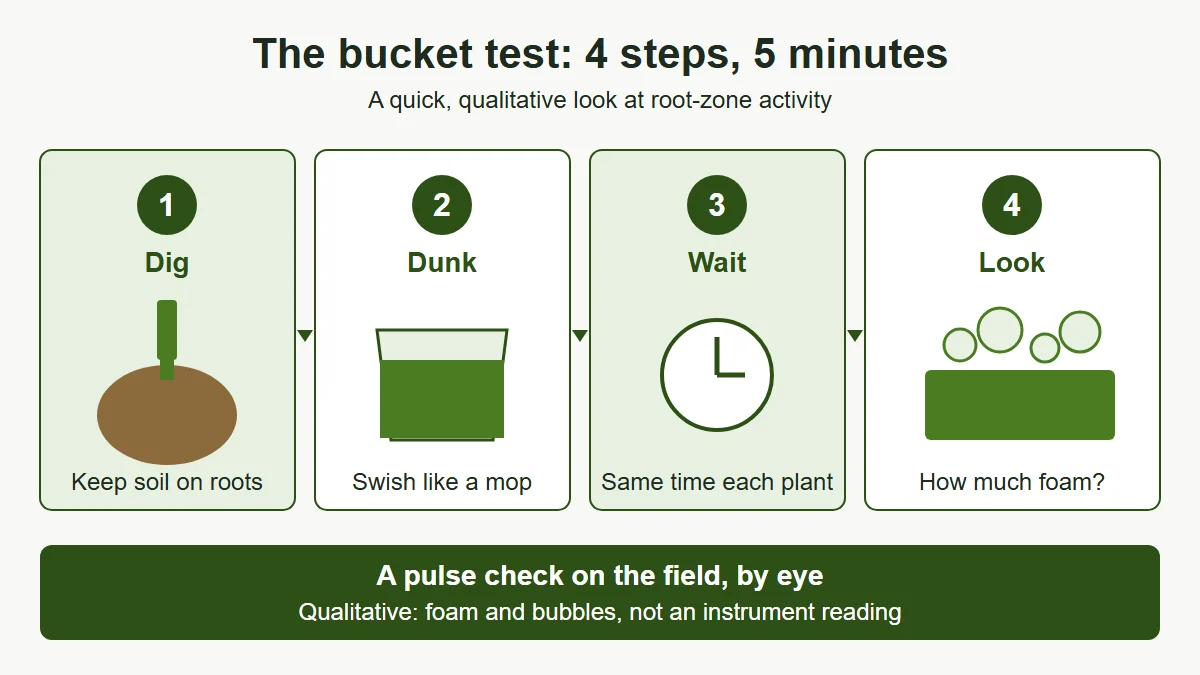
The bucket test is a five-minute field check of root-zone biology: dig a corn plant with soil still on the roots, swish it in a bucket of water like a mop, let it sit and see how much foam rises. The foam gives you a quick, by-eye read of how much soluble food the microbes around the roots are working.
What is the bucket test, and where does it come from?
It came up during the TNT Talk Time webinar of December 18, 2025, where TNT and RhizeBio, the independent soil microbiome lab that analyzed TNT's 2025 trial soil, rhizosphere and plant tissue, went through the results. In that session, "TNT 2025 Trial Results", the call had just talked about water-extractable organic carbon, the soluble carbon that feeds soil microbes. Someone on the call asked how you could get a feel for that out in your own field. The answer was a bucket, some water and a corn plant.
It is the same family of idea as the respiration reading in a Haney lab test, where instruments measure the CO2 that comes off the soil. In the bucket there are no instruments. You are looking at foam and bubbles. It is a pulse check on a field, nothing more and nothing less.
How do you run the bucket test step by step?
- Fill a clean bucket with water. Use the same water and the same bucket for every plant on test day.
- Dig up a corn plant, roots and all. Do not knock off the dirt. On sandy soil, take care to keep some soil on the plant.
- Dunk it like a mop. Push the roots and the soil on them into the water and swish them around for the same count each time.
- Leave it to sit. Set the bucket down and wait. Keep the timing the same for every plant.
- Look at the surface. See how much it foams up. The microbes get at the soluble food that washed off the roots and form a froth.
- Write it down. Record the field, strip, crop stage, date and a simple foam score, and take a photo from the same angle.
What does the foam tell you?
On the call the foam was described as showing how much soluble food is available to the microbes you have just washed off the roots. More soluble food and more activity can mean more froth on the surface. That connects the bucket to soil carbon: the soluble carbon that feeds microbes is what a Haney lab test reports as water-extractable organic carbon, and our post on water-extractable organic carbon explains that number.
The bucket cannot give you a lab number. What it gives you is a look, which is often enough to start a good conversation in the field. If you have been running a biological program, it is a simple way to see your own ground respond year over year, and it costs nothing but a bucket and a shovel.
How do you make the comparison fair?
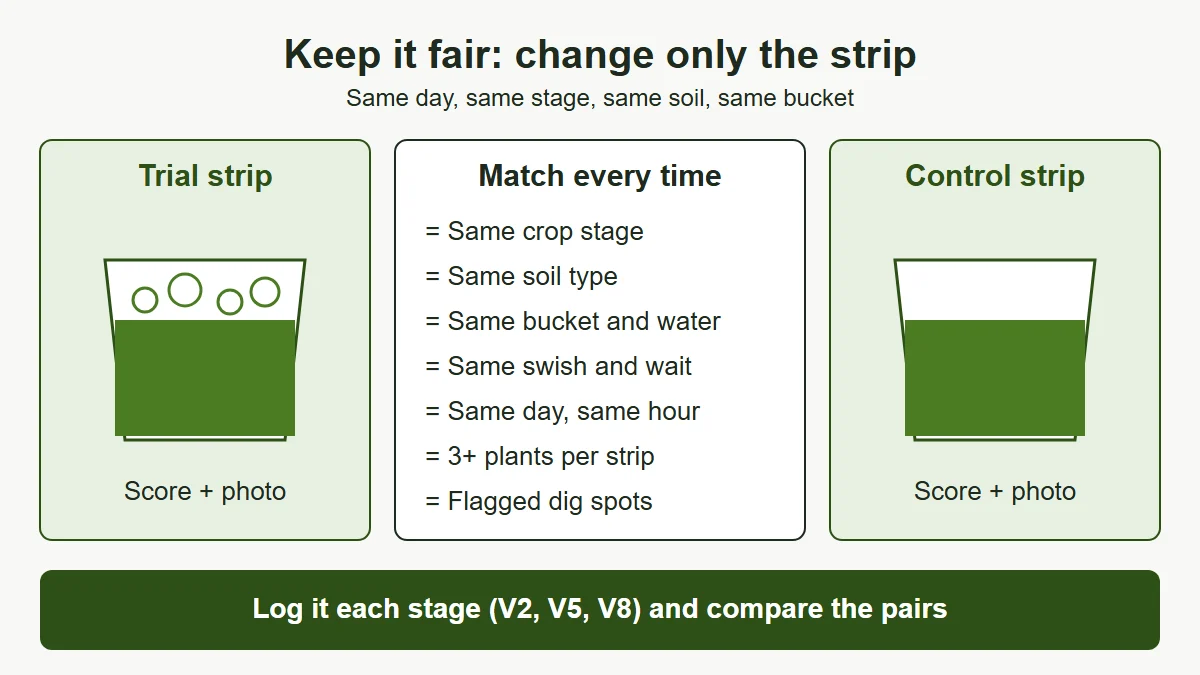
Foam depends on more than biology, so a fair test holds everything else steady. The TNT 2025 trial itself had strips in sandy to clay soil on the same field, which is exactly why this matters: compare like with like.
| Keep the same | Why it matters |
|---|---|
| Crop stage | Root-zone activity changes through the season. The TNT trial sampled at set stages such as V2, V5 and V8. |
| Soil type | Sand and clay hold and release soluble material differently. Dig from the same soil in trial and control. |
| Bucket, water and volume | A bigger bucket or different water changes what you see. |
| Swish and wait times | Count them. Use a phone timer. |
| Day and time | Dig every strip on the same day, ideally the same hour. |
| Number of plants | Three or more per strip so one odd plant does not mislead you. |
For the strip layout itself, see our guide to running an on-farm strip trial. Flag the spots where you dig, so you can come back to the same place in the next stage and the next season.
Where does the bucket fit with lab testing?
Use the bucket for quick looks and the lab for numbers. In TNT's 2025 trial, RhizeBio sequenced the microbes, ran soil fertility on soil shaken off the roots and tissue-tested the plants. In a corn strip treated with TNT HEF 2-3-0 plus TNT Super Salmon+, that work showed 315% more soil community diversity than the control at V2 (RhizeBio soil analysis, 2025, one farm).
The bucket is the on-the-fly companion to that. It will not tell you which microbes are present or what your tissue nitrogen is. It will tell you, in the field and in minutes, whether the root zone looks lively. If it is a close call, that is your cue to pull a soil and tissue sample and read them together; our post on soil tests and tissue tests covers how.
How do you use it with a TNT program?
TNT HEF is made from naturally fermented whole saltwater salmon with over 70% volatile fatty acids, which is a food source for soil biology. In the 2025 trial, 2 qt/acre of HEF went in-furrow at planting. For your own fields the in-furrow rate is 2-4 qt/acre for TNT HEF 2-0-0 and TNT HEF 2-3-0; read the label for the full set of rates.
A simple plan looks like this:
- Lay out replicated strips, with your normal program as the control.
- Flag the dig spots in each strip.
- Run the bucket check at the same crop stages on every strip, such as V2, V5 and V8, and log a foam score and photo.
- Add a lab soil and tissue test at one or two stages if you want numbers.
- At harvest, correct yield to standard moisture and read the pairs.
For measured yield, the only figures TNT quotes are the 2025 corn trial, and always both trials: Trial 1 came in at 238 bu/ac against a 223 bu/ac control with inputs of $58 against $145. Trial 2 came in at 232 bu/ac against a 245 bu/ac control strip, with inputs of $73 against $145, and still came out about $7 per acre ahead on input cost. One farm, one season; results vary. The 2025 corn trial write-up has the full design.
What is a good first step?
Pick one field you know, order a free sample, and set up three pairs of strips. Take the bucket and a shovel out at V2, dig one plant from each flag and see what you get. You may find, as the people on the TNT call said, that a simple check in your own hands is the quickest way to start paying attention to what happens around the root. TNT brings 20+ years of experience and a team you can call at (574) 532-6201 to help you set up the trial.