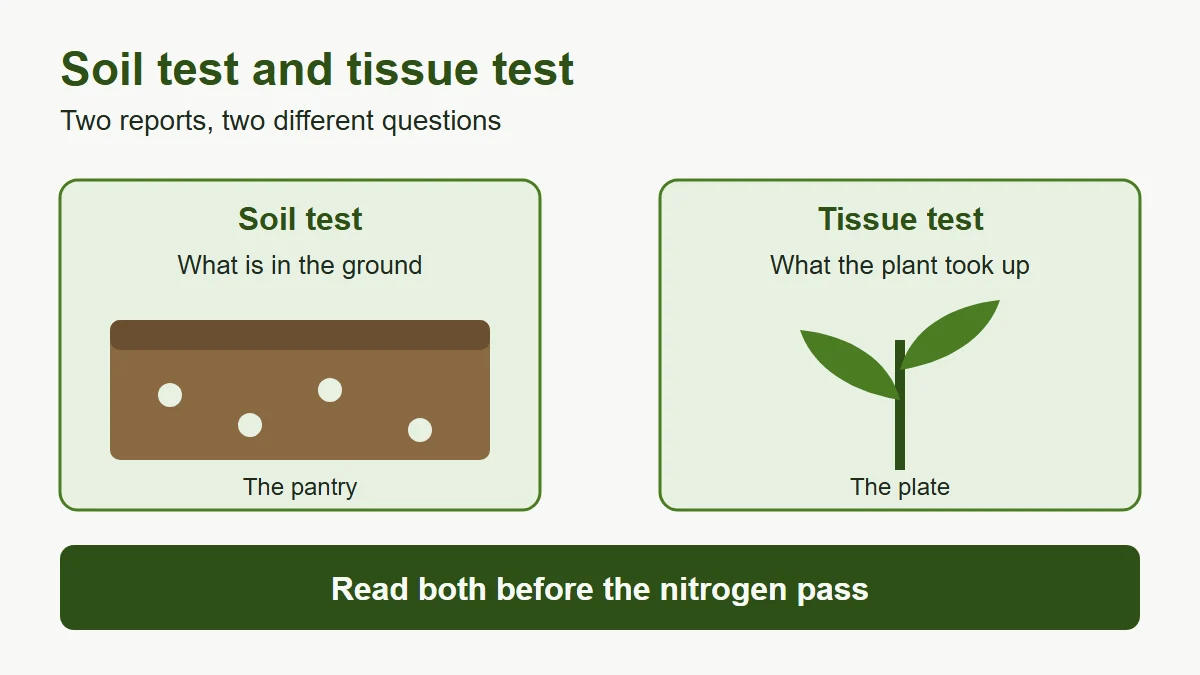
A soil test tells you what is in the ground, and a tissue test tells you what the plant actually took up. You need both to make a good nitrogen decision, and the tissue test is the one that tells you whether the crop is asking for more.
What does a soil test tell you?
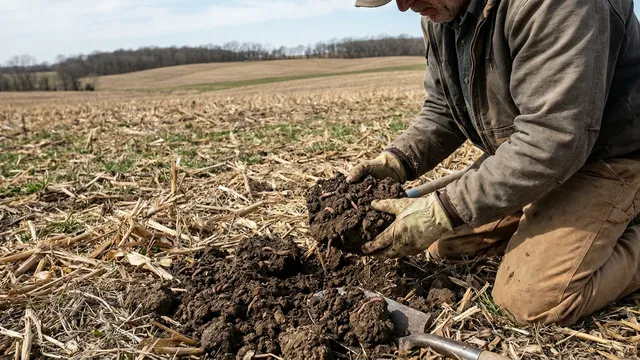
A soil test measures the nutrients, pH and organic matter in the soil sample you send to the lab. It is a picture of the pantry. It shows what is in the field and what the ground can hold, and it is the right tool for planning lime, phosphorus and potash. It is a snapshot of one moment and one spot, taken at the depth you sampled.
What it cannot show is how much of any nutrient the crop is actually using. That depends on moisture, soil temperature, root growth and the biology around the roots. Two fields with the same soil numbers can feed their crops very differently.
What does a tissue test tell you?
A tissue test measures what is inside the leaf at the time you sample it. It is a read on the plate rather than the pantry. It shows whether nitrogen, sulfur, phosphorus, potassium and the micronutrients such as manganese, copper, zinc and boron are present in the plant at useful levels.
It also answers a question the soil test cannot: is the crop short of something right now? In a TNT Coffee Shop session on hay and home gardens, the message was plain. By the time a hunger shows up as a symptom on the leaf, it has already cost you. A tissue sample catches it earlier. A visible symptom is the late alarm, and the tissue report is the early one.
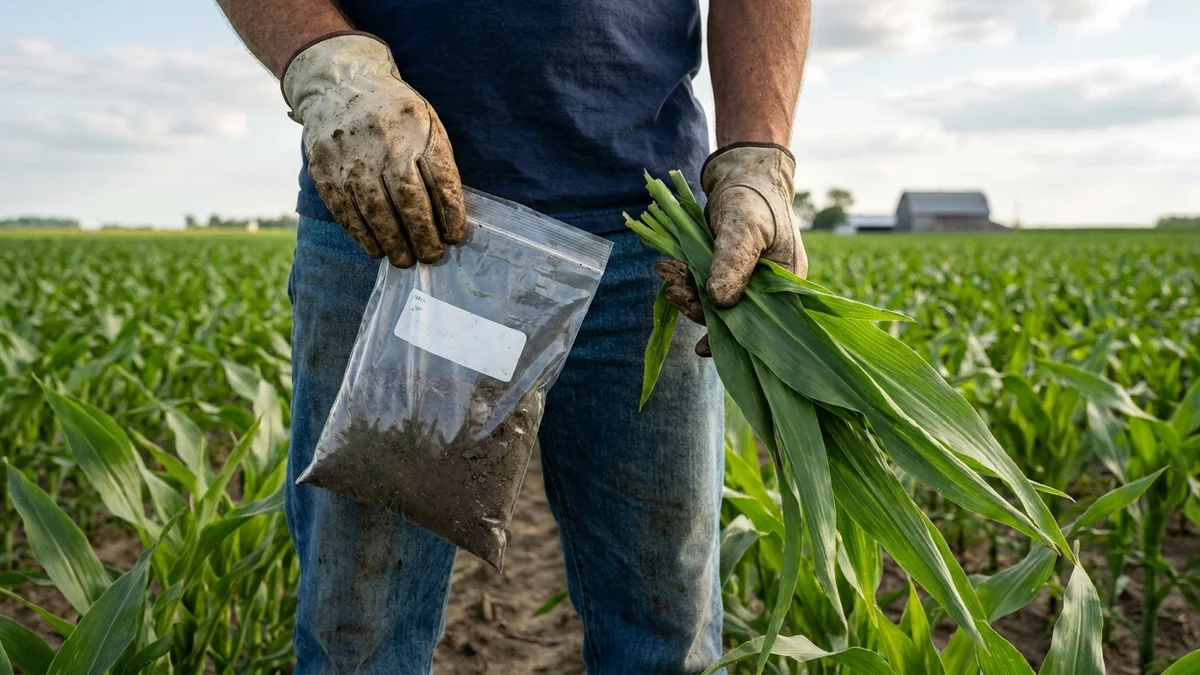
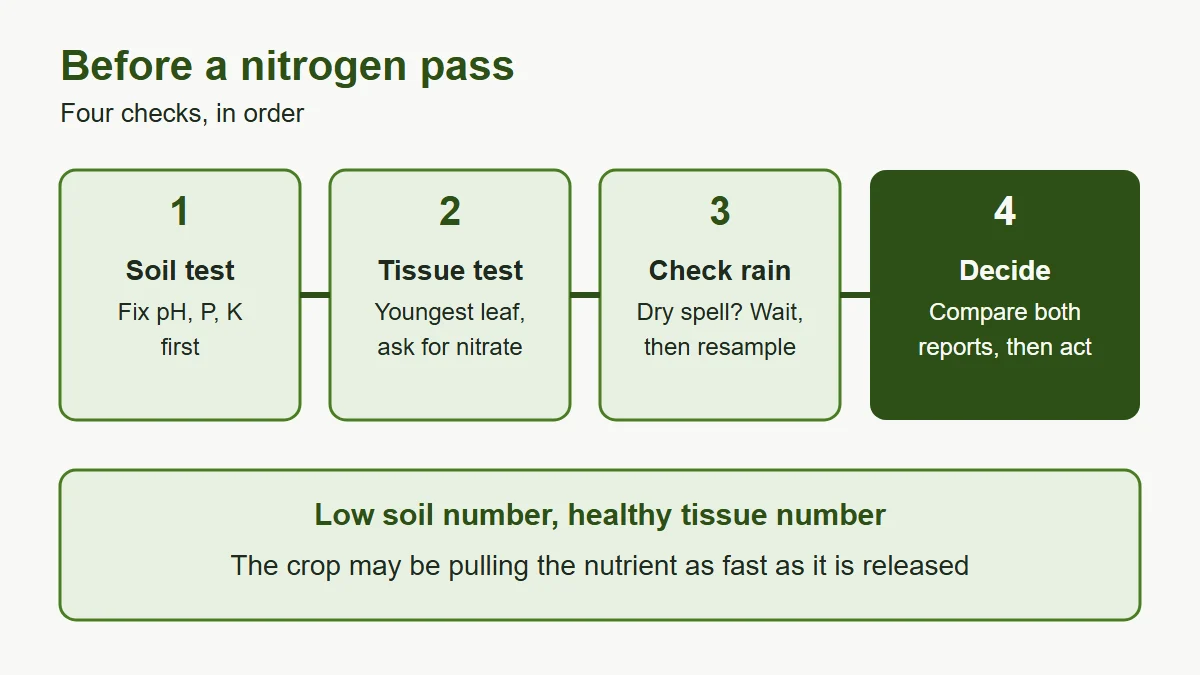
Sample the youngest fully developed leaf, at about the same growth stage each time, so your reports compare from one pass to the next. Your lab will tell you which leaf and how many to send.
How do the two tests compare?
| Question | Soil test | Tissue test |
|---|---|---|
| What it measures | Nutrients, pH and organic matter in the soil sample | Nutrients inside the plant leaf |
| Best for | Planning lime, phosphorus and potash before the season | Checking the crop during the season, before a nitrogen or foliar pass |
| Timing | Before planting, or on a regular schedule | In season, at a consistent growth stage |
| What it cannot tell you | How much the crop is actually taking up | What the soil has in reserve for later |
| Ask the lab for | pH, buffer pH, P, K, organic matter, CEC | Total nitrogen, nitrate, sulfur and the micronutrients |
Do you need a tissue test before nitrogen?
It is the most useful check you can make before a nitrogen or foliar pass. If the tissue report says the crop is sufficient, you can put that money where the crop needs it. If it says the crop is short, you know what to apply and you have the number to measure the result against.
When you order the test, tick the box for nitrate. Total nitrogen in the leaf does not by itself show whether the plant is turning it into amino acids and proteins. Nitrate shows what is still sitting in the leaf unconverted, and that reading helps you decide on the rest of the program, including the trace minerals that help the plant use nitrogen.
There is also the matter of timing. If you have had two or three weeks without rain and your nitrogen reads low, hold off before you read too much into it. Without soil moisture, nitrogen in the ground cannot reach the roots, so it may well be there and simply not moving. Wait for a rain, sample again a few days afterward, and compare. Often the crop greens up on its own once water returns.
What happened when TNT used tissue tests in 2025?
In the 2025 corn trial, run on one Ohio farm with RhizeBio, an independent soil microbiome lab, the grower's normal program was the control: 5 gal of 8-24 starter, 10 gal of 28% in the 2x2, a 60 gal 28% side-dress and a fungicide pass. The TNT strips cut the starter to 3 gal and added 2 qt/ac of HEF in-furrow. A tissue test then showed no extra nitrogen was needed, so the 60 gal side-dress was skipped on both TNT strips. Trial 2 also swapped the 28% in the 2x2 for 2 gal/ac of TNT Super Salmon+.
| 2025 corn trial | Control | Trial 1 (HEF) | Trial 2 (HEF + Super Salmon+) |
|---|---|---|---|
| Yield | 223 bu/ac (Trial 1 side), 245 bu/ac (Trial 2 side) | 238 bu/ac | 232 bu/ac |
| Input cost | $145/ac | $58/ac | $73/ac |
| Net vs control | Baseline | About $147/ac ahead | About $7/ac ahead |
One farm, one season; results vary with soil, weather and program. Trial 2 ran with no 28% at all, beside a 245 bu/ac control strip, and still finished ahead on the per-acre math. The tissue test is what let the team skip the side-dress with evidence instead of a guess. The full write-up is on the reports and trial page, and the session where the team walked through it is TNT 2025 Trial Results.
Why can soil numbers go down while tissue goes up?
This is the part that surprises people, and it is the best reason to read both reports together. In the RhizeBio analysis of the same trial, soil sulfur, manganese and copper read lower in the root-ball sample on the treated strips, while the plant tissue read higher for those nutrients.
The reading is that microbes were solubilizing those nutrients and the plant was taking them up efficiently. A lower number in the soil next to the root was the sign of a plant drawing on it. Read together, the two reports tell the whole story: where the nutrient came from and where it went (RhizeBio soil analysis, 2025, one farm; a soil-biology observation).
It also fits how the HEF products are meant to work. TNT HEF 2-3-0 and TNT HEF 2-0-0 are made from naturally fermented whole saltwater salmon, and they feed the fungi and bacteria around the seed and root. Active biology is what moves nutrients from soil to plant, and the tissue report is where you see the result of that.
How should you read the two together?
- Start with the soil test before the season. Fix pH and the large gaps in phosphorus and potash first. Our guide to reading a soil test walks through each line.
- Pull a tissue sample in season. Take it before you spend on nitrogen or a foliar pass, from the youngest fully developed leaf, and ask for nitrate.
- Check the weather. If it has been dry, wait for a rain and sample again before you act on a low nitrogen number.
- Compare the two reports. A low soil number with a healthy tissue number can mean the plant is drawing the nutrient as fast as it is released. A low number in both is the case to act on.
- Keep a strip beside your normal program. Sample both strips at the same stage and you will see on your own ground what the plant took up.
A tissue test is the report that tells you whether the next pass is needed at all, and it pairs well with a Brix reading on the same leaf, since both come from the same sampling walk.
How does this connect to a TNT program?
TNT supplies fish fertilizers and biostimulants, and the team has 20+ years of experience helping growers set up programs and trials. Our approach is to put a measurement next to every change. If you start with HEF in-furrow at 2-4 qt/ac, or add TNT Hi-Energy Spray (HES) 1-0-0 to a foliar pass, the soil and tissue reports are how you see what the crop did with it. For certified organic acres, HEF 2-3-0 and Super Salmon+ are OMRI Listed for US organic (NOP); HES is made of organically approved ingredients but is not OMRI Listed itself.
If you want to try it, request a free sample, lay out a strip trial next to your normal program, and sample both at the same stage. Our strip-trial guide covers the layout.