A soil test report has four jobs: tell you the pH, tell you how much lime to put on, rate your phosphorus and potassium, and give a few numbers that describe the soil itself. Read pH first, then P and K, and fix them in that order.
What do I do first when the soil test comes back?
Find the pH and the lime recommendation, then look at the P and K ratings. Ignore the sales pitch on the envelope. The lab's own recommendation is built from your sample, your crop and your yield goal. Penn State's lab, for example, uses a "build and maintain" approach: one part of the recommendation builds a low nutrient up to the optimum range, and the other part maintains it by replacing what the expected yield removes. The rest of this guide explains each line so the recommendation makes sense to you.
What is soil pH and what should it be?
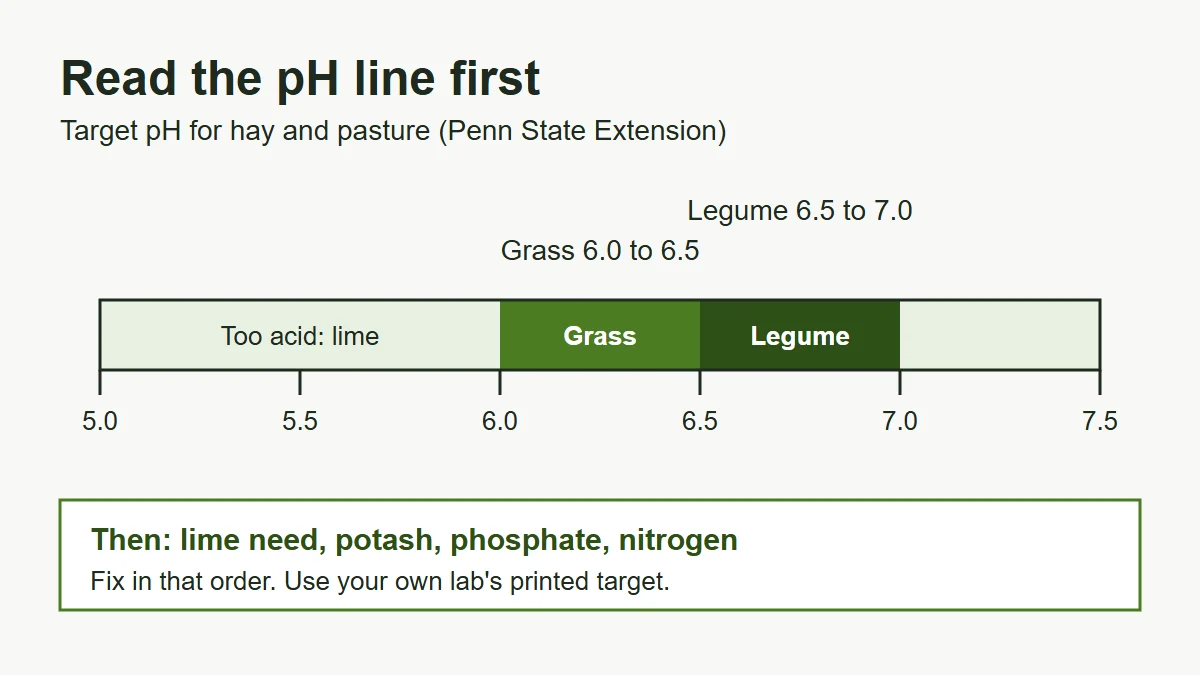
Soil pH is a measure of acidity on a 0 to 14 scale. Hay and pasture grasses want it slightly acid, and legumes want it closer to neutral. Targets differ a little by state lab, so use the one printed on your report. These are the published ones.
| Source | Crop | Target pH |
|---|---|---|
| Penn State Extension | Grass forages | 6.0 to 6.5 |
| Penn State Extension | Legumes (alfalfa, clovers) | 6.5 to 7.0 |
| NC State Extension | Cool-season perennials, such as tall fescue | 5.7 to 6.5 |
| University of Missouri Extension | Cool-season grasses (soil salt pH) | 5.6 to 6.0 |
The spread between sources is real. Missouri measures in a salt solution and has its own calibration, so do not mix one state's target with another state's lab numbers.
What is buffer pH, and why is there a second pH?
Soil pH says where you are. Buffer pH says how much lime it takes to move. Two soils can both read 5.5, but the one with more clay and organic matter resists change and needs more lime. The lab turns buffer pH into a lime recommendation, often in tons per acre or pounds of effective neutralizing material (ENM).
University of Missouri Extension gives a worked example. If the report calls for 1,395 pounds of ENM per acre and your lime supplier guarantees 400 ENM per ton, divide the first by the second: 3.48 tons of limestone per acre. Ask your supplier for the ENM or neutralizing value on the ticket so you can run the same math.
How do I read the P and K lines?
Phosphorus and potassium come back as a number (ppm or an index) and a rating. The ratings are usually low, medium, high and very high, sometimes with "optimum" in the middle. The rating matters more than the raw number, because each lab uses its own method and scale.
- Low or very low: a large response to fertilizer is likely. NC State Extension describes a very low P index as indicating a large plant response to P, and a low K index as a great response to potash.
- Medium or optimum: apply what the crop removes to hold the level.
- High or very high: a response is unlikely. NC State Extension says a very high P index means a response is unlikely.
Fertilizer is written as P2O5 (phosphate) and K2O (potash), not as elemental P and K. Check which one your report is using before you compare it to a quote.
Why does hay need more P and K than pasture?
Hay leaves the field. Virginia Tech Extension says a ton of tall-grass hay may carry about 50 lb of nitrogen, 16 lb of P2O5 and 52 lb of K2O. Four tons off an acre is then around 64 lb of P2O5 and 208 lb of K2O gone. Pasture returns most of that as manure and urine, so it drops more slowly. That is why hay fields drift low on potash first, and why the soil test is the check on whether your program is keeping up.
What do CEC, organic matter and base saturation tell me?
These describe the soil, not the fertilizer need. Most reports list them, and they help you read the rest.
| Line on the report | What it describes | How to use it |
|---|---|---|
| CEC (cation exchange capacity) | How many nutrients such as calcium, magnesium and potassium the soil can hold | Higher CEC is usually heavier soil with more clay or organic matter. It holds nutrients better and takes more lime to change. |
| Organic matter (OM) | Decomposed plant and animal residue | Higher OM generally holds more water and nutrients and supplies some nitrogen. It is slow to change. |
| Base saturation | Share of the CEC taken up by calcium, magnesium, potassium and sodium rather than acid | Low base saturation goes with low pH. Lime raises it. |
| Calcium and magnesium | Available levels | If the lab calls for lime, dolomitic lime can cover low magnesium. Your lab will say. |
Sandy soils have low CEC. They hold potash poorly and respond to smaller, more frequent applications. Heavy clay soils hold nutrients and resist pH change. Missouri Extension lists CEC as one of the regular soil tests; the lab's recommendation already accounts for it.
What should I fix first?
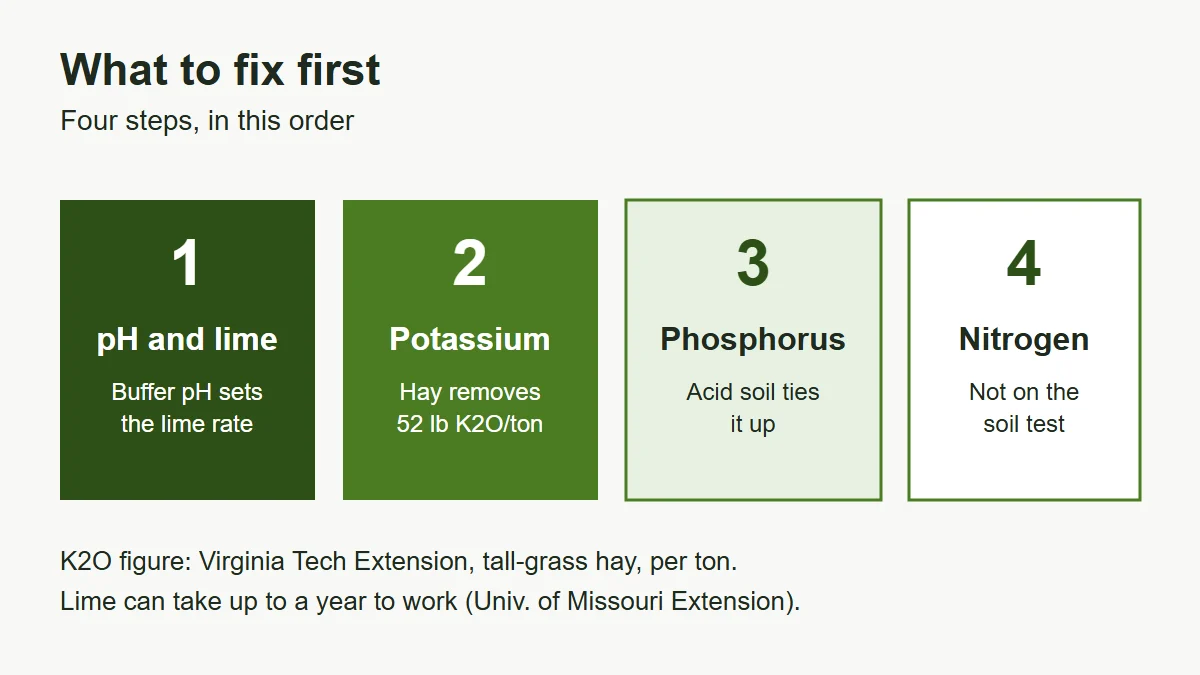
- pH and lime. Penn State Extension says that when pH is below optimum before a seeding, the recommended lime should be worked into the soil. For long-term no-till without recent lime, Penn State says to apply 1 ton per acre on the surface if a sample of the top 1 to 2 inches tests below pH 6.0. For maintenance liming that calls for more than 3 tons per acre, Virginia Tech suggests surface-applying half now and the rest in 6 to 12 months.
- Potassium. Hay removes a lot of it, so it is often the next gap after lime.
- Phosphorus. Soil that is too acid ties up phosphorus, so liming first helps the P you apply.
- Nitrogen. The lab does not measure it. Set it by forage type and yield goal, and cut it back where legumes are in the stand.
This order is why a "fertilizer plan" that skips lime often disappoints. If pH is low, you are paying for P and K that the plant cannot use well.
When should I put lime on?
As early as you can. University of Missouri Extension says limestone may take as long as a year to correct acidity. On hay ground, spreading soon after the test means the lime has the months it needs before the next seeding or the next season. For a new seeding that needs more than 2 tons per acre, Virginia Tech suggests applying half, working it in, then applying the second half. Always spread to the lab's rate and check your lime's neutralizing value first.
Where does a biological product fit after reading the test?
After the basics. A soil test tells you what the soil lacks, and lime, potash and phosphate are how you fill those gaps. Foliar or in-furrow biologicals are not a stand-in for any of them. If your numbers are in range and you want to add one, TNT Hi-Energy Spray (HES) 1-0-0 goes on as a foliar spray at 1 gal/acre once the field has been cut or grazed, and no later than two weeks ahead of the next cut or grazing. We cover how liquids compare to granular for hay in liquid vs. granular fertilizer for hay. Test it on your own field with a strip trial instead of taking our word for it.
Sources
- Penn State Extension, "Soil fertility for pasture or hay renovation or establishment."
- University of Missouri Extension, guide G9112, soil test interpretation for forages.
- Virginia Tech Cooperative Extension, Soil Test Note No. 3 (publication 452-703).
- NC State Extension (Stokes County), "Navigating Fertilizer Prices Part 2: Interpreting Soil Test Results," 2022.