Neither liquid nor granular fertilizer is better for hay in every field. Pick the form that gives you the lowest cost per pound of the nutrient you need, then split the nitrogen across the season instead of putting it all on at once.
The question came up in a Facebook hay group, where one grower asked whether anyone had good or bad results using liquid fertilizer on hay fields, and what kind. Here is how we would think it through, using university Extension work for the numbers and leaving the sales pitch out.
What does the research say about liquid vs granular on hay?
Mississippi State University Extension ran a trial on Tifton 9 bahiagrass hay with ten treatments across three 30-day cuttings. Two were granular (urea and urea ammonium sulfate) and seven were liquid products, with a control. The granular plots got 50 units of nitrogen per acre per cutting. The liquids were tested at the manufacturer-recommended rate and again at the same 50 units of nitrogen.
The Extension summary reported that liquid products did not prove beneficial at the manufacturer-recommended rate, and that the granular products had higher crude protein. Some liquids had a lower cost per pound of dry matter, but their yield increase over the control was lower than the granular products, and at 50 units of nitrogen they were not significantly different from granular. That is one trial on one grass in one state, so treat it as a caution, not a law.
The lesson is narrow and useful: a jug that says "1 gallon per acre" is not the same as 50 pounds of nitrogen per acre. Look at the pounds of nutrient, not the volume.
How do I compare cost per pound of nutrient?
Put every option on the same footing before you look at price per ton or per gallon.
- Weight of product, in pounds.
- Multiply by the nutrient percent on the tag to get pounds of nutrient.
- Divide the product price by those pounds.
- Add your cost to spread or spray the field.
Take TNT HES as an example. It is 1-0-0, and a gallon weighs 8.7 pounds. That is under a tenth of a pound of nitrogen per gallon, so it is nowhere near a bulk nitrogen source. We say that plainly because it is the honest way to place a foliar product in a hay budget.
Which form loses less nitrogen?
Surface-applied urea is the one to watch. Ohio State University Extension says applying nitrogen shortly before a rainfall event reduces volatilization, and advises against putting lime and urea on together. Penn State Extension adds that, because nitrogen is mobile in the soil, a controlled-release product or split applications are essential to managing it.
Liquid urea-based products face the same chemistry once they hit the surface, so the form alone does not fix volatilization. Timing does.
| Question | Granular | Liquid |
|---|---|---|
| Cost per pound of nutrient | Often lower for plain N, P and K | Varies by product; calculate it |
| Spreading or spraying | Spinner or pneumatic spreader | Sprayer, needs water or carrier |
| Wet ground | Heavy spreaders can rut | Lighter rigs may still run |
| Nitrogen loss risk | Urea can volatilize on the surface | Urea-based liquids carry the same risk |
| Uniform spread | Depends on spreader pattern | Boom coverage is even |
| Micronutrients and biologicals | Harder to add | Easy to tank mix, after a jar test |
Does sand vs clay change the answer?
It changes your schedule more than your product. Sandy ground holds less nitrogen and moisture, so smaller, more frequent applications make sense there. Clay holds nutrients longer, but it can stay too wet for a spreader after a rain. If you cannot get on the field, a sprayer or a lighter rig may be the only way to hit your window. Your soil test and your own field history should settle the rest.
How should I split nitrogen across cuttings?
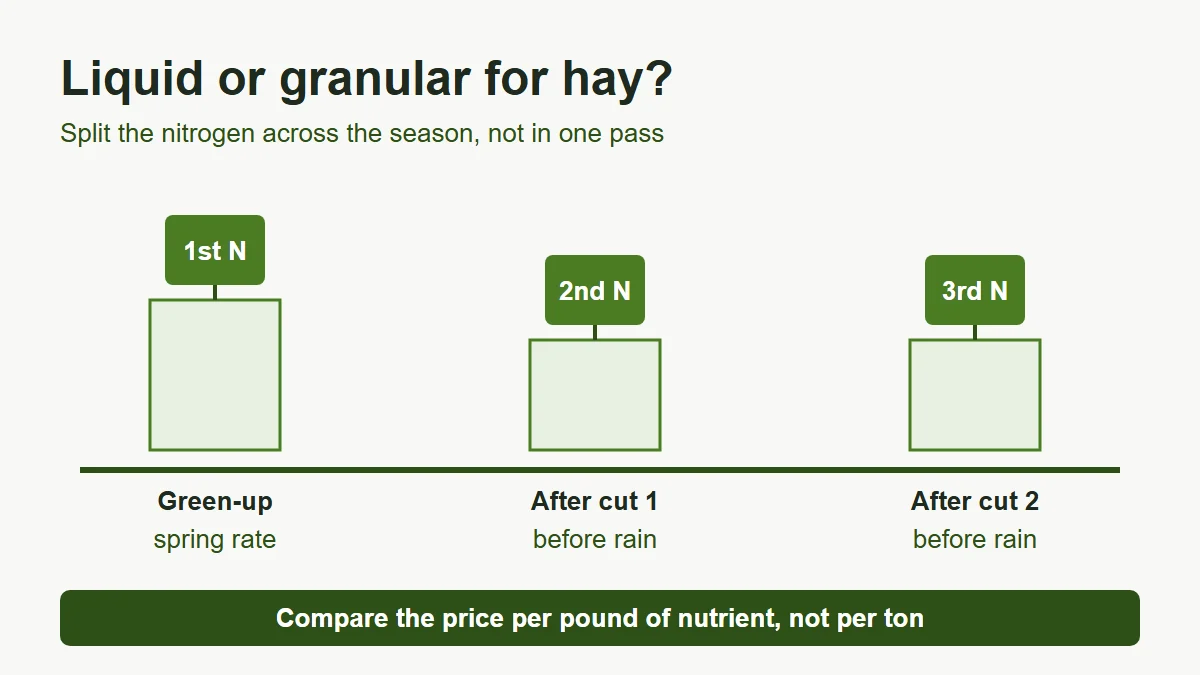
Both Penn State and Ohio State Extension describe a split program. Penn State recommends a spring pass around 200 growing degree days (base 32) and further passes after the first and second cuttings, with a base spring rate of 50 pounds in Pennsylvania. Ohio State reports better returns when nitrogen is split into about three applications under 80 pounds per acre each, made shortly before rain, and says Ohio grasses on loamy soils see economic returns up to around 150 pounds of nitrogen per year.
Those are Pennsylvania and Ohio numbers. A Midwest or Southern field may differ, so check with your state Extension office and your soil test.
| Pass | Timing | What goes on |
|---|---|---|
| 1 | Green-up, about 200 GDD (base 32) | Spring nitrogen, plus lime, P and K per soil test |
| 2 | After the first cutting, ahead of rain | Nitrogen under 80 lb per acre |
| 3 | After the second cutting, ahead of rain | Nitrogen under 80 lb per acre |
Where do foliar biologicals fit on a hay field?
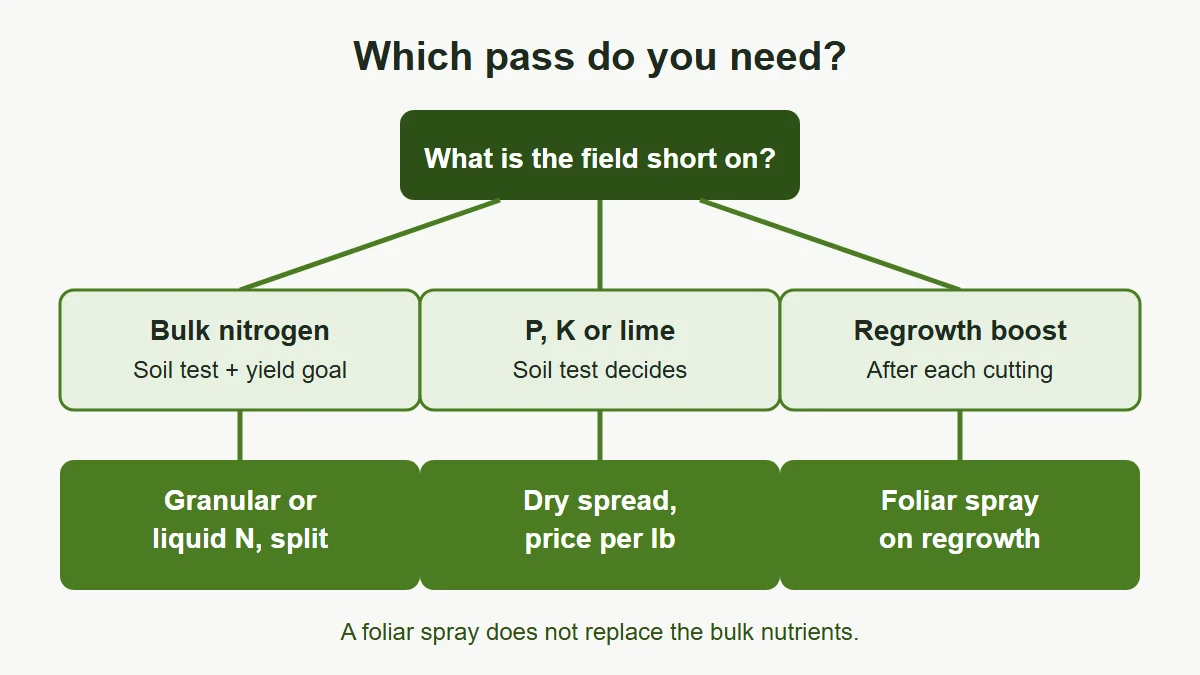
After the bulk fertility is handled. TNT HES (Hi-Energy Spray) is a fish-based foliar for forages. The label rate is 1 gallon per acre after each cutting or grazing, at least two weeks before the next cut, in a minimum of 10 gallons of water per acre. Read the full timing and mixing notes in spraying hay and pasture after cutting and on the TNT HES product page.
It will not correct a low pH or a low potassium test. Test a strip against an untreated strip and judge it on your own ground.
One more habit that pays: write down what you put on each field, the date, the rain that followed and the yield at the next cut. After two seasons you will have your own answer to the liquid-versus-granular question, on your own soil, which beats any single trial from another state.
What should I do first?
- Pull a soil test and fix pH first.
- Price each option per pound of nutrient, delivered and applied.
- Split nitrogen across green-up and the next two cuttings, ahead of rain.
- Keep lime and urea passes apart.
- Add a foliar pass only after the basics are covered.
Questions about fitting a foliar into your hay program? Call us at (574) 532-6201, ask for a quote, or request a free sample.
Sources: Mississippi State University Extension, "Liquid Fertilizers and Their Role in Hay Production" (Forage News, 2022); Penn State Extension, "Spring Nitrogen Management for Grass Hay and Pasture"; Ohio State University Extension, "Summer Nitrogen Applications for Forage Grasses" (C.O.R.N. Newsletter 2026-14).