An on-farm strip trial is a side-by-side test of your normal program against one change, run in several paired strips so the field cannot fool you. It works when you ask one question, replicate at least three times, randomize the order, harvest carefully and correct for moisture.
What is a strip trial, and why replicate it?
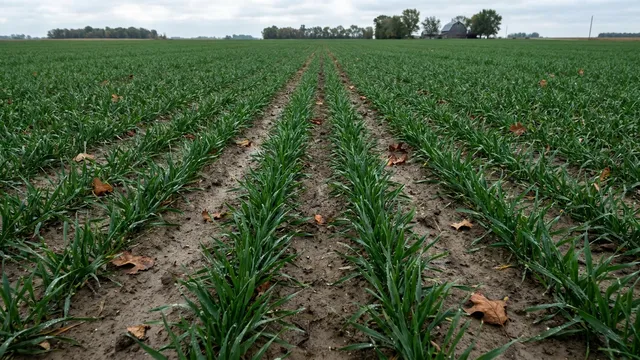
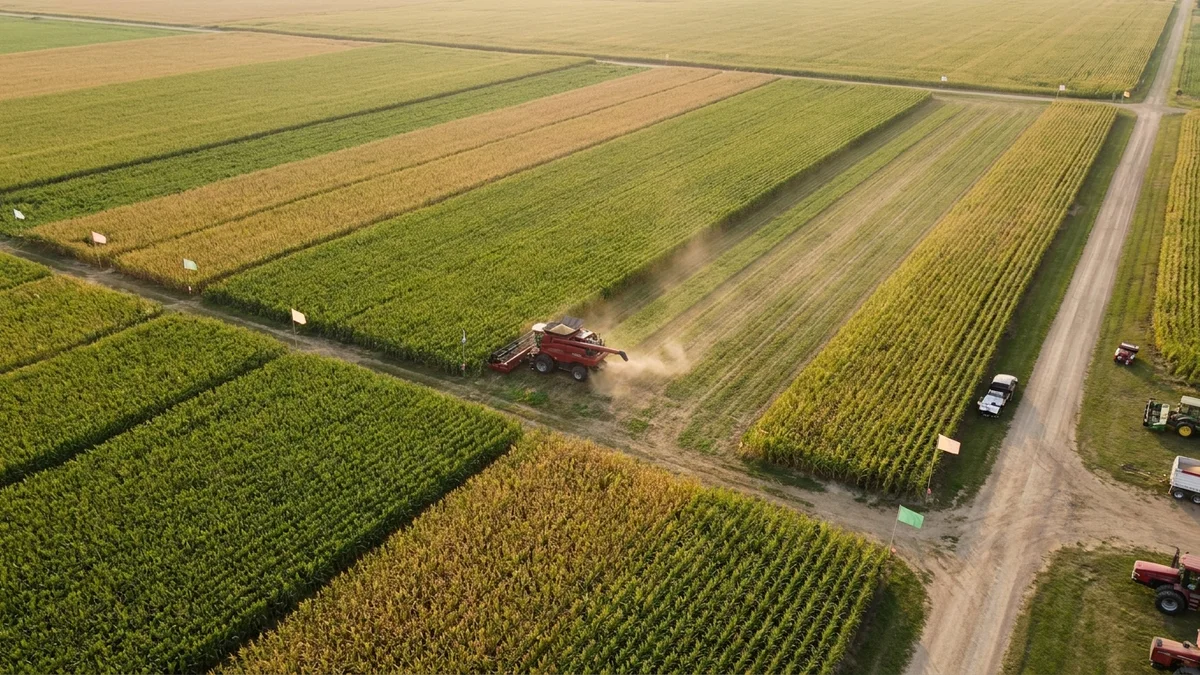
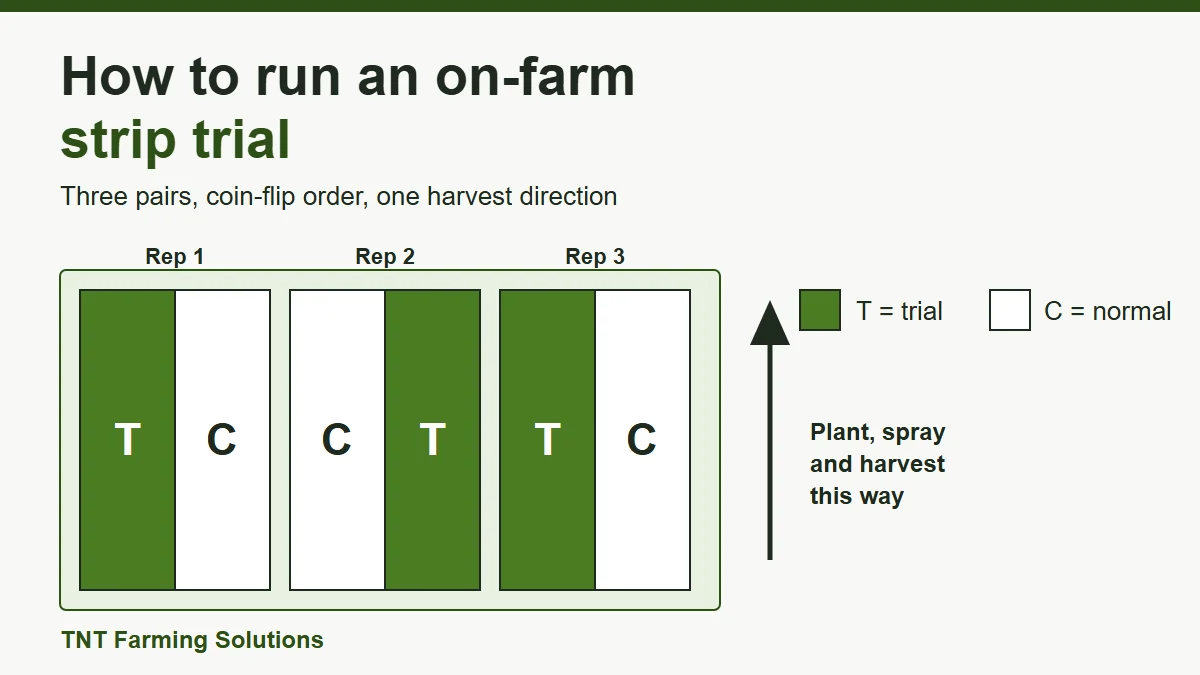
A strip trial puts treatments in adjacent strips across a field. Laid out across the field, adjacent strips each cross the same good and poor ground, so no treatment gets all of one or the other. Iowa State University Extension, in its "Conducting On-Farm Trials" article, sums up the design as: randomize and replicate to account for field variability. Practical Farmers of Iowa, which runs farmer-led research, lays out its cooperator trials the same way; one of its research reports used randomized, paired strips, 2 treatments by 4 replications, 8 strips in all.
Replication is the part people skip. Every field has good spots and poor spots. If you plant one trial strip beside one control strip, a sandy knoll under one of them can look like a product effect. With several pairs, the field noise averages out and the real difference, if there is one, shows up in every pair.
How do I pick the question and the field?
Write one yes-or-no question before you plant. "If I put 2 qt/ac of TNT HEF in-furrow, can I drop part of my side-dress and keep my yield?" is a good one. "Is this product any good?" is not.
- Your normal program is the control. Hybrid, planting date, population, tillage, herbicide and fertility stay the same on every strip except the one thing you are testing.
- Use a field you know. Old feedlots, manure history and high soil-test spots can swamp a fertility trial.
- Run strips across the variability. If one end is sand and the other clay, every strip should run from sand to clay.
- Never split the field in half. Iowa State Extension advises against it.
Is your goal SMART?
In our Talk Time session Trials: Yours and Ours we ran every trial idea through five letters before planting:
- Specific: one goal, and you know what you will measure, how, and when.
- Measurable: a number you can compare, such as yield, Brix, plant height, root mass or a tissue nutrient.
- Achievable: there is a test for it, and the hoped-for result is within reach. A 1,000-bushel corn goal is not.
- Realistic: it fits your time, equipment and testing budget.
- Timely: samples go in on schedule and come back fast enough to act on.
Can a trial show whether I can cut an input rate?
Yes, and it is one of the most useful trials to run. Keep everything the same on every strip, then lower the one rate you want to test on the trial strips, with the TNT product added. That is how TNT set up its 2025 corn trial with RhizeBio: the same base inputs on every strip, control included, a smaller starter plus TNT HEF in-furrow on the trial strips, and mid-season tissue tests to decide whether the side-dress was needed. They showed it was not, so it was skipped on both trial programs. Tissue tests at the right stage are what let you make that call during the season.
How do I lay out the strips?
- Count the pairs. Use no fewer than 3 strips of each treatment. Iowa State Extension says to start with a minimum of four replications, so add a fourth pair if the field has room.
- Randomize inside each pair. Flip a coin for each replication. You might end up with T C, C T, T C. Do not always put the trial first.
- Size the strips to your machines. One planter pass wide, and a width your combine header divides into evenly. Soybeans are the usual trouble: a 40-foot planter and a 35-foot head do not line up, so plan harvest passes before planting.
- Make them long. Run the full field length if you can, and never shorter than 100 feet. A yield monitor smears grain flow over several seconds, so short strips blur into each other.
- Add border rows for foliar products. Spray drifts and roots reach sideways. Iowa State Extension's example is to plant an 8-row treatment strip and harvest the middle 6 rows. Leaving an untreated pass between strips also works.
- Mark both ends. Save the A-B line and the as-applied map, set a flag at each end of every strip, and write the strip order on a sheet.
What should I write down?
Most failed trials are ones nobody can rebuild in October. For every pass on every strip, record the product, rate, date and time, crop stage, tank-mix partners and order, water volume, weather and anything odd, such as a plugged nozzle or a wet spot. At the top of the sheet put the year, field, crop, the question you are answering, and acres treated and untreated; list each measurement with when you will take it, in side-by-side trial and control columns; and leave space at the bottom for your conclusion and anything you noticed that you had not planned to test. Jar-test each tank mix first: add each product to a jar of your water in the order you will use at the tank, shake it, and check it after 15 minutes.
Do in-season checks on trial and control the same day at the same flagged spots. Stand counts about three weeks after planting, tissue samples on matched days, and photos from the same place each visit all help you explain a yield result later, not just report it.
How do I harvest a strip trial?
- Best: harvest each strip on its own and weigh it on a weigh wagon or a grain cart with scales. Record weight and moisture per strip.
- Yield monitor: acceptable if it is calibrated on this crop, this field and this moisture. Check the impact plate, elevator chain and moisture sensor first.
- Harvest the way you applied. Same direction, same passes. Iowa State Extension says harvest should always run in the direction the treatment was applied, not at a diagonal.
- Skip the end rows and border rows. Compare only the treated center.
- Hay and pasture: bale each strip separately, weigh several bales per strip, record moisture and compare on a dry-matter basis.
How do I correct yield for moisture?
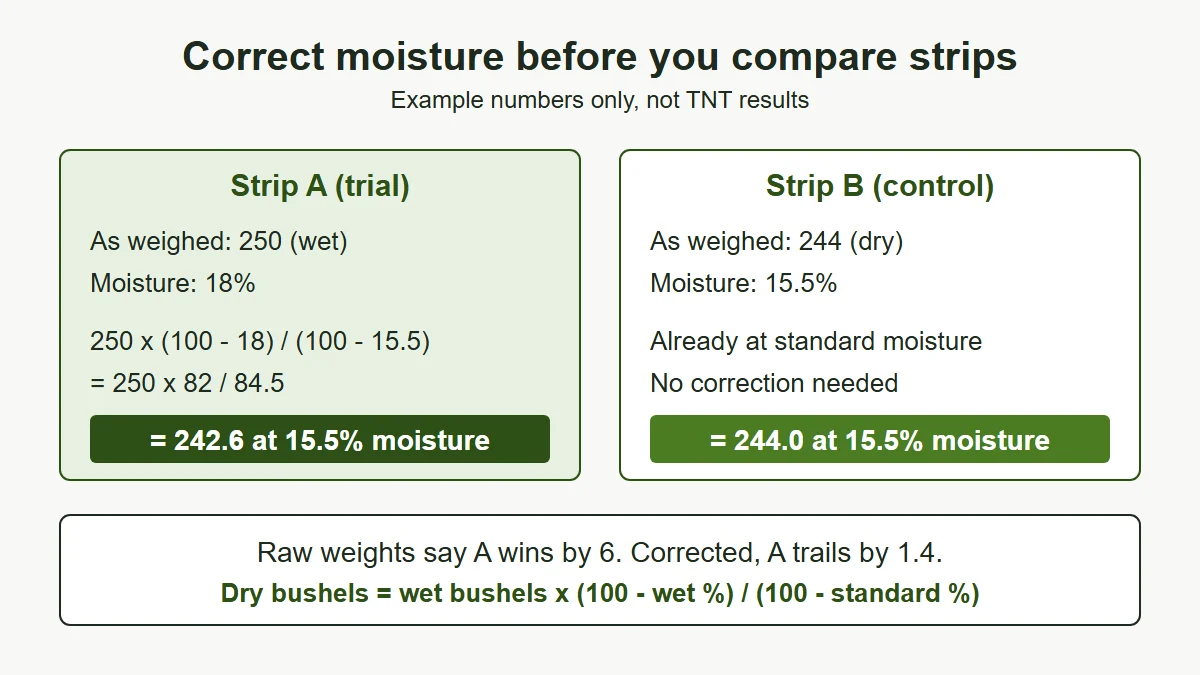
Grain at different moistures cannot be compared by weight. Standard moisture is 15.5% for corn and 13% for soybeans. University of Nebraska-Lincoln CropWatch adjusts its corn hybrid trial yields to 15.5% moisture, which is the usual basis. The formula is:
Dry bushels = wet bushels x (100 - wet moisture %) / (100 - standard moisture %)
| Step (example numbers only) | Strip A (trial) | Strip B (control) |
|---|---|---|
| As weighed (per acre, example units) | 250 | 244 |
| Moisture at harvest | 18% | 15.5% |
| Correction factor | (100 - 18) / (100 - 15.5) = 82 / 84.5 = 0.970 | 1.000 |
| Corrected to 15.5% | 242.6 | 244.0 |
These numbers are made up to show the math. Look at what happened: the raw weights said strip A won by 6. After correction, strip A trails by 1.4. Without the correction, you would have credited the product for extra water in the grain.
How do I read the results?
- Correct every strip first, then average the trial strips and the control strips separately.
- Look at the pairs. A treatment that wins 4 of 4 pairs by a small margin is a stronger result than one that wins big in one pair and loses in two. If the sign flips, you are looking at field noise.
- Size the difference against the noise. Iowa State Extension describes the least significant difference (LSD) as the smallest gap between two treatments that counts as a real difference, and ties it to a confidence level such as 90% or 95%. An extension agronomist can run it from your strip numbers.
- Treat zero as an answer. "No yield difference, and less spent on inputs" is a result you can use.
- Repeat it. Weather often moves yield more than an input does. One farm and one season is a start.
What are the common mistakes?
- Splitting the field in half instead of replicating strips
- Changing more than one thing between trial and control
- No border rows on a foliar trial
- Harvesting on a diagonal, or with a header that does not fit the strips
- Comparing wet weights at different moistures
- Judging by averages without looking at the pairs
- Not recording what the control actually received
Where can I see a real example?
TNT ran this kind of trial in 2025 on one Ohio farm, with RhizeBio: triplicate field strips, the same base program on every strip, control included, and tissue tests during the season. The write-up, including the strip where the control out-yielded the trial, is on the 2025 corn trial page. Read it as a single farm in a single season; your soil and weather will give different numbers. If you want to test a TNT program on your own ground, you can request a free sample, and rates for the product you choose are on the label. Use the steps above, and a trial of TNT HEF in-furrow will give you an answer you can trust either way.