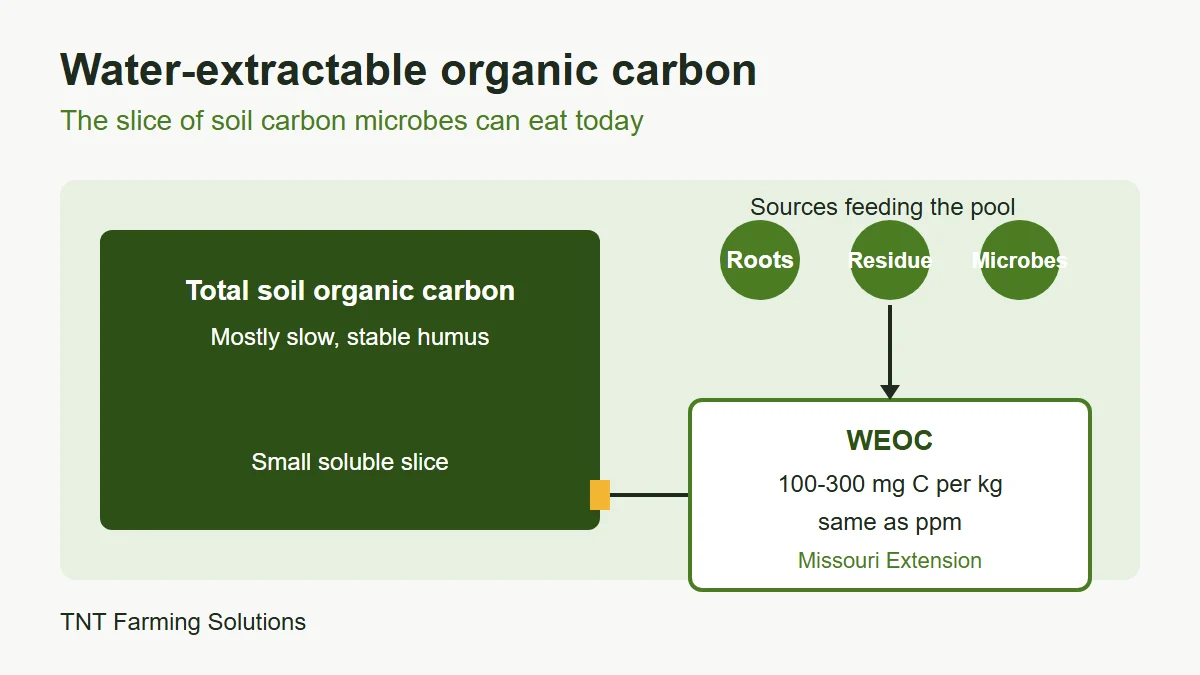
Water-extractable organic carbon, or WEOC, is the part of your soil carbon that dissolves in water, which makes it the carbon microbes can eat right now. On a Haney test it is one of the main numbers for microbial food, usually between 100 and 300 mg C per kg of soil.
What does water-extractable organic carbon actually measure?
Soil carbon comes in pools. Most of it is slow, stable humus. A small share is soluble and moves with water. University of Missouri Extension describes WEOC as a small, dynamic fraction of soil organic carbon that comes from plant roots, crop residues, microorganisms and decomposing organic matter.
That is why people call it microbial food. Microbes need carbon for energy before they can cycle nitrogen, phosphorus and micronutrients. WEOC is the carbon they can pick up without having to break anything down first.
In our Talk Time session on the 2025 trial results, the RhizeBio soil team called it the water-soluble carbon feed source for soil microbes (TNT 2025 Trial Results).
How does the lab get a WEOC number?
The method is simple on purpose. Missouri's lab, for example, mixes 4 grams of soil with 40 mL of deionized water (a 1:10 ratio), shakes it for 10 minutes, spins it in a centrifuge, filters the liquid and measures the carbon in it with a total organic carbon analyzer. Your lab will list its own procedure on the report.
Results come back as mg C per kg of dry soil, which is the same number as ppm on a mass basis.
Where does WEOC sit on a Haney soil health test?
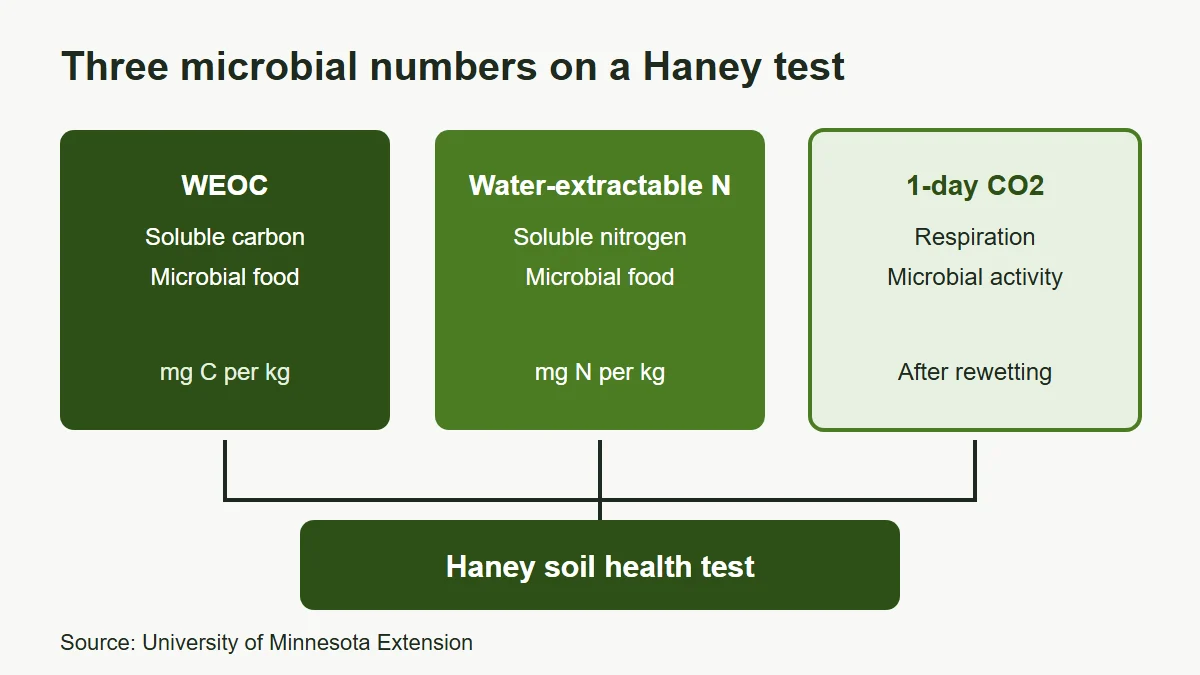
The Haney test pairs the usual plant-nutrient numbers with a look at what microbes have to work with. University of Minnesota Extension describes three sub-pools of soil organic matter the test measures: soil respiration, water-extractable carbon and water-extractable nitrogen.
- WEOC: the soluble carbon food.
- Water-extractable nitrogen: the soluble nitrogen food.
- 1-day CO2 respiration: how much CO2 the microbes give off in a day after the soil is rewetted, a sign of how active they are.
Missouri Extension reports that 1-day CO2 release after rewetting was more strongly correlated with WEOC (r = 0.87) than with total organic carbon (r = 0.70), so food and activity move together.
What are typical WEOC numbers, and how should I read them?
| Item | What to know | Source |
|---|---|---|
| Units | mg C per kg dry soil, same as ppm by mass | University of Missouri Extension |
| Common range on the Haney test | 100 to 300 mg C per kg | University of Missouri Extension |
| Share of total organic carbon | About 0.9% in Missouri's example | University of Missouri Extension |
| Microbial sub-pools measured | Respiration, water-extractable C, water-extractable N | University of Minnesota Extension |
| Recommended use | Track the same field over time, same method | Missouri and Minnesota Extension |
Missouri Extension is clear that there is no broadly validated WEOC sufficiency level for crop production yet. So do not chase a magic number. Treat your first result as the baseline for that field and watch which way it moves after each change you make.
Why does a growing season change the WEOC number?
Roots are always leaking sugars and organic acids into the soil, and residue is always breaking down. Both feed the soluble carbon pool. Microbes then use it. The number you see is the balance of what came in and what got used, and that balance shifts with moisture, temperature, crop stage and residue.
That is also why Minnesota Extension calls the Haney measurements snapshots and says to focus on trends. Sampling at the same crop stage each year makes the comparison fair.
How does TNT use soil biology testing in its trials?
TNT ran strip trials in 2025 on one cooperating Ohio farm with RhizeBio, an independent soil microbiome lab that pairs Haney soil chemistry with DNA sequencing of the root zone. In a corn strip treated with TNT HEF 2-3-0 alone, RhizeBio reported an overall soil health score 51% above the untreated control at V8 (RhizeBio soil analysis, 2025, one farm). It is a soil-biology observation from one season, and the study detail is on our reports page.
The yield side of the same trial is worth reading with it. Both trials are shown below with their controls. Results vary with soil, weather and program.
| Control | Trial 1 (HEF in-furrow) | Trial 2 (HEF + Super Salmon+) | |
|---|---|---|---|
| Yield | 223 bu/ac (Trial 1 pair) / 245 bu/ac (Trial 2 pair) | 238 bu/ac | 232 bu/ac |
| Input cost | $145/ac | $58/ac | $73/ac |
| Net vs control | baseline | +$147/ac | +$7/ac |
Trial 2 still came out ahead on input cost with no nitrogen beyond a 3 gal starter. The full design and caveats are in the 2025 corn trial write-up. The two products used, TNT HEF 2-3-0 and TNT Super Salmon+, are made from naturally fermented whole saltwater salmon, with Super Salmon+ adding kelp and chitin. They are fertilizers and biostimulants, so the point of the trial is the whole program, not one number.
How can I feed the carbon pool on my own farm?
Carbon in the soil comes from living roots and from residue. Practical steps that keep that supply coming:
- Leave residue on the field and let it cycle instead of removing the stubble.
- Keep living roots in the ground as long as you can, with cover crops where they fit.
- Add a biological program to the mix. HEF goes in-furrow at 2-4 qt/ac, and it was part of the 2025 trial above.
- Sample the same fields, same time of year, same lab, and keep every report in one folder.
If you would like to test it on your own ground, a free sample and a replicated strip trial give you a fair comparison. Add a Haney sample from each strip at the same stage and you have your own WEOC comparison.
Why does a simple soil carbon number matter to a grower?
Carbon is the currency of the soil food web. When a microbe has soluble carbon within reach, it can keep cycling nutrients around the root. That is why a lab that studies soil biology looks at carbon next to nitrogen and respiration. For a grower, WEOC is a low-cost way to ask whether the biology on a field has food to work with. Pair it with a tissue test and the usual soil nutrient numbers and you read the whole system instead of one line of the report.
Is there a quick check I can do in the field?
Yes. Dig up a corn plant with some soil left on the roots, dunk it in a bucket of water and swish it like a mop. Let it sit and watch the foam. The froth is the microbes working the soluble food that washed off the roots. On the call it was described as a quick in-field check of rhizosphere activity (TNT 2025 Trial Results). It is qualitative, not a lab number, but it works from the same idea as the Haney respiration step.