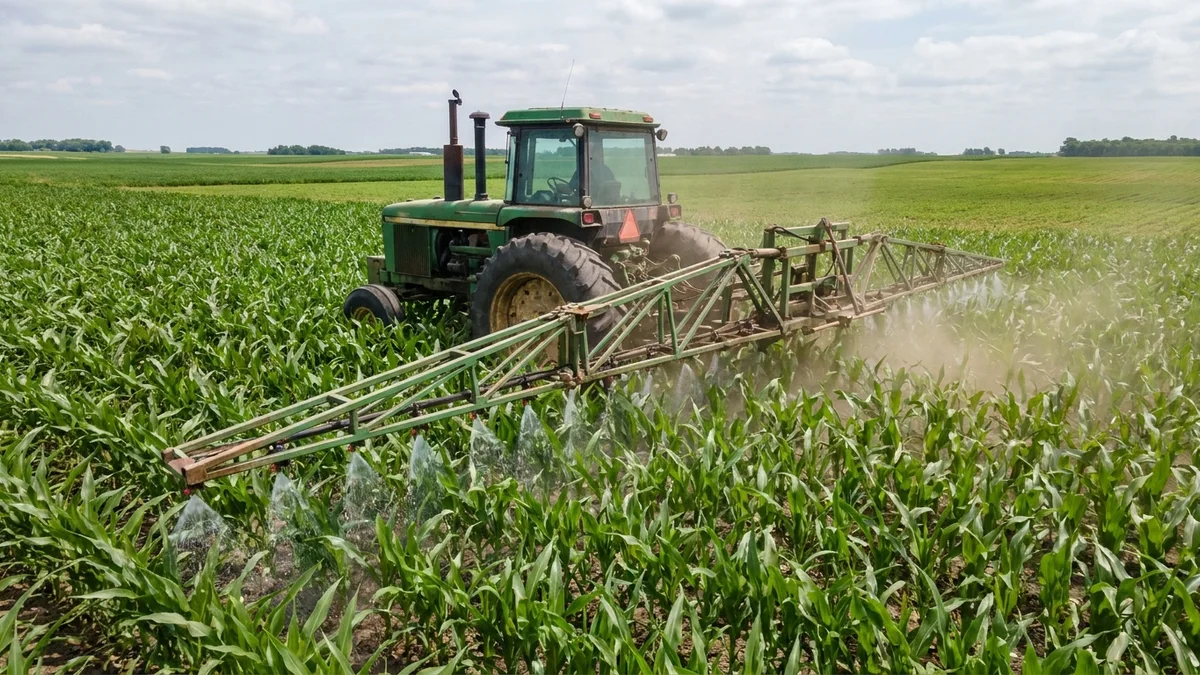
Yes. Fish fertilizer can ride along in a wide-drop or any liquid nitrogen pass, because TNT HEF 2-0-0 is only 2% nitrogen and a quart per acre adds a fraction of a pound of N. Jar test the mix, keep the sprayer set up for biology, and the same trip carries your nitrogen and your soil biology.
How much nitrogen does fish add to a nitrogen pass?
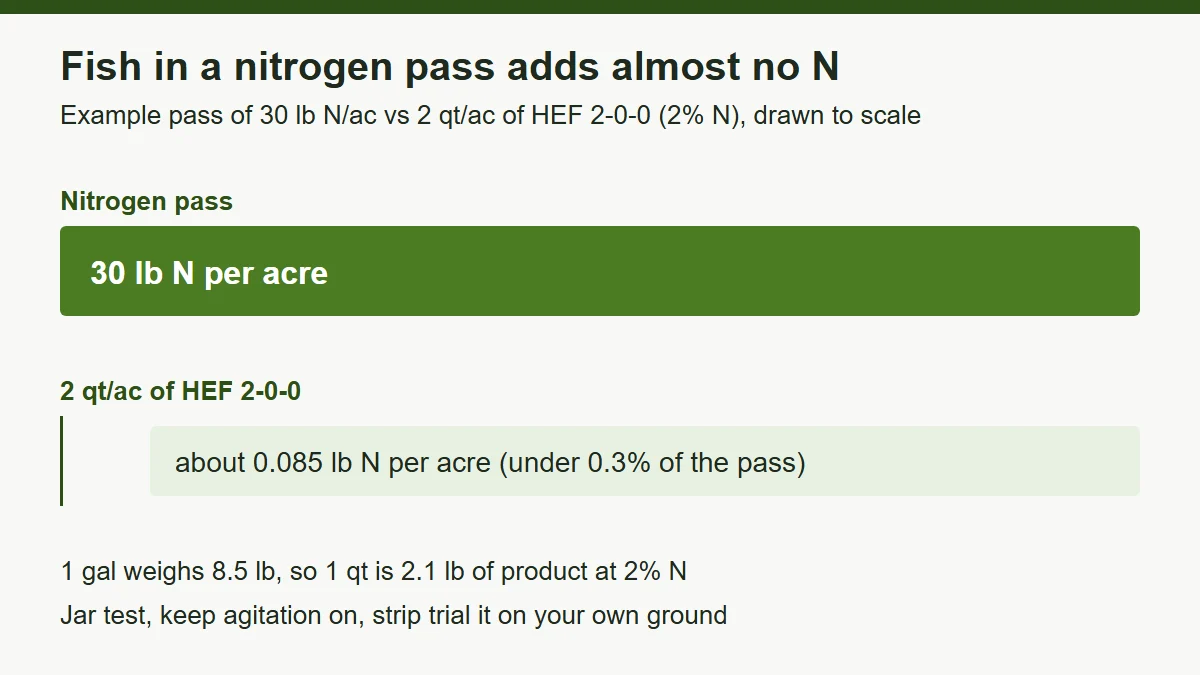
Very little, and that is a good thing. It means the pass you planned is still the pass you get. TNT HEF 2-0-0 carries a guaranteed analysis of 2% total nitrogen, and a gallon weighs 8.5 lb. Do the arithmetic for one quart: 2.1 lb of product times 2% is about 0.04 lb of N. A 2 qt/ac rate adds about 0.085 lb, and the top in-furrow rate of 4 qt/ac adds about 0.17 lb.
In our Talk Time session "Trials: Yours and Ours" (42:14 in the recording), a grower with a tote of liquid nitrogen on hand asked whether adding fish to a wide-drop would make the pass hot. The answer from the room: no, the fish is only about 2% nitrogen, so at a quart per acre it adds a fraction of a pound. Other growers on the call already add fish to their wide-drop passes.
What does fish do in the tank if it is not the nitrogen source?
It feeds biology. TNT HEF is a GMO-free, naturally fermented whole saltwater salmon with over 70% volatile fatty acids (71.01% total acids on a Dairy One report). Those acids and the fish solubles are food for fungi and bacteria, which supports soil biology and plant vigor and helps nutrient uptake. Think of the nitrogen as the fertilizer and the fish as the biology program that travels with it.
That is why adding it to a pass you were already making is attractive. The sprayer is already in the field, the labor is already paid for, and the biology goes on with the nitrogen instead of needing its own trip.
How do the numbers compare?
| Item | Number | Source |
|---|---|---|
| HEF 2-0-0 guaranteed nitrogen | 2% total N | TNT label analysis |
| Weight of 1 gal | 8.5 lb | TNT label |
| N in 1 qt/ac | about 0.04 lb | Calculated: 2.1 lb x 2% |
| N in 2 qt/ac | about 0.085 lb | Calculated |
| N in 4 qt/ac (top in-furrow rate) | about 0.17 lb | Calculated |
| Foliar rate | 0.5-4 qt/ac, at least 10 gal water | TNT label |
| Soil broadcast rate | 2-4 qt/ac, at least 10 gal water | TNT label |
A Midwest Laboratories analysis of HEF 2-0-0 in October 2025 read 2.49% total nitrogen as received, so the guaranteed 2% is the conservative figure to plan with.
How do I mix fish into a nitrogen tank?
Treat it like any new tank mix: small steps, tested first.
- Jar test first. Use water from the same source as the field, the same dilution and the same order you will use in the tank.
- Watch for curdling. Humates in particular can curdle, so check the jar before anything else goes in.
- Fill with water first. HEF is fully water-soluble and goes in at a minimum of 10 gal of water per acre for foliar or broadcast, with 15 gal the standard on the TNT crop chart.
- Keep agitation running with the return line going back to the tank so the biology does not settle.
If you spray a foliar nitrogen solution, the TNT guidance is to pair it with humic acid at 1 qt of humic per 10 lb of N, spray 15-20 gal/ac of total volume, and avoid direct 28-0-0 with no buffer. Our post on humic or fulvic acid with foliar nitrogen walks through that mix.
How should the sprayer be set up for a fish and nitrogen mix?
- Screens: 50 mesh or coarser, not 180 mesh.
- Tips and strainers: strainers sized to the tip delivery rate; twinjet flat fan tips for foliar passes.
- Agitation: constant, so products stay in suspension.
- Water: the same source as the field for consistent results.
HEF is completely water-soluble, so with the right screens and steady agitation it moves through the lines with the nitrogen.
Where does the fish pass fit by crop stage?
The TNT crop chart gives corn a soil application with the seed and foliar passes at V3-V4 and V9 to early silking, each in 15 gal of water per acre. A nitrogen pass in that window is a natural place to include the foliar rate. For beans the chart lists V3, R2 and R7; for oats and barley, Feekes 3-4 or 3-5 and flag leaf. Pick the stage that matches the pass you are already making rather than adding a trip.
Do I still need to plan my nitrogen the usual way?
Yes. HEF contributes biology, not bulk nitrogen, so keep your nitrogen plan and let tissue tests tell you when the crop needs more. TNT's own 2025 corn strips show why the tissue test matters. With 2 qt/ac of HEF 2-3-0 in the furrow, the tissue reports said the corn had enough N, so the grower's usual 60 gal/ac side-dress of 28% never went on. Trial 1 kept a 10 gal 2x2 of 28% and made 238 bu/ac against 223 for its control, on $58 of inputs against $145. Trial 2 swapped all the 28% for Super Salmon+ and made 232 bu/ac against 245 for its control, yet still finished $7/ac ahead because inputs were $73 against $145. These are results from one Ohio farm in one season, and they will vary with soil, weather and program; the trial write-up has the full detail.
How do I trial fish in my own nitrogen pass?
That same Talk Time session spent most of its time on trials, and the method fits this question well.
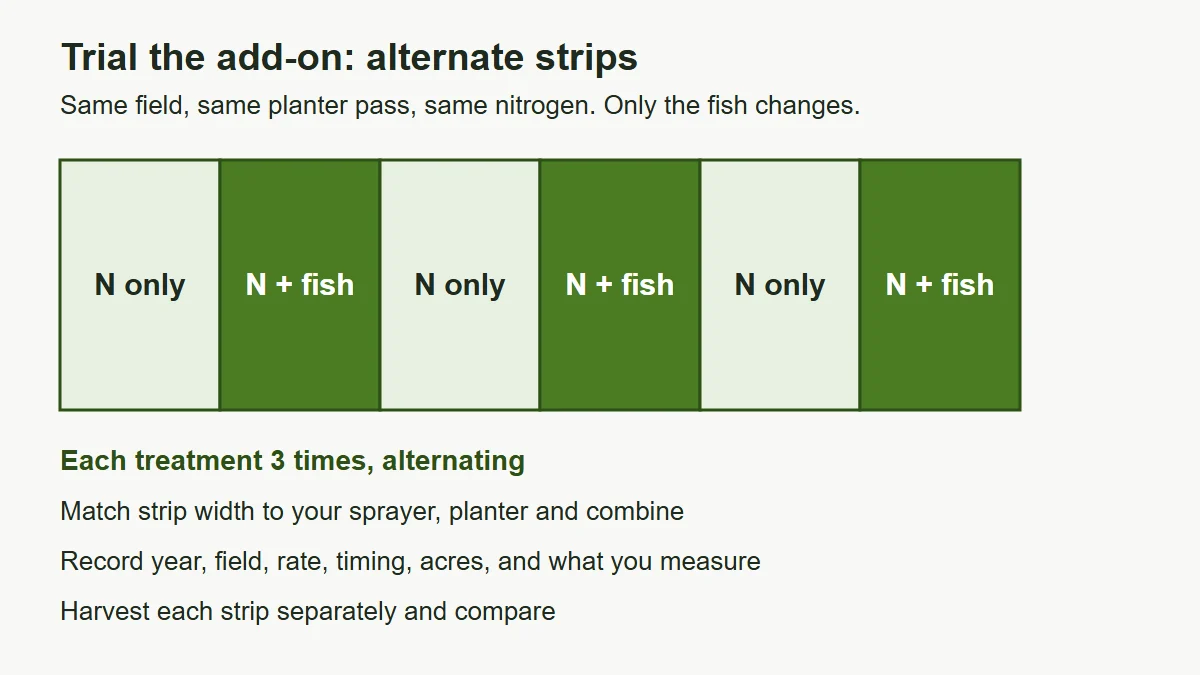
- Ask one question: does adding fish to this pass change what I measure?
- Keep a control. Without an untreated strip you cannot tell what the fish did, since variety, weather and soil change year to year.
- Repeat it. Ideally three treated and three untreated strips, alternating, so field variability is spread across both.
- Match the widths to your sprayer and combine so the strips stay separate. Splitting a field in half can put different soil in each half.
- Choose something measurable: yield, Brix, plant height, root mass or tissue nutrient levels.
- Write it down in a record: year, field, crop, treatment, timing, rate, acres treated and untreated, and your conclusions.
If you are already confident in the response, a smaller untreated area still gives you a comparison while keeping more acres treated. Our guide to running an on-farm strip trial covers the moisture correction and harvest steps.
Which TNT product should I add?
TNT HEF 2-0-0 is the usual choice for a general soil health program and is fully compatible with calcium blending programs. TNT HEF 2-3-0 adds phosphorus for starters and cool soils, and it is OMRI Listed for US organic (NOP). Call or text (574) 532-6201 and the TNT team, with 20+ years of experience in fish fertilizer, will help you pick a rate, check the mix and lay out the strips. A free sample is enough to try it on a few acres first.