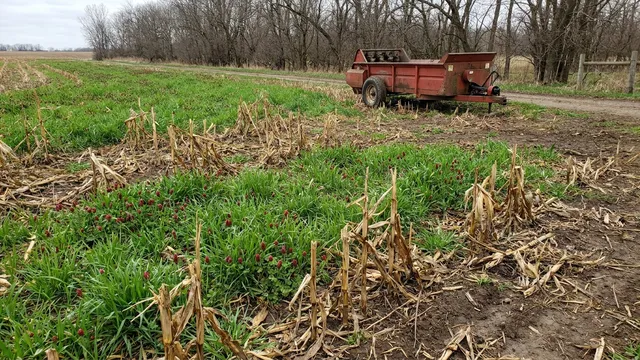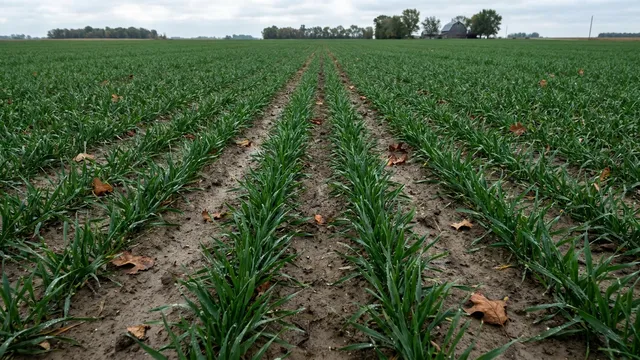
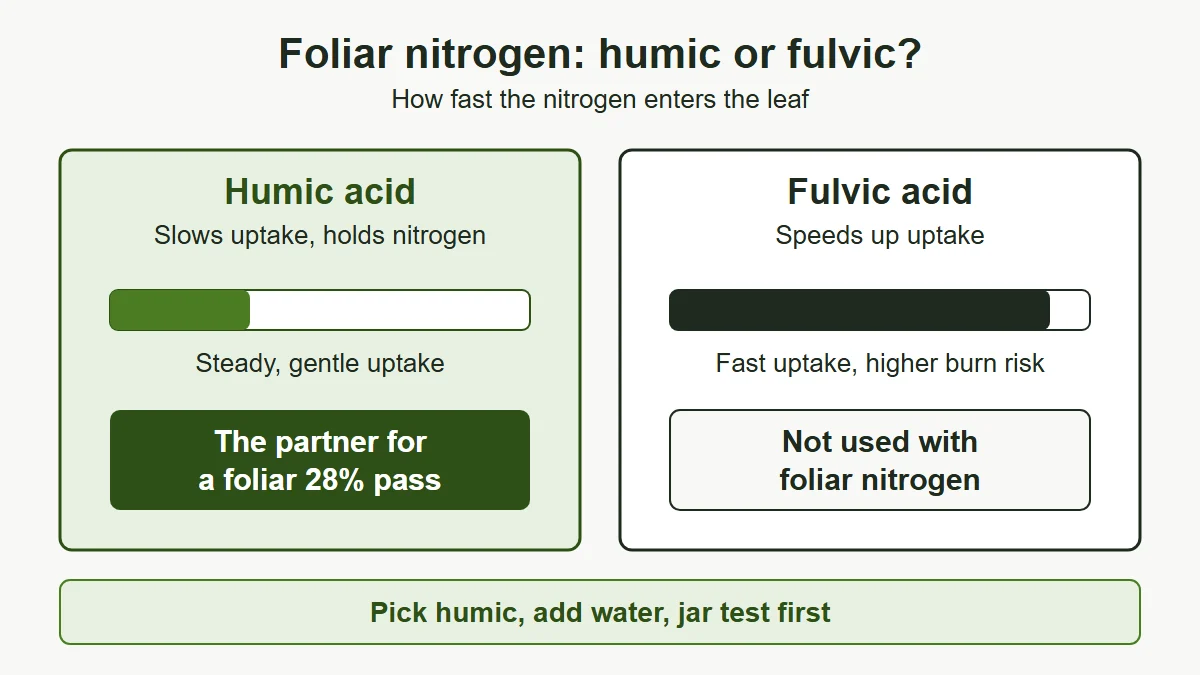
Use humic acid, not fulvic acid, when you spray foliar liquid nitrogen such as 28%. Humic slows uptake and holds the nitrogen on the leaf, while fulvic speeds uptake, and the faster the uptake the higher the chance of leaf burn.
Why does humic acid suit a foliar nitrogen pass?
A foliar nitrogen pass is a trade between speed and safety. You want the plant to take the nitrogen in, but a strong solution entering a leaf all at once is what stresses tissue. Humic acid sits on the gentle side of that trade: it slows the uptake and holds nitrogen, so there is less flash-off from the leaf and the plant takes it in at a steadier pace.
Fulvic acid does the opposite. It amplifies and speeds up uptake into the plant, which is useful in some programs, but it is the wrong partner for a concentrated nitrogen solution on a leaf. In TNT's Talk Time session "What's Up With Fish?" (33:19 in the recording), the advice to a grower asking how to spray nitrogen without burning it up was a short one: definitely a humic, not a fulvic.
How do humic and fulvic compare in the tank?
| Question | Humic acid | Fulvic acid |
|---|---|---|
| Effect on uptake | Slows uptake | Speeds up and amplifies uptake |
| Effect on nitrogen | Binds and holds it, less flash-off | Moves it into the plant faster |
| With a foliar 28% pass | The partner to use | Raises the chance of leaf burn |
| TNT program note | 1 qt of 10% humic per 10 lb N | Not used with foliar nitrogen |
| Mixing | Jar test the exact product first | Jar test first as well |
Both materials have a place in a biological program. The point here is narrow: when the thing in the tank is liquid nitrogen sprayed on a leaf, humic is the one that makes the pass steadier.
How much humic acid goes with the nitrogen?
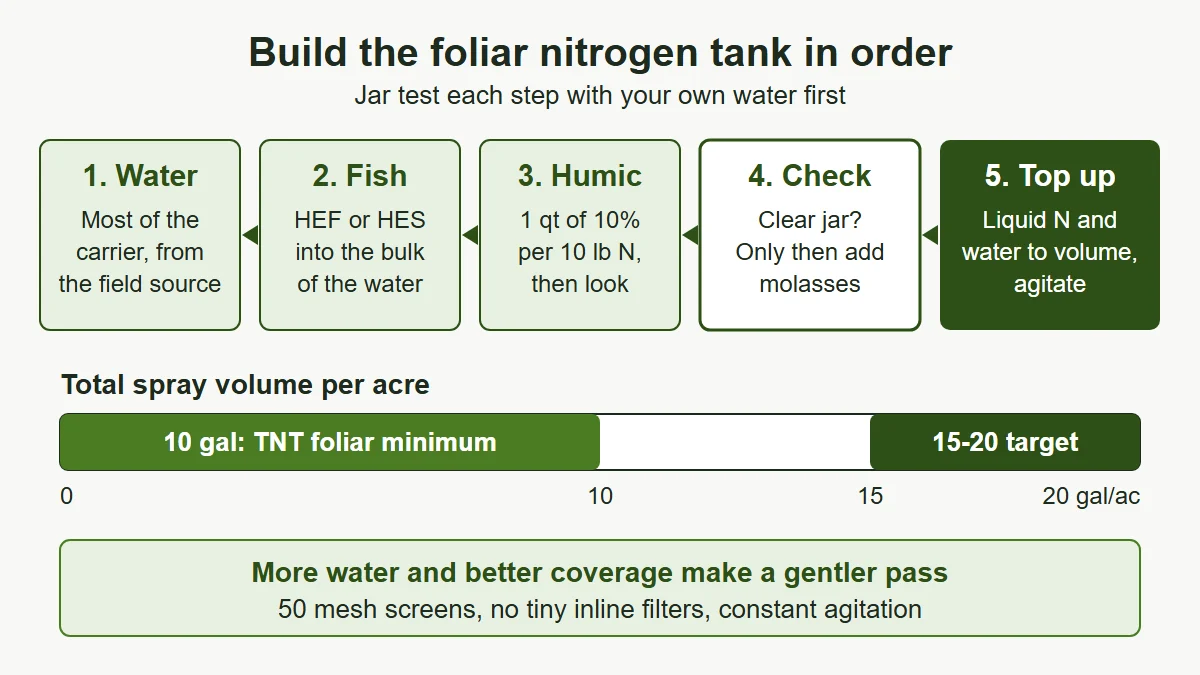
The TNT working rule is 1 qt of humic acid for every 10 lb of nitrogen you spray. It assumes a 10% humic solution, the common concentration, so read your label and adjust if yours is stronger or weaker.
- Decide the nitrogen you want to apply in pounds per acre, based on your tissue test.
- Divide by 10 to get quarts of 10% humic. A 20 lb N pass takes 2 qt.
- Add the liquid nitrogen and fill the rest of the tank with water.
How much water should the foliar pass carry?
Carry plenty. Spray at your sprayer's normal rate, typically 15-20 gal/ac total, and put whatever liquid nitrogen and humic you need in the tank, with the balance water. More water spreads the nitrogen across more leaf area, and better coverage is easier on the crop than a few concentrated drops. The TNT crop chart uses 15 gal of water per acre as the standard foliar volume, and TNT foliar rates assume at least 10 gal per acre.
Plan for a coarser droplet and a bit more volume rather than a fine mist at a low gallonage. That suits fish and humic products well, and it keeps the pass uniform.
What order do I mix a humic, fish and nitrogen tank?
Order matters, and so does a jar test. The steps below come from the same Talk Time session, where the host blended humates with TNT products for an in-furrow program and tested several before settling on one that stayed in solution.
- Jar test first. Use water from the same source, the same dilution and the same sequence you will use in the tank.
- Add the fish and the biology to most of the water. TNT HEF or HES goes in with the bulk of the carrier.
- Add the humic. Not all soluble humates are alike, so test the exact product.
- Check the jar before molasses. Curdling is hard to see once molasses is in, so confirm the mix is clean first.
- Add molasses and top up with water. Keep agitation running.
The TNT corn notes pair molasses with HES at 1-2 qt/ac each in a foliar pass, so this mixing order lines up with a program you may already run.
How do I check nitrogen need before I spray?
Let the tissue test make the call: if the plant is low on nitrogen, spray; if not, leave it alone. When you send corn tissue to the lab, tick the box for nitrate as well as total nitrogen. In TNT's program, a corn tissue nitrate reading above 1,000 ppm is the cue to add molybdenum to the foliar pass, because molybdenum feeds the nitrogen-fixing bacteria and is a key cofactor in nitrogen use.
This is the same tissue-first approach used in the 2025 TNT corn trial on one Ohio farm, where tissue tests showed no extra nitrogen was needed and a 60 gal/ac 28% side-dress was skipped. Trial 1 yielded 238 vs 223 bu/ac for the control, with inputs of $58 vs $145 per acre. Trial 2 yielded 232 vs a control strip of 245 bu/ac, with inputs of $73 vs $145, and still finished $7/ac ahead net. One farm, one season; results vary with soil, weather and program. Both trials, with their controls, are laid out on the 2025 corn trial page.
What sprayer setup keeps the pass trouble-free?
- Screens: 50 mesh or coarser, never 180 mesh.
- Inline filters: remove the small ones right before the orifice; they are easy to forget and are the usual place a fine screen hides.
- Tips: twinjet flat fan tips with strainers sized to the tip delivery rate.
- Agitation: constant, with the return line running to the tank, so biological products do not settle.
- Water source: use the same water as the field for consistent results.
TNT HEF is naturally fermented whole saltwater salmon and is completely water-soluble, so it moves through sprayers and planters easily when the screens are right.
Where does TNT fit in a humic and nitrogen program?
TNT products tank-mix with most herbicides, fungicides and liquid fertilizers such as 28%, 32% and 10-34-0, and a jar test confirms each new combination. TNT HEF 2-0-0 or HEF 2-3-0 can go in at 0.5-4 qt/ac foliar to support soil biology and plant vigor, and TNT Hi-Energy Spray (HES) 1-0-0 adds energy at 1-2 qt/ac on corn. With 20+ years of experience behind the TNT team, our sales line at (574) 532-6201 walks growers through rates, mix order and a strip trial on their own ground, and you can request a free sample to try it on your own acres.