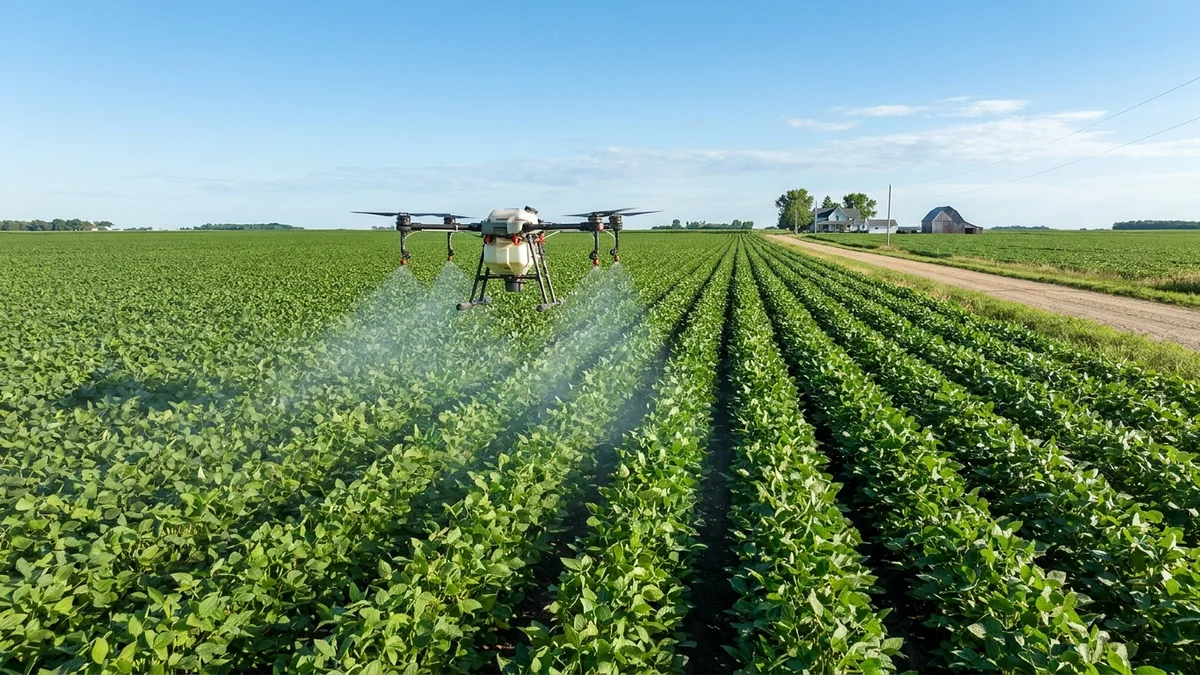
Yes, you can apply liquid fish fertilizer with a drone if the setup matches the product: enough carrier water, a 50 mesh or coarser filter, a jar-tested mix and a coverage check before the full field. TNT lists foliar fish at a minimum of 10 gallons of water per acre, so the plan has to start with volume.
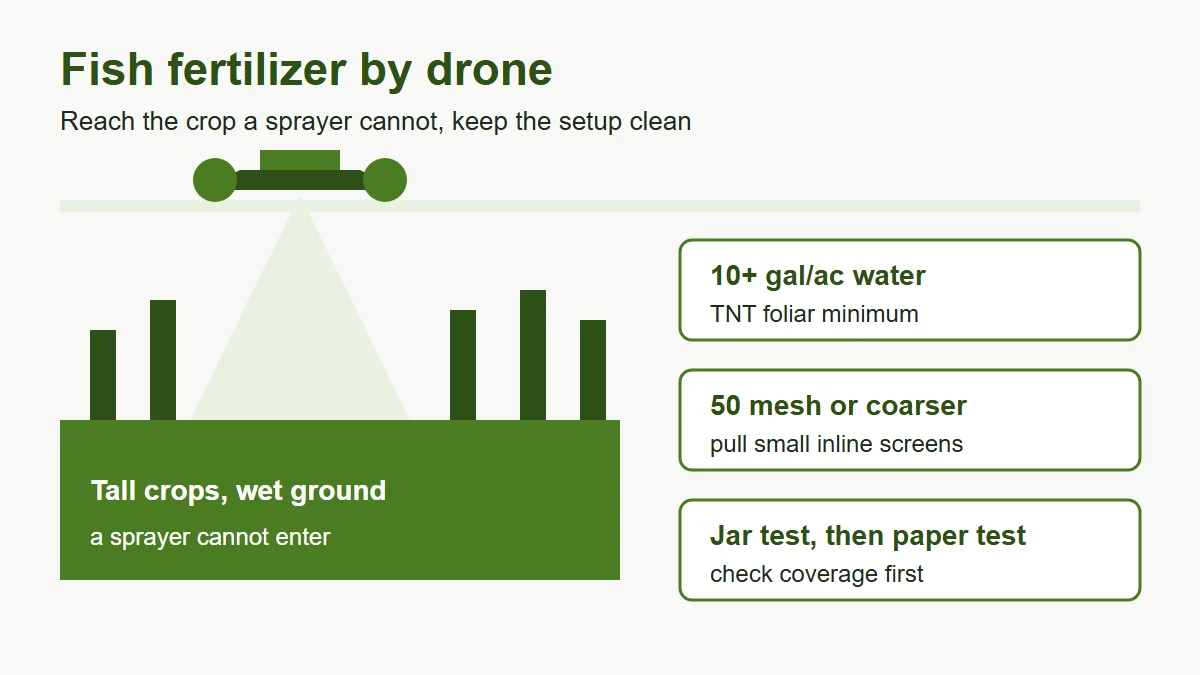
Growers ask us about drones for crops a sprayer cannot reach. The rest of this post is the setup checklist we walk them through.
Why are growers looking at drones for liquid fertilizer?
Access. Ohio State Extension says drones fit where topography or soil conditions do not allow a ground sprayer, and that drone spraying avoids the soil compaction and crop damage ground equipment can cause once a crop canopy is established.
Drones also work when the ground is too wet to drive. If your window for a foliar biological is closing and the field is soft, an aircraft can still make the pass.
How much water does a fish product need on the label?
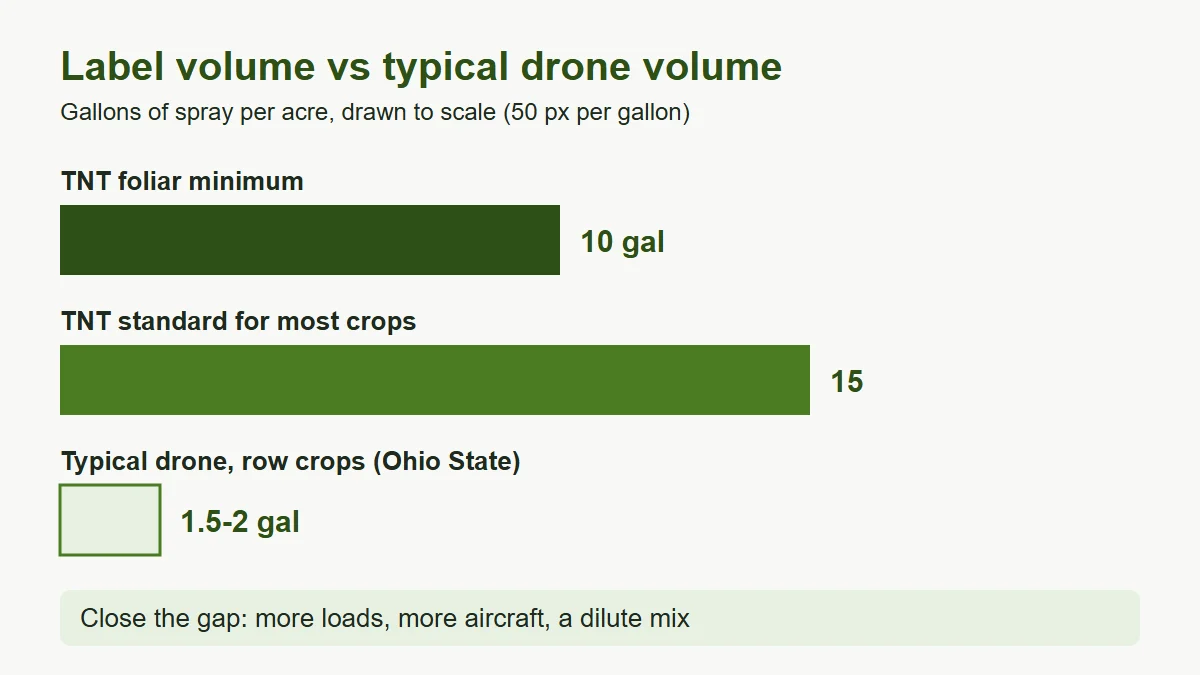
TNT lists a minimum of 10 gallons of water per acre for foliar passes and 15 gallons as the standard for most crops. That keeps the product dilute, spread over more leaf area and easy to handle in the tank.
Ohio State Extension reports that spray drones in row crops usually apply 1.5 to 2 gallons per acre. The gap between those numbers is the planning task: more water per acre than a typical drone program, which means more loads or more aircraft.
A second drone filling while the first one flies is one way to carry a dilute mix over many runs and keep the job moving.
What filters and nozzles work best?
The same rules that keep a ground sprayer running keep a drone running. TNT recommends 50 mesh or coarser, not 180 mesh, and with that setup TNT fish products move freely from tank to nozzle.
- Check the main tank filter and any small inline filter or strainer before the nozzle or atomizer. Growers often forget those, and they are the finest screens in the system.
- Use the coarser nozzle or atomizer option your drone offers. Ohio State notes that on rotating-disc drones a single-layer disc gives relatively larger droplets and a dual-layer disc gives smaller ones.
- Keep agitation on. TNT calls for constant agitation with biological products.
- Use the same water you will spray with when you test the mix.
On the ground, TNT recommends twinjet flat fan tips with strainers sized to the tip delivery rate. Your drone manual is the guide for the aircraft equivalent.
What should I check before the first field?
| Check | What to do | Source |
|---|---|---|
| Volume | Plan for 10+ gal/ac foliar; add loads or aircraft to get there | TNT label; Ohio State (1.5-2 gal/ac typical) |
| Filters | 50 mesh or coarser; remove small inline screens | TNT equipment guidance |
| Jar test | Same water, same order, watch for curdling | TNT mixing protocol |
| Coverage | White paper tape and food-grade dye under a test pass | Ohio State |
| Calibration | Calibration and coverage checks with water; verify swath width with pattern testing | Iowa State |
| Licensing | FAA Part 107 and Part 137 plus state requirements | Ohio State |
How do I confirm even coverage?
Check it in the field. Iowa State Extension recommends calibration and coverage checks with water, and says verifying swath width through calibration checks and pattern testing keeps coverage uniform. Ohio State calls laying a strip of white paper tape under the flight path, with food-grade coloring in the tank, the most effective approach, and notes that drones with two rotating discs deliver a swath close to the 30 to 35 feet it gives as optimum.
Lay paper at several spots across the swath, fly a pass with plain water and dye, and look at the spread. Fix the height, speed or overlap and test again. Ten minutes of paper saves a field of guesswork.
Which TNT products make sense behind a drone?
The foliar products are the natural fit because they are liquids built for spraying. TNT HEF 2-0-0 is naturally fermented whole saltwater salmon and completely water-soluble, so it handles easily in a tank. TNT HES 1-0-0 is the foliar choice for hay and forage regrowth. Super Salmon+ (2-2-0) is filtered to 120 mesh and should be used within 4 hours of diluting.
| TNT product | Label foliar rate | Water |
|---|---|---|
| HEF 2-0-0 or HEF 2-3-0 | 0.5-4 qt/ac | At least 10 gal/ac |
| HES 1-0-0 | 1 gal/ac | At least 10 gal/ac |
| Super Salmon+ 2-2-0 | Up to 2 gal/ac | Diluted at least 1:10 |
Timing helps too. TNT suggests spraying early in the morning or late in the afternoon, with clean water at pH 6.0 to 7.0, and skipping the pass when rain is expected within 6 hours. Those habits suit a drone as well as they suit a ground rig.
Pick the product and rate from the product page or the crop page, such as corn, and keep to the label foliar rate. For certified organic acres, only HEF 2-3-0 and Super Salmon+ hold OMRI listings for the US National Organic Program, so check your certifier before any pass. See which TNT products are OMRI Listed.
What about the rules?
The aircraft side has its own requirements. Ohio State Extension says operators need an FAA Part 107 certificate to fly and a Part 137 certificate to apply pesticides, with state licensing on top. Iowa State notes that only products labeled for aerial application may be legally applied with a drone. Rules differ by product, so if you tank-mix anything with a fish product, confirm that each label allows it. When in doubt, ask your state department of agriculture.
How do I prove it works on my farm?
Run a strip. Treat a swath with the drone, leave an untreated strip next to it with the same crop and fertility, and compare at harvest. Iowa State also suggests starting with small acreage and comparing results with conventional application, which is exactly what a strip does. Our strip trial guide walks through it, and our free sample is a low-risk way to start.
The short version
- Drones reach tall crops and soft ground that sprayers cannot.
- Plan for label volume: 10+ gallons per acre of water, even if that takes more loads or aircraft.
- Filters at 50 mesh or coarser, small inline screens out.
- Jar test, calibrate, and check coverage on paper first.
- Call TNT for a plan before you scale up, and keep an untreated strip.
Sources: Ohio State University Extension, “Drones for Spraying Pesticides: Opportunities and Challenges” (FABE-540); Iowa State University Extension, “Getting Started with Spray Drones in Iowa: A Practical Guide” (2026).