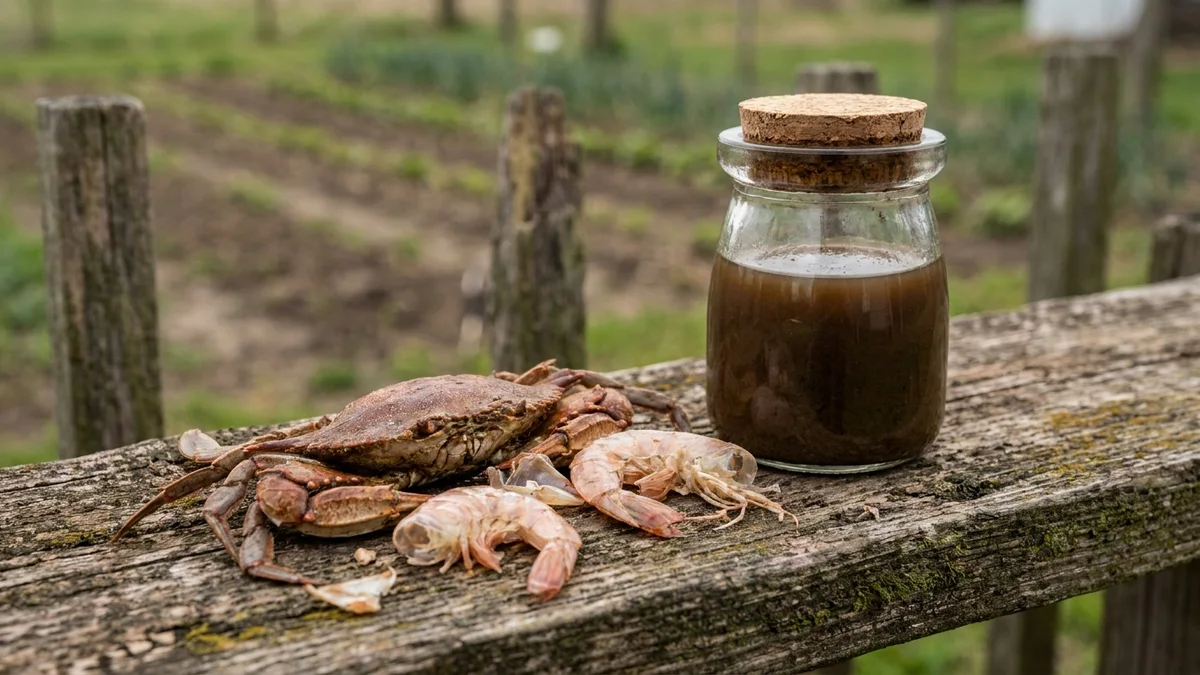
Chitin is the tough, fibrous material that forms the shells of crab, shrimp and lobster. In a fish fertilizer it is an extra food source for soil microbes, and it only shows up when crustacean shells are part of the recipe.
What is chitin, in plain words?
Think of chitin as the rebar in a crab shell. It is a long chain of sugar-like units that gives the shell its strength, and it is the part of the shell that soil microbes slowly feed on.
It is not a fish product on its own. Fish flesh is mostly protein and oil. Chitin arrives with crustaceans, which is why we talk about it as a separate ingredient and not as a feature of all fish fertilizers.
How is chitin different from chitosan?
Chitosan is chitin with part of its acetyl groups removed, which chemists call deacetylation. Malerba and Cerana, in a 2019 review in the journal Polymers, describe chitosan as the deacetylated derivative of chitin. They also point out that bulk chitin does not dissolve in most common solvents, which is the main practical reason chitosan and small chitin pieces (oligosaccharides) get more attention in plant research.
| Chitin | Chitosan | |
|---|---|---|
| Where it comes from | Crab, shrimp and lobster shells | Made from chitin by deacetylation |
| Form | Tough, fibrous, slow to dissolve | More soluble |
| Role in a fertilizer | Slow-release food for microbes in the soil | Studied mostly as a soluble plant and seed treatment |
What does chitin do in the soil?
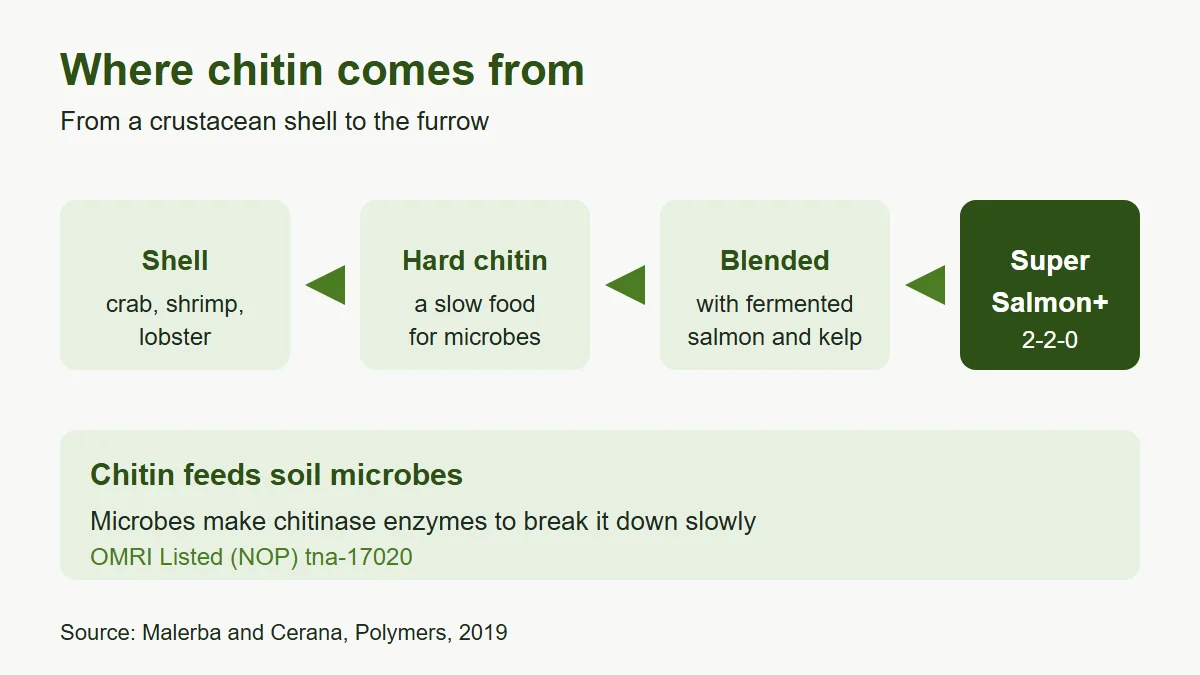
It feeds biology. Microbes make enzymes called chitinases to break chitin down, and that work puts their activity right where the material lands. The Malerba and Cerana review reports that adding chitin to soil improves microbial communities in both their abundances and their structures. The same review describes lab work on Arabidopsis, a small model plant, where plants treated with a chitin oligosaccharide showed about 10% more fresh weight, along with longer radicles and more total carbon and nitrogen.
That is research on chitin in general, not a promise for any one product on your farm. It does explain why a hard, slow-to-break-down fiber is a useful partner to a liquid that is quick to use.
Why put chitin in a fish product at all?
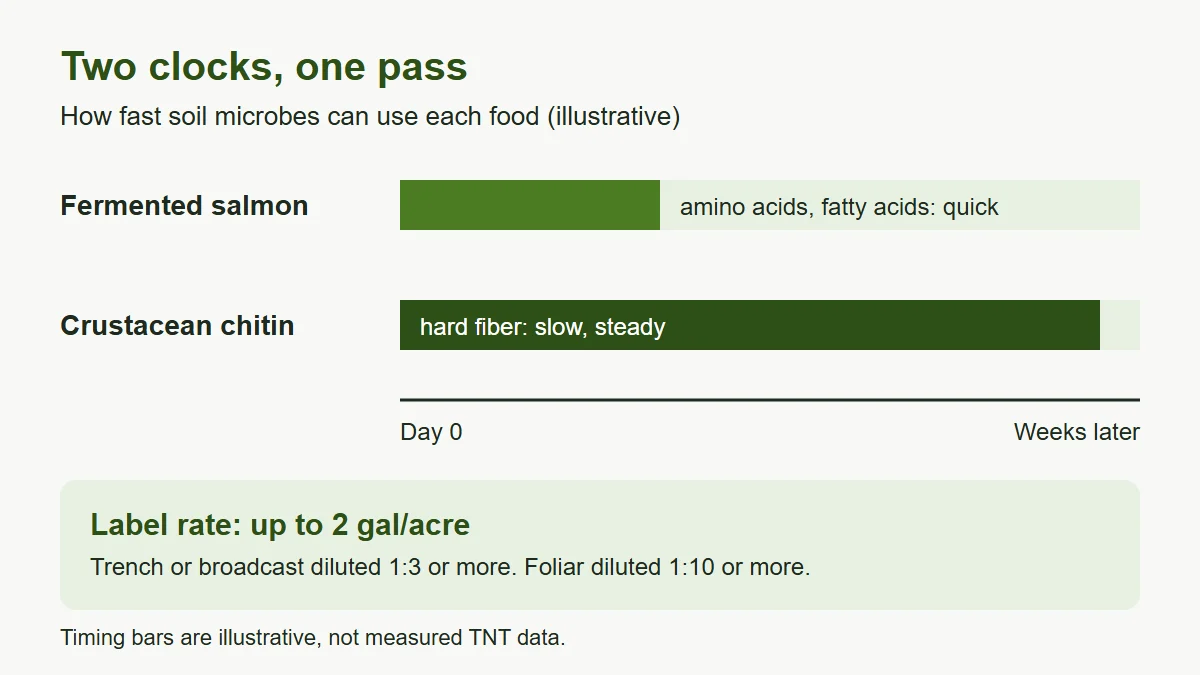
Because fish and chitin work on different clocks. Fermented salmon is rich in amino acids and volatile fatty acids that microbes can use quickly. Hard chitin takes longer to break down. Together they give biology a quick meal and a longer one in the same pass.
In our What's Up With Fish? TNT Talk Time session, we walked through where chitin in a fish product comes from (video, from 2:11). The short version: crustacean shell in the recipe is the reliable source, which is why Super Salmon+ includes it on purpose.
Why do growers ask about chitin on the label?
Because they want to know where it comes from and what it rides with. Three questions clear it up fast.
- Where does the chitin come from? Crab, shrimp or lobster shell is the usual answer. TNT Super Salmon+ names crustacean shells on its ingredient list.
- What else is in the jug? Chitin alone is a fiber. The value comes from what it rides with: amino acids, volatile fatty acids and kelp in Super Salmon+.
- Is the listing current? For organic acres, search the exact product at omri.org, confirm NOP status and note the expiry date.
Write the answers down next to the guaranteed analysis, and you have a clear picture of what goes on the field.
How does chitin fit with the rest of a biology program?
It is one tool, not the whole toolbox. Soil biology does best when it has living roots, cover and residue to work with. Chitin adds a slow, fibrous food, and a fermented fish liquid adds a fast one. Kelp brings its own plant-growth compounds. None of that replaces a soil test, a sound rotation or your certifier's sign-off.
Growers who like to see for themselves can add a simple check. Pull a shovel of soil from a treated strip and an untreated strip a few weeks after application. Look at structure, smell and root hairs. It is not a lab test, but it tells you what your own ground is doing and gives you something to compare next year.
Which TNT product has chitin?
TNT Super Salmon+ is the one. It is made from naturally fermented whole saltwater salmon, hard chitin from crustacean shells, and kelp. TNT describes it as a fortified salmon hydrolysate with chitin, kelp, amino acids, volatile fatty acids and natural fermentation organisms. Label analysis is 2-2-0 (2% total nitrogen, 2% available phosphate), and it is filtered to 120 mesh.
It is OMRI Listed for US organic production under NOP, product code tna-17020, with the listing expiring 1 March 2027. Check omri.org and your certifier before you buy.
| Product | Analysis | Chitin added? | OMRI (NOP) |
|---|---|---|---|
| TNT Super Salmon+ | 2-2-0 | Yes, hard chitin from crustacean shells | Listed, tna-17020 |
| TNT HEF 2-3-0 | 2-3-0 | No, fermented whole salmon | Listed, tna-16447 |
| TNT HEF 2-0-0 | 2-0-0 | No, fermented whole salmon | COR (Canada) only |
How do you use a chitin-fortified fish product?
- Trench or broadcast: up to 2 gal/acre, diluted at least 1:3.
- Foliar or fertigation: up to 2 gal/acre, diluted at least 1:10.
- Tank: keep it agitated, use a strainer of 50 mesh or coarser, and jar-test before mixing with anything new.
- Mixing: it is highly biologically active once diluted, so use it within 4 hours of mixing.
The label rate is the ceiling, not a target. Start lower on a test strip and see how your own soil responds.
Where does it fit in the season?
Most growers add Super Salmon+ where they already have a pass planned, and it rides well with constant agitation.
- At planting: in the trench, diluted at least 1:3, up to the 2 gal/acre label ceiling.
- In season: foliar or fertigation, diluted at least 1:10.
- Heat, drought or nutrient stress: 1-2 qt/acre as an in-season stress-support pass.
Keep records of date, rate and field. Next season those notes are worth more than any brochure.
How do you find out if it pays on your farm?
Run a simple strip trial. Treat one pass, skip the next, and harvest both the same way. The 2025 corn trial, which put 2 gal/acre of Super Salmon+ in the trench on one of its strips, is written up with both trials and their controls on our reports page (one farm, one season, results vary). The TNT team brings 20+ years of experience and will help you set the strips up. Ask for a free sample or call (574) 532-6201.