A good organic in-furrow starter for corn is gentle on the seed, low in salt, and gives cold roots a small dose of phosphorus and nitrogen plus something for the soil biology to work with. Liquid fish products fit that job when they are diluted, applied at label rate and checked against your certifier.
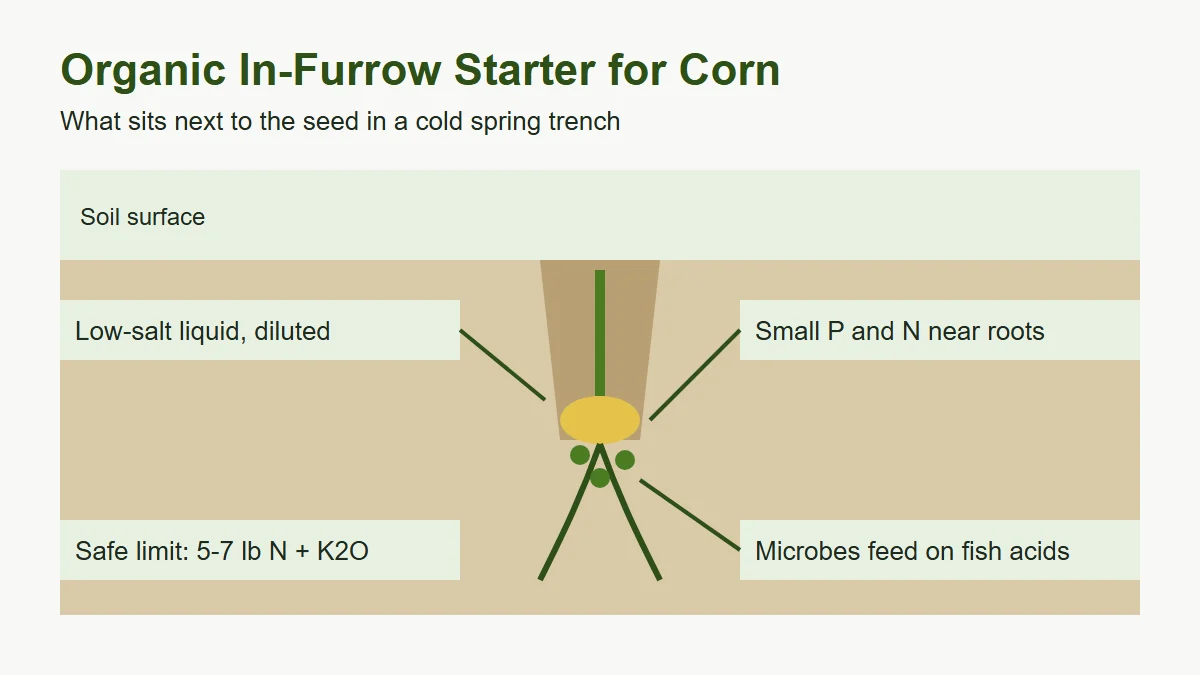
What does a starter have to do in cold soil?
Corn planted in April does not grow roots the way corn does in June. Iowa State Extension (Antonio Mallarino) explains that in cold soil, root growth slows, the roots take up nutrients less well, and nutrients move through the soil toward the root more slowly. Phosphorus moves the least, so the supply right at the root can be thin even when the soil test looks fine.
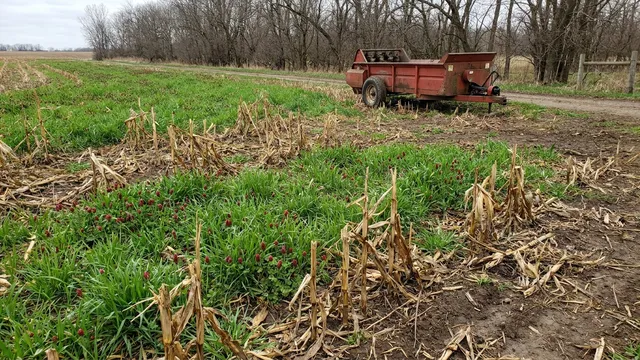
Iowa State adds that starter response is more likely on moderately poor to poorly drained soils and in no-till with thick residue, especially cornstalks, because those soils stay cool longer in spring. The Nebraska Extension guide NebGuide G361 says the same about nitrogen: early growth benefits are most likely where soil nitrogen is low at planting, or where soils are cool under heavy residue.
So a starter is not a magic bullet. It is a small, well-placed meal for a plant that cannot reach much yet.
How much can you safely put in the furrow?
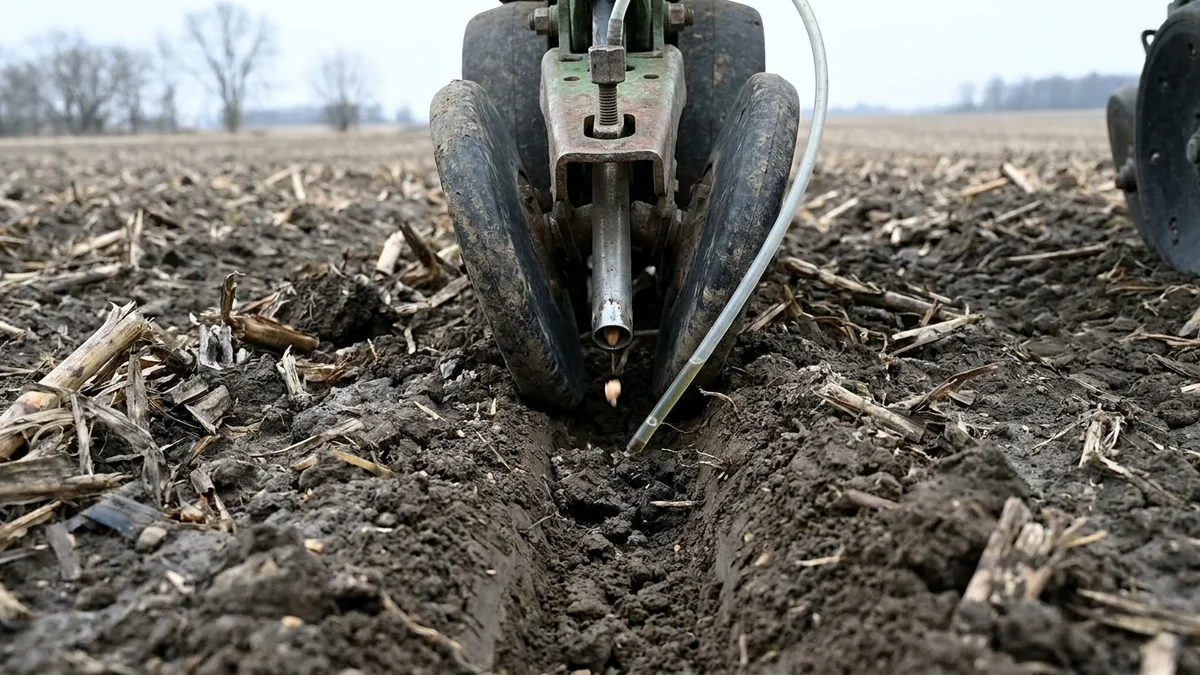
Salt is the limit, not the nutrient. Fertilizer in the trench pulls water away from the seed as it dissolves, and ammonia can do damage too. NebGuide G361 states that the amount that can be applied safely is limited, usually less than 5-7 lb per acre of N plus K2O in-furrow. It also warns that the risk goes up when the soil dries after planting and no rain falls for two to three weeks.
The same NebGuide says ammonium thiosulfate (12-0-0-26S) should never be placed in the furrow with the seed. It also reports that in its no-till trials, starter placed over the row, in the furrow, or to the side and below the seed was equally effective. So if you want more fertilizer than the seed can safely sit next to, put it beside the row, not on the seed.
That is why most starters for organic corn are liquids that are low in salt and diluted before they go in the trench. It is also why more is never better here.
What goes in an organic starter program?
| Input | What it gives the seedling | Watch for |
|---|---|---|
| Liquid fish (fermented or hydrolyzed) | Small amounts of N and P, amino acids, volatile fatty acids, food for soil microbes | OMRI status of the exact product; dilution and rate |
| Seaweed or kelp extract | Trace minerals and plant-growth compounds | Nutrient content is low, so it is a supplement |
| Microbial inoculants | Live organisms placed at the seed | Check the label and jar-test before mixing |
| Rock or bone phosphate, banded | Slow-release phosphorus for the season | Goes beside the seed or broadcast, not on it; availability depends on pH |
| Composted manure or poultry litter, spread ahead | Main nitrogen and phosphorus supply | Not an in-furrow product; follow your plan and certifier |
Notice what is missing: a liquid in the trench cannot carry the whole phosphorus or nitrogen budget. Those come from compost, manure, cover crops and rock phosphate. The starter is the nudge that gets the crop out of the ground cleanly.
Where does a fish-based starter fit?
HEF starts as whole saltwater salmon, naturally fermented in a cold process. For US certified organic corn, TNT HEF 2-3-0 is OMRI Listed (NOP, tna-16447, expires 1 March 2027). Its label analysis is 2% total nitrogen and 3% available phosphate (P2O5), and TNT lists it as the starter and phosphorus-boost product for early growth in cool soils.
On corn, plan on 2-4 qt per acre in the furrow, mixed with at least ten times as much water. TNT's crop chart gives 2 qt on 20-30 inch rows and 4 qt on narrower 8-20 inch rows.
Here is the honest math. A gallon weighs 8.5 lb. Two quarts is half a gallon, or 4.25 lb of product. At 3% P2O5 that is about 0.13 lb of P2O5 per acre, and at 2% nitrogen about 0.09 lb of N. Four quarts doubles that. That is a small amount of fertilizer, and it should be, because it sits right on the safe side of the 5-7 lb limit Nebraska describes. What a fish product adds beyond the numbers is the biology side: volatile fatty acids and amino acids that soil microbes can feed on near the seed.
Corn starter results vary. For reference, Purdue Extension reported that in continuous corn, starter at 20-50 lb of N per acre raised yield at 15 of 36 trial locations, by an average of 8.3 bushels per acre at the sites that responded. That is a much larger nutrient load than any in-furrow liquid. If you want measured TNT numbers, see the 2025 corn trial (one farm, one season, results vary) at our reports page.
What does fish in the furrow do for emergence?
It gets the biology to the seed early. In our Coffee Shop session Lessons from 2022, Part 1, we described HEF as a potent biostimulant for both soil fungi and bacteria: placed in the trench, it draws beneficial microbes from the surrounding soil to the seed. The sooner the seedling and those microbes start working together, before the sprout even breaks the surface, the better the start, much like colostrum for a newborn calf. Growers on TNT in-furrow programs describe consistent emergence and better late-season plant health.
If you already run a compost extract or a microbial package through the planter, HEF fits with it: it gives those organisms something to feed on the moment they land in the trench. Load the tank in this order and jar test it the same way: extract or biology into most of the water, then HEF, then any humate (check for curdles), then molasses if you use it, then the last of the water.
How do you calibrate an in-furrow kit?
Do the math once, then check it at the planter. Per row unit:
- Pick your total liquid rate in gallons per acre. For 2 qt of product at a 1:10 dilution, that is 0.5 gal of product plus 5 gal of water, so about 5.5 gal/acre.
- Use this formula: gallons per minute per row = gal/acre x mph x row width (inches) / 5,940.
- For 5.5 gal/acre at 5 mph on 30-inch rows: 5.5 x 5 x 30 / 5,940 = about 0.14 gal per minute per row, or roughly 18 oz.
- With the planter parked and the pump running at the set pressure, catch the flow from several row units for one minute. Each should be within a few percent of the target.
- Check for plugged orifices and worn check valves. A row that puts out double is the one that burns seed.
Use clean strainers. TNT's sprayer guidance is 50 mesh or coarser, and constant agitation in the tank so the product does not settle. Always jar-test before you mix anything new in the same tank.
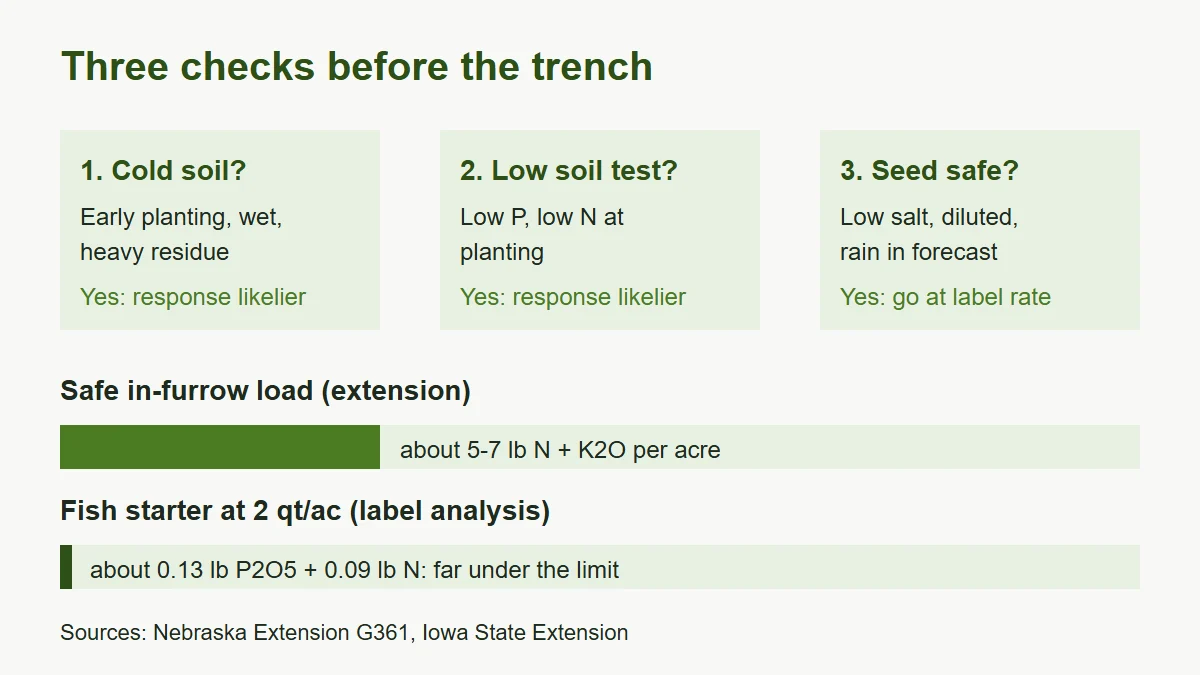
What should you check before you commit?
- Certification. Search the exact product name at omri.org and read the ruling body (NOP for the US), status and expiry. Send your certifier the label.
- Soil test. If phosphorus already tests adequate or high, Iowa State says early growth responses are unlikely, so a starter is less likely to pay.
- Seed-to-fertilizer gap. Keep total N plus K2O in contact with the seed low, and put any extra beside the row, not on it.
- Dry spring. If the forecast is dry for weeks, cut the rate or skip the pass. Nebraska flags that exact situation as the riskiest.
- A check strip. Leave an untreated pair in the same field and harvest both the same way. Your ground is the proof that counts.
Frequently asked: where do I start?
Start with the soil test and your certifier, then pick one field and one pair of strips. Our corn guide shows the full HEF program by growth stage, and you can ask for a free sample at /free-sample or call (574) 532-6201.