Yes. A liquid fish fertilizer that is OMRI Listed under the USDA National Organic Program (NOP) and has not expired can go on certified organic soybeans, and your certifier will usually accept the listing as proof. The work is in checking the listing yourself and in timing the pass, because soybeans make most of their own nitrogen and a fish product is a supplement, not a nitrogen program.
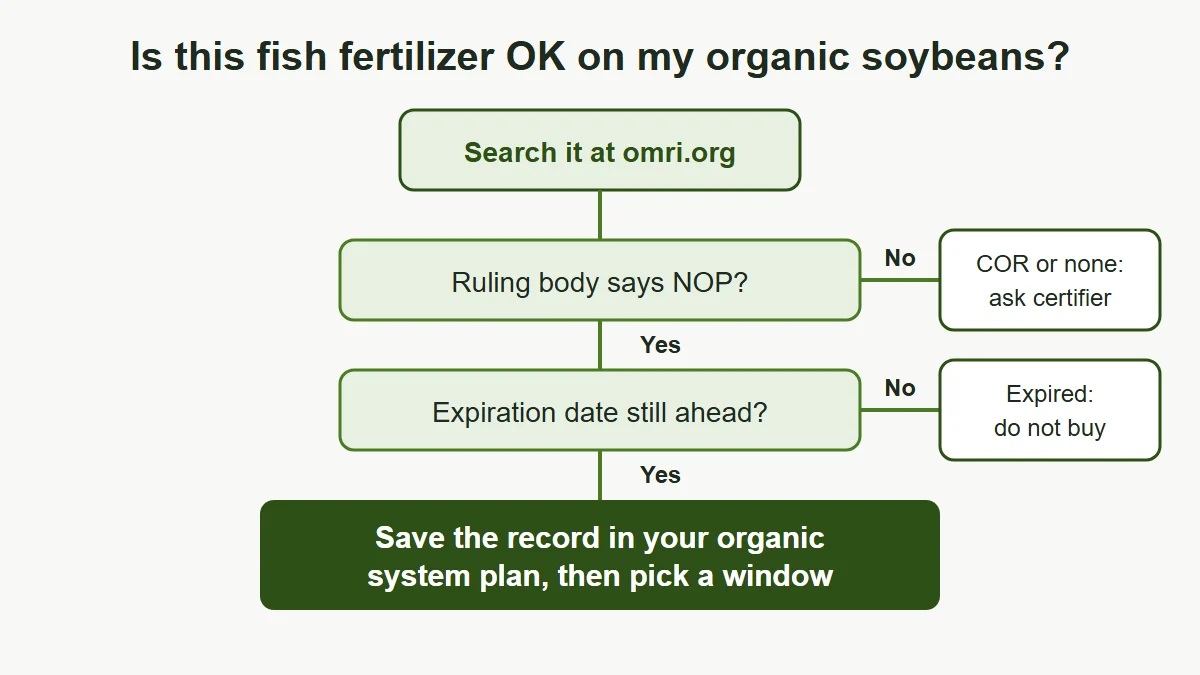
How do I check that a fish fertilizer is OMRI Listed?
Look it up at omri.org. OMRI, the Organic Materials Review Institute, says its online search and downloadable lists are updated nightly, and that a jug showing the seal may not be currently listed if it does not appear in the search. So the record is the proof, not the label. Read four lines:
- Product name and maker. OMRI asks users to confirm both match the label in your hand.
- Ruling body. NOP is the US standard. COR is Canada. A COR-only listing does not cover a US certified farm.
- Status. It should say listed, not withdrawn or pending.
- Expiration. OMRI says listings renew annually and a product that is not renewed by its date comes off the list. Save a copy of the record the day you buy.
The OMRI listing tells you the product complies. Your certifier still has the last word, so put the record and the label in your organic system plan. For the list of liquid fish products checked on a date, see which TNT products are OMRI Listed.
Which TNT products are OMRI Listed for soybeans?
| Product | OMRI status | Code | Expires | Fits certified US soybeans? |
|---|---|---|---|---|
| TNT HEF 2-3-0 | Listed, NOP | tna-16447 | 1-Mar-2027 | Yes |
| TNT Super Salmon+ 2-2-0 | Listed, NOP | tna-17020 | 1-Mar-2027 | Yes |
| TNT HEF 2-0-0 | Listed, COR only | tna-16908 | 1-Mar-2027 | Only after certifier review |
| TNT HES 1-0-0 | Not listed | none | none | Only after certifier review |
The same checking steps apply to any other maker. If a competitor's product shows NOP and an unexpired date in the OMRI record, it passes the same test.
When does a fish fertilizer fit in the soybean season?
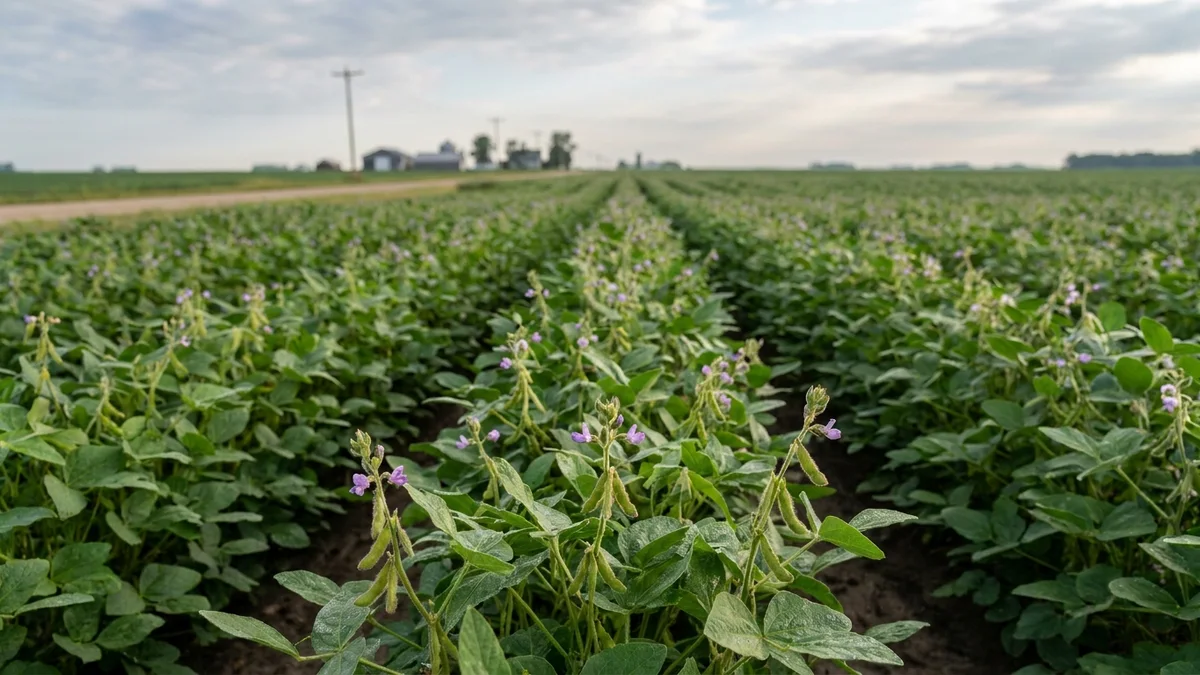
Use the growth stages to pick the pass. NDSU Extension defines V3 as three nodes above the unifoliolate node, R1 as at least one flower on the main stem, and R3 as a 3/16 inch pod on the upper four nodes.
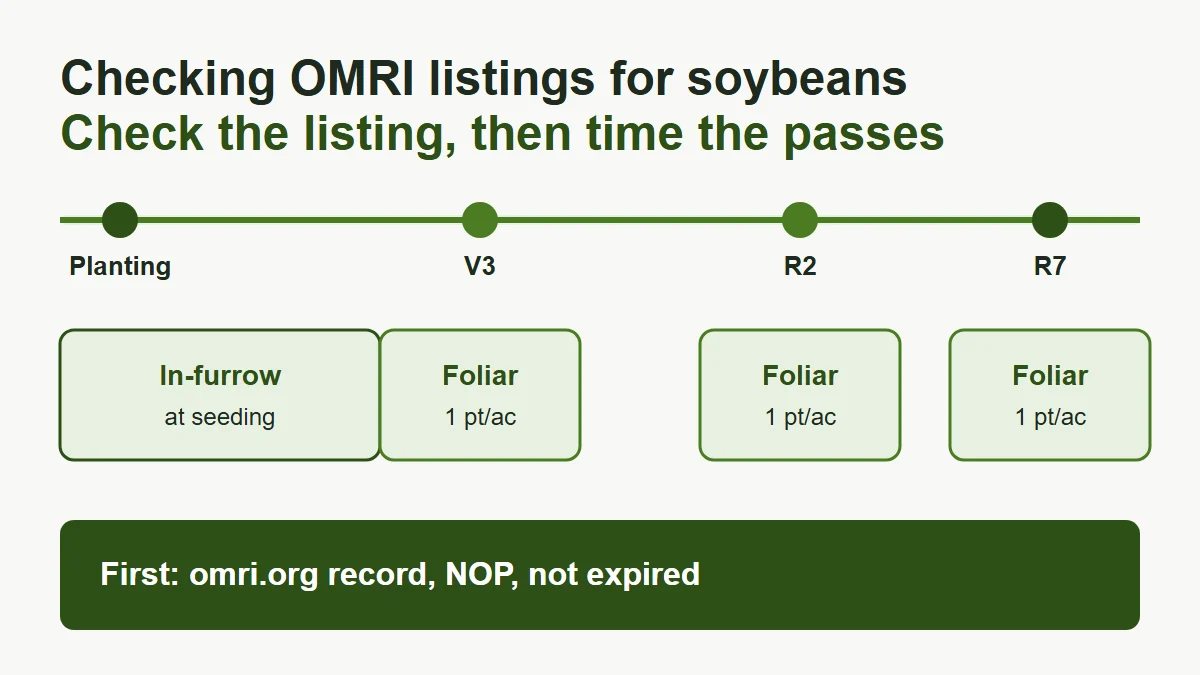
What does TNT's soybean stage chart look like?
TNT's application chart has one row for beans. In-furrow at planting is 1 quart per acre in 20 to 30 inch rows and 2 quarts per acre in 8 to 20 inch rows. Foliar is 1 pint per acre, at V3, R2 and R7, in 15 gallons of water per acre. Here it is by stage, with the bloom-support rate from TNT's product brief.
| Stage | What is happening (NDSU Extension) | TNT chart or brief |
|---|---|---|
| Planting, in-furrow | Seed goes in. Active N fixation is just beginning by V2. | HEF, 1 qt/ac in 20-30 in rows, 2 qt/ac in 8-20 in rows |
| V3 | Three nodes above the unifoliolate node. | Foliar, 1 pt/ac |
| R1 to R2, bloom | At least one flower on the main stem at R1. N fixation increasing rapidly by R2. | Foliar at R2, 1 pt/ac. HEF 2-3-0 at 1 qt/ac for bloom support |
| R3, pod set | A 3/16 inch pod on the upper four nodes. Stress here can cut pod count or seed size. | No separate pass on the chart |
| R7 | Late season. | Foliar, 1 pt/ac |
The 1 qt/ac bloom-support rate is for TNT HEF 2-3-0. TNT HES can also go on soybeans as a foliar at 1 gal/ac, but HES is not OMRI Listed, so it stays off certified ground until your certifier approves it. TNT Super Salmon+ is the other OMRI Listed (NOP) option for a foliar pass; follow its label.
What does an organic certifier ask for?
Every certifier works a little differently, so call yours before you buy. The usual paperwork looks like this, and it is why the OMRI record matters:
- The input is on your Organic System Plan. Add the product name, maker, what it is for and which fields it goes on.
- Proof it is allowed. An OMRI record showing NOP, listed and unexpired, plus the product label, is the easiest thing to hand over.
- Approval before use. Get the yes first, in writing, and apply second. Using an input that is not approved can put the field's certification at risk.
- Records after. Date, field, rate and product lot for each pass.
OMRI states that its lists and search give "accurate, current information about products and materials allowed for organic use." Your certifier still decides.
You do not need every pass on the chart. Pick one window and run an untreated strip beside it. If you want a second pass, TNT Super Salmon+ is the other OMRI Listed (NOP) option for a foliar pass.
How much nitrogen is a fish fertilizer worth on soybeans?
Not much, and that is fine. NDSU Extension says active nitrogen fixation is just beginning at V2 and peaks at R5. It also says pink or red nodules are fixing nitrogen and white, brown or green nodules are not doing so efficiently. A 2 percent nitrogen product at a few quarts per acre adds a small amount next to that. If you buy a fish product for soybeans, buy it for the fats, amino acids and phosphorus in the case of TNT HEF 2-3-0 (2-3-0), and judge it on your own strip.
Does fish fertilizer interfere with inoculant?
This is the caution. TNT's own results include a RhizeBio study of TNT HEF 2-3-0 applied in-furrow on commercial soybeans, sampled at V2, V4 and V7 on one farm. The report found Bradyrhizobium, the main nitrogen-fixing bacteria in soybeans, lower in the treated strip. It is one farm and one season, and it describes bacteria counts, not yield. Michigan State University Extension has an article, "Soybean inoculation: will the added cost pay off?", which is worth reading before you change your inoculant program in either direction.
- Keep the inoculant program you already trust.
- Dig a few plants at V3 to V4 and look at nodule color inside, as NDSU describes.
- Run a treated strip and an untreated strip on the same soil, and compare nodulation and yield.
How do I jar test, and when does the inoculant go on?
Rhizobia inoculant is a live product and fish fertilizers are biologically active, so treat them as separate jobs until a label says they can be mixed.
- Keep them separate by default. Do not tank-mix fish fertilizer into your inoculant or seed treatment unless both labels allow it.
- Jar test anything new. Use the same water, the same order of addition and the same ratios you plan to use. Let it sit and look for clumps, separation or settling. TNT's rule is to jar test any new combination first.
- Time the passes apart. If you inoculate at planting, a foliar pass at V3 or later is a different step from the seed.
- Check the roots. TNT's soybean notes say to monitor nodulation and consider supplemental inoculant when using HEF 2-3-0 on soybeans. NDSU says pink or red nodules are fixing nitrogen.
What about the TNT products that are not listed?
TNT HES, TNT Activator and TNT Trash Buster are not OMRI Listed. HES is made from organically approved ingredients, but until your certifier approves it, keep it to conventional ground. On conventional soybeans, HES goes on as a foliar at 1 gal/ac.
What should I do before the first pass?
- Pull the OMRI record and note NOP, status and expiration.
- Put the record and the product label in your organic system plan.
- Pick one window and mark a strip with flags at both ends.
- Check nodules at V3 to V4.
- Compare strips at harvest, same direction, moisture corrected.
Want a jug to try on a strip? Request a free sample and we will send the OMRI certificate with it, or see fish fertilizer on soybeans. Sources: omri.org (search help and OMRI Listed products pages), NDSU Extension Soybean Growth and Management Quick Guide, Michigan State University Extension, "Soybean inoculation: will the added cost pay off?"