The right fish fertilizer for corn is the one that fits your organic standard, goes through your planter and sprayer without trouble, and is applied at the stage it was made for. Run the six checks below and the choice gets short.
What should I check before buying a fish fertilizer for corn?
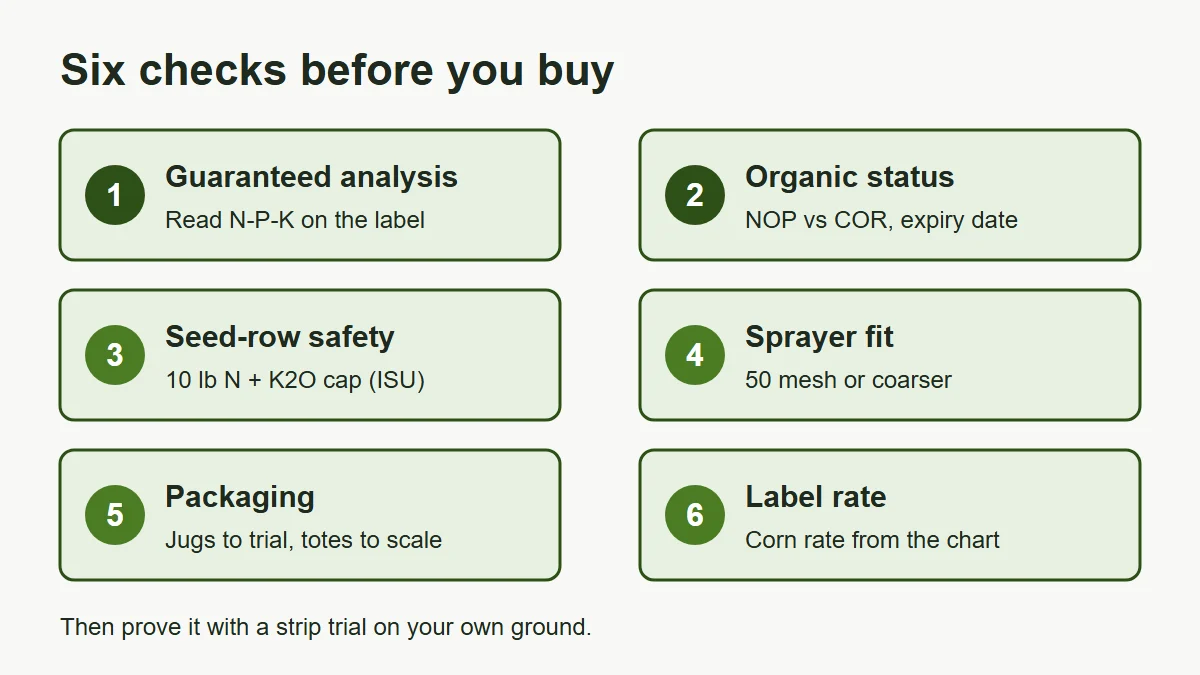
Most buying mistakes happen because two jugs that look alike are not the same product. Check these six things, in this order.
- Guaranteed analysis. It is on the label. Fish fertilizers are low-analysis liquids. TNT HEF 2-0-0 and HEF 2-3-0 are 2% nitrogen; HEF 2-3-0 adds 3% available phosphate (P2O5).
- Organic status. If you are certified organic, the product must be listed for your standard. More on this below.
- Seed-row safety. If it goes in-furrow, the salt load matters.
- Sprayer fit. Mesh size, agitation and how it mixes with your tank partners.
- Packaging. Jugs for a trial, totes for acres.
- Label rate for corn. Use the rate on the label, not a rate from a forum post.
Is fish fertilizer a nitrogen source for corn?
Not in any meaningful amount. Do the math on the label: a gallon of TNT HEF 2-3-0 weighs 8.5 lb and is 2% nitrogen, so about 0.17 lb of N per gallon. At 2 qt/acre in-furrow that is under a tenth of a pound of N. Iowa State University Extension says corn takes up roughly 70% of its nitrogen before tasseling, and that demand is far larger than a fish product supplies. Plan your N separately and treat fish as a biological input that feeds soil life around the seed and roots.
What does in-furrow safety mean?
Fertilizer placed in the seed row sits right against the seed. Iowa State University Extension (Antonio Mallarino, 2015) gives the rule to avoid applying more than 10 lb of N plus K2O per acre to the corn seed furrow. Your starter and anything else you put in the seed furrow all count toward that limit.
The fish side of the math is small. One gallon of TNT HEF 2-3-0 carries roughly 0.17 lb N and 0.26 lb P2O5. Even at the 4 qt/acre rate for narrow rows, that is a small share of the 10 lb ceiling. Still, add up everything in the furrow, and jar test the mix first.
Which fish fertilizer is OMRI Listed for organic corn?
For US certified organic (NOP), only two TNT products are OMRI Listed: TNT HEF 2-3-0 (tna-16447) and TNT Super Salmon+ (tna-17020). TNT HEF 2-0-0 is OMRI Listed for Canada (COR) only. TNT Hi-Energy Spray, Activator and Trash Buster are not OMRI Listed. All listings expire 1 March 2027. Look up any product yourself on the OMRI site, and read which TNT products are OMRI Listed before you buy. Your certifier has the final word.
How do the TNT fish products compare for corn?
| Product | Analysis | US organic (NOP) | Typical corn job |
|---|---|---|---|
| TNT HEF 2-0-0 | 2-0-0 | No (Canada COR only) | General soil biology, calcium blending programs |
| TNT HEF 2-3-0 | 2-3-0 | Yes, OMRI Listed | In-furrow starter, cool soils, added phosphate |
| TNT Super Salmon+ | 2-2-0 | Yes, OMRI Listed | Fortified with kelp and chitin; 120 mesh filtered |
| TNT Hi-Energy Spray (HES) | 1-0-0 | No | Foliar add-in, vegetative and reproductive stages |
Both HEF grades come from whole saltwater salmon left to ferment naturally, in a cold process. Super Salmon+ takes part of that ferment and adds kelp and chitin.
Where does each product fit in the corn season?
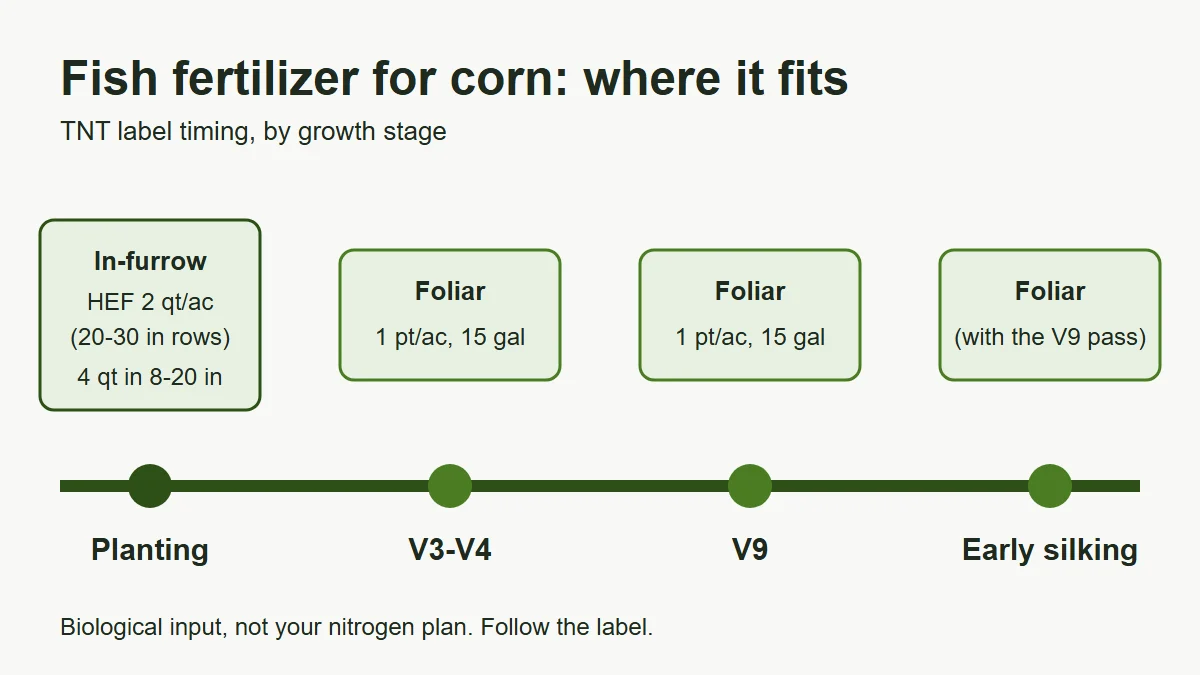
The TNT application chart for corn lists soil timing "with seed" and foliar timing at V3-V4 and again at V9 or early silking. Here is how that maps to the stages most growers think in.
| Stage | How it goes on | TNT label rate |
|---|---|---|
| At planting | In-furrow with the seed | HEF 2 qt/acre (20-30 inch rows), 4 qt/acre (8-20 inch rows) |
| At planting (alternative) | Broadcast on soil, 10 gal water/acre minimum | HEF 2-3 qt/acre |
| V3-V4 | Foliar | HEF 1 pt/acre in 15 gal water; HES 1-2 qt/acre plus molasses 1-2 qt/acre can be added |
| V9 or early silking | Foliar | HEF 1 pt/acre in 15 gal water |
The chart names V3-V4 and V9 or early silking as the two foliar passes. Use the rate calculator for your acres and the corn crop page for the full chart.
Will it run through my sprayer and planter?
TNT recommends a 50 mesh screen or coarser for HEF, not 180 mesh. Use twinjet flat fan tips with strainers sized to the tip, and keep the tank agitating, because these are biological products that settle. Always run a jar test before mixing anything new, and use the same water source as the field. Watch for curdling, especially with humates. For a step-by-step, see how to jar test a fish fertilizer tank mix.
How do I calibrate an in-furrow system?
Do it before planting, with water, not product. Work out how many gallons per acre your system should deliver, using the label rate and the dilution you plan to run. Then check the output.
- Fill the tank with clean water from the same source you will use in the field.
- Run the planter or a ground-speed test over a measured distance and catch the output from each row for a set time.
- Compare every row. A row that is off by a wide margin usually has a clogged tip or a kinked line.
- Convert the caught volume to gallons per acre for your row spacing and speed, and adjust the pump or tip until it matches.
- Check the strainers, then run a jar test of the real mix before it goes in the tank.
Rows at 30 inches and rows at 15 inches need different output per row even at the same per-acre rate. The chart also raises the per-acre rate from 2 qt in 20-30 inch rows to 4 qt in 8-20 inch rows, so recalculate whenever you change row spacing.
How do I handle bulk totes?
Jugs come in 1 gallon and 2.5 gallon sizes for a trial. TNT HEF and Super Salmon+ also come in 275 gallon totes, and TNT ships to all 50 states from Versailles, Indiana. A few handling points from the label and SDS:
- Freeze-thaw: HEF is freeze-thaw stable and performs well after freezing. Keep Super Salmon+ in a room-temperature shed rather than a cold one.
- Venting: vent the container above 40°F.
- Storage: keep it cool and out of direct sunlight.
- Filtration: ask what mesh the product was screened to at the plant (120 for Super Salmon+) and what screen it needs on your rig (50 mesh or coarser for HEF).
- Dilute use: use diluted Super Salmon+ within 4 hours for peak activity.
Buy jugs for the trial, and move to totes once the strips have earned it.
How do I verify an OMRI listing for NOP?
Do not rely on a jug or a sales sheet. Check these four things yourself.
- Search the product on the OMRI website and confirm it is listed.
- Check the standard: NOP is US organic, COR is Canada. TNT HEF 2-0-0 is COR only.
- Check the expiry date. TNT’s three listings (HEF 2-0-0, HEF 2-3-0 and Super Salmon+) all expire 1 March 2027.
- Ask your certifier, who makes the final call on your operation. TNT’s OMRI certificates are on the reports page.
How do I know it pays on my ground?
Ask for proof from your own field. TNT's own 2025 corn numbers come from a single Ohio farm in a single year, so treat them as one data point, not a forecast. Read the full trial write-up with both trials and the control numbers, then run your own treated and untreated strips, same hybrid, harvested in the same direction. A free sample from TNT covers a strip trial.
What is the short version?
- Check analysis, organic listing, in-furrow load, mesh, packaging and rate.
- Fish is a biological add, not your nitrogen.
- For US organic corn, only HEF 2-3-0 and Super Salmon+ are NOP listed.
- Trial it before you scale it.