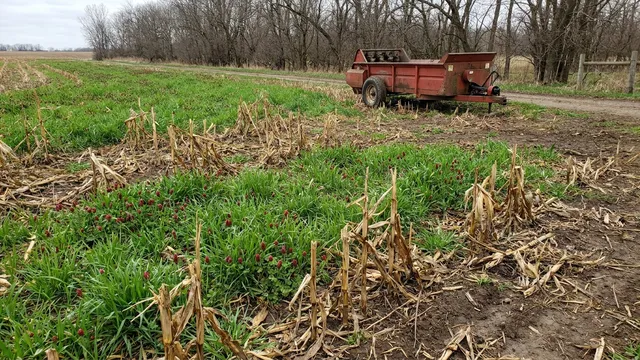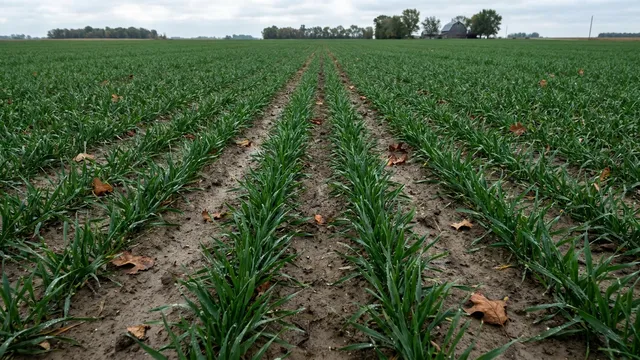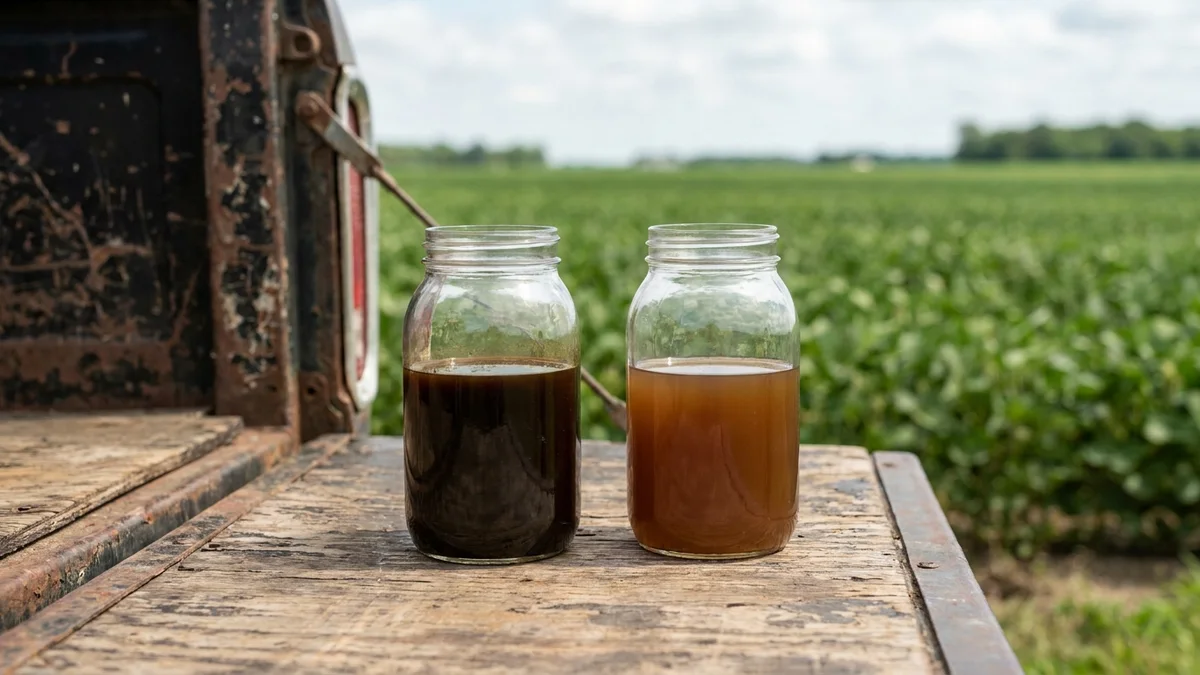
Fish emulsion and fish hydrolysate are both liquid fish fertilizers, but they are made differently, so they leave different things in the jug. For field crops, the better choice is the one whose label, analysis and handling fit your sprayer and your program, and you find that out by reading the label and running a strip trial.
How is fish emulsion made?
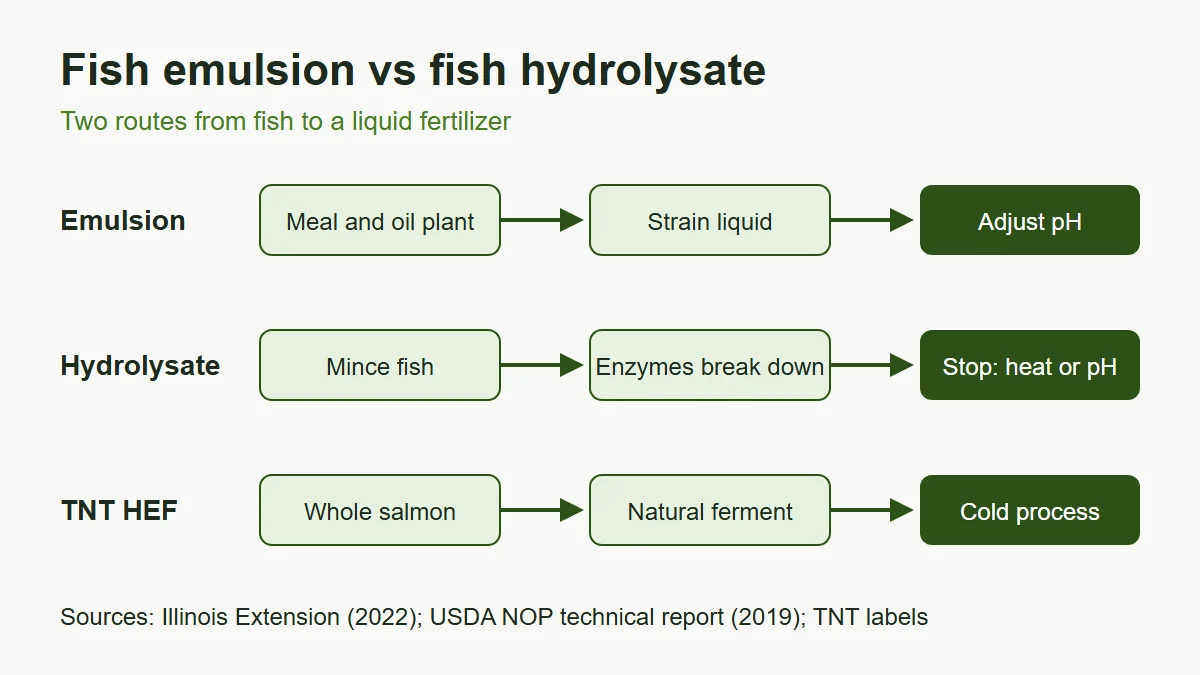
Illinois Extension describes fish emulsion as "the leftover liquid from the fish meal and fish oil industry." The maker strains out solid pieces and adjusts the pH so the product does not spoil. The same page says a typical fish emulsion may be about 2-4-1 and that nutrient ratios may vary, so use the label on the jug in front of you.
Because emulsion starts as a by-product of meal and oil production, ask the maker what the raw material was.
How is fish hydrolysate made?
The USDA National Organic Program technical report on fish-based fertilizers (July 2019) describes it this way: fish or fish waste is minced, put in a tank, sometimes with salt, and broken down. The breakdown is done by enzymes already in the fish, or by added proteolytic enzymes. Once the proteins are broken down enough, the process is stopped by heating or by pH adjustment.
The same report lists fish emulsions, fish hydrolysate, fish solubles, fish silage and liquid fish as other names for fish-based fertilizers, so you will see the words mixed on labels and websites.
Where does cold-fermented whole salmon fit?
TNT HEF is made from naturally fermented whole saltwater salmon, using a cold process. It is a fermented product, not an emulsion. TNT describes Super Salmon+ as a fortified salmon hydrolysate with kelp and chitin, made with a portion of that same fermented salmon. If a seller uses the word "hydrolysate" for everything, ask what the fish was, whether it was whole, and how the process was stopped.
What does each process leave in the jug?
In our Talk Time session What’s Up With Fish? we walked through the three liquid routes this way:
- Hydrolysate: digested just enough to liquefy the flesh. It keeps the fish’s free oils, some nutrients are available right away, and the rest is released as soil microbes digest it further, so it acts as a natural slow-release feed.
- Emulsion: a hydrolysate-like liquid with the oils pulled out, usually by cooking. It behaves much like a hydrolysate.
- Fermented: the breakdown is carried all the way through by natural fermentation. That is the route TNT HEF takes with whole saltwater salmon, and it is why HEF 2-0-0 tests at over 70% volatile fatty acids on a dry-matter basis (Dairy One report 24338880). Volatile fatty acids and amino acids are ready food for soil fungi and bacteria.
Fish emulsion vs hydrolysate: side by side
| Question | Fish emulsion | Fish hydrolysate | Fermented whole salmon (TNT HEF) |
|---|---|---|---|
| Starting material | Liquid left from fish meal and oil production (Illinois Extension) | Whole fish or fish waste, minced (USDA NOP report, 2019) | Whole saltwater salmon |
| How it breaks down | Strained from meal and oil production; ask the maker | Enzymes, from the fish or added | Natural fermentation, cold process |
| How it is stabilized | pH adjusted so it does not spoil | Heat or pH adjustment stops the enzymes | See the label and SDS |
| Typical analysis | 2-4-1 given as a typical example; varies | Varies by brand | HEF 2-0-0 and 2-3-0; Super Salmon+ 2-2-0 |
| Smell | "Smells, well like blended up fish" (Illinois Extension) | Varies | Mild marine smell from the jug; fades within hours on soil |
| Check before buying | Guaranteed analysis, OMRI listing | Guaranteed analysis, OMRI listing | Guaranteed analysis, OMRI listing |
Which one handles better in a sprayer?
Handling is where most field-crop jobs are won or lost. Whatever you buy, ask these four questions.
- Filter size. A 180 mesh screen is too fine for TNT fish products; fit 50 mesh or coarser. Super Salmon+ arrives pre-screened at 120 mesh, which does not replace the strainer your equipment calls for.
- Agitation. Keep the tank agitating, with a return line, so biological products do not settle.
- Jar test. Test with your starter, herbicide or liquid fertilizer before you fill the tank. Watch for curdling, especially with humates.
- Same water as the field. Mix with the water you will actually spray.
Super Salmon+ is biologically active once diluted, so TNT's guidance is to use it within 4 hours for peak performance.
Why do fish fertilizers plug sprayers, and how do I stop it?
Almost always it is the screens, not the product. Growers new to fish products often still have 180 mesh screens in from their chemical program, and those catch the fine solids that a biological liquid carries. The fixes from the same session are simple:
- Fit 50 mesh or coarser at the main tank filter.
- Check the small inline filters right before each nozzle. They are the ones people forget; take them out or swap them for coarse ones.
- Use a coarser droplet. Twinjet flat fan tips with strainers sized to the tip, and at least 10 gallons of water per acre for foliar passes, rather than a very fine mist at low volume.
- Jar test with your own water. Very hard water can turn a mix cloudy; the jar shows you before the tank does.
Why does the label word matter less than the analysis?
"Emulsion," "hydrolysate," "hydrolyzed" and "fermented" are marketing words as much as process words. The USDA report lists hydrolysate, silage and emulsion as names for one broad group, and Illinois Extension notes that emulsion nutrient ratios may vary. Two jugs with the same word on the front can carry different nitrogen, different phosphate and a different pH. That is why the guaranteed analysis and the product's pH and specific gravity belong in your comparison, along with the price per unit of what you actually want from the jug.
Also check the pH. Low-pH products can behave differently in a tank mix than neutral ones, and that is exactly what a jar test is for. Mix a small batch in the same water, in the same order you will use in the tank, let it sit, and look for curdling, layers or clumps before you commit a full load.
What about in-furrow?
The TNT HEF in-furrow rate is 2-4 qt/acre, diluted at least 1:10 at planting. A phosphorus-bearing option such as TNT HEF 2-3-0 (2-3-0, OMRI Listed for US organic) fits a cool-soil starter, and TNT HEF 2-0-0 fits programs where phosphorus is not limiting. Whichever liquid you pick, calibrate the kit, jar test it with the starter and check for plugging before you plant a full field.
Can fish replace my nitrogen?
No. The guaranteed analysis is low: HEF 2-0-0 carries 2% total nitrogen. Treat any liquid fish product as a biological and nutrition add-on, not a bulk nitrogen source. In the 2025 TNT corn trial, tissue tests were used to decide whether to skip a side-dress. That was one farm and one season, results vary, and you can read both trials in full on the reports page.
What if I farm organic?
Do not choose by the words "emulsion" or "hydrolysate." Choose by the OMRI listing for your standard. Among TNT products, only HEF 2-3-0 (tna-16447) and TNT Super Salmon+ (tna-17020) are OMRI Listed for US organic (NOP), and listings expire 1 March 2027. HEF 2-0-0 is OMRI Listed for Canada (COR) only. See which TNT products are OMRI listed, and search the product yourself at omri.org.
How do I pick one for my farm?
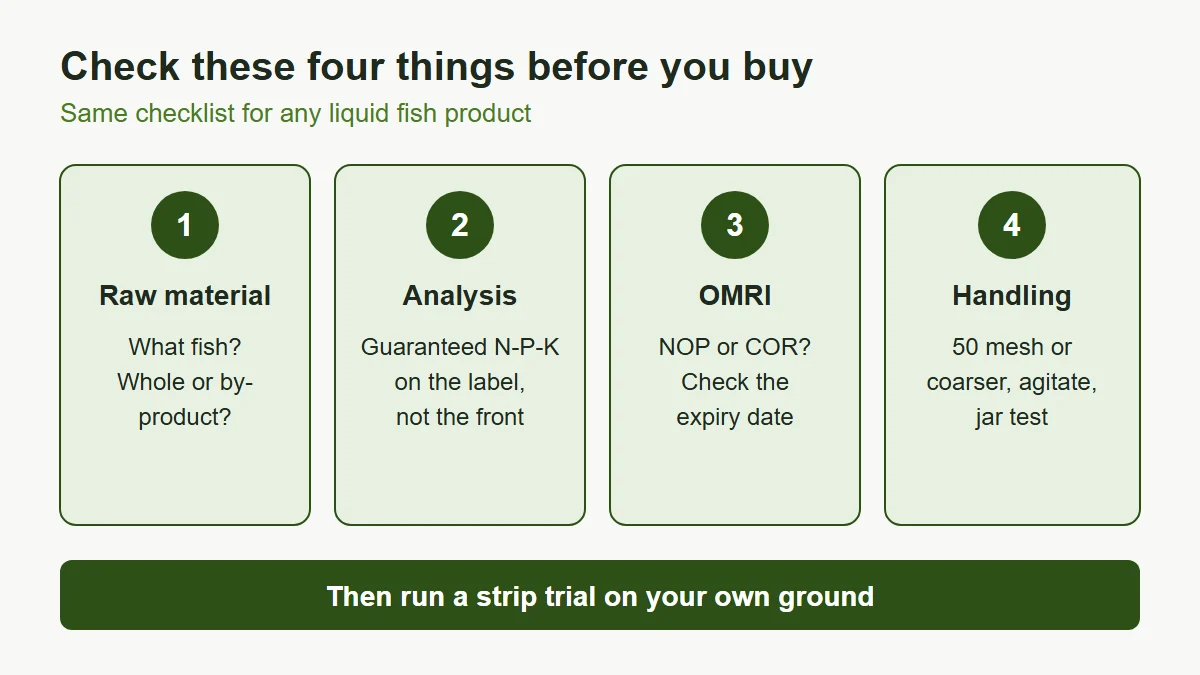
- Read the guaranteed analysis and compare per gallon, not per brand name.
- Ask what fish it is made from, and whether the whole fish is used.
- Check the OMRI listing, the standard (NOP or COR) and the expiry date.
- Confirm the filter mesh and the dilution before you load the tank.
- Run two products side by side on matched strips, on your ground, and compare at harvest.
If you are comparing brands, the fish fertilizer brand comparison lists the facts that are on each label. TNT also offers a free sample for a strip trial at /free-sample.
Sources
- Christopher Enroth, University of Illinois Extension, "Scale up your garden's health with fish emulsion fertilizer," April 25, 2022.
- USDA Agricultural Marketing Service, National Organic Program, Technical Evaluation Report on fish-based fertilizers, July 26, 2019.
- TNT product labels, SDS and Midwest Laboratories reports.