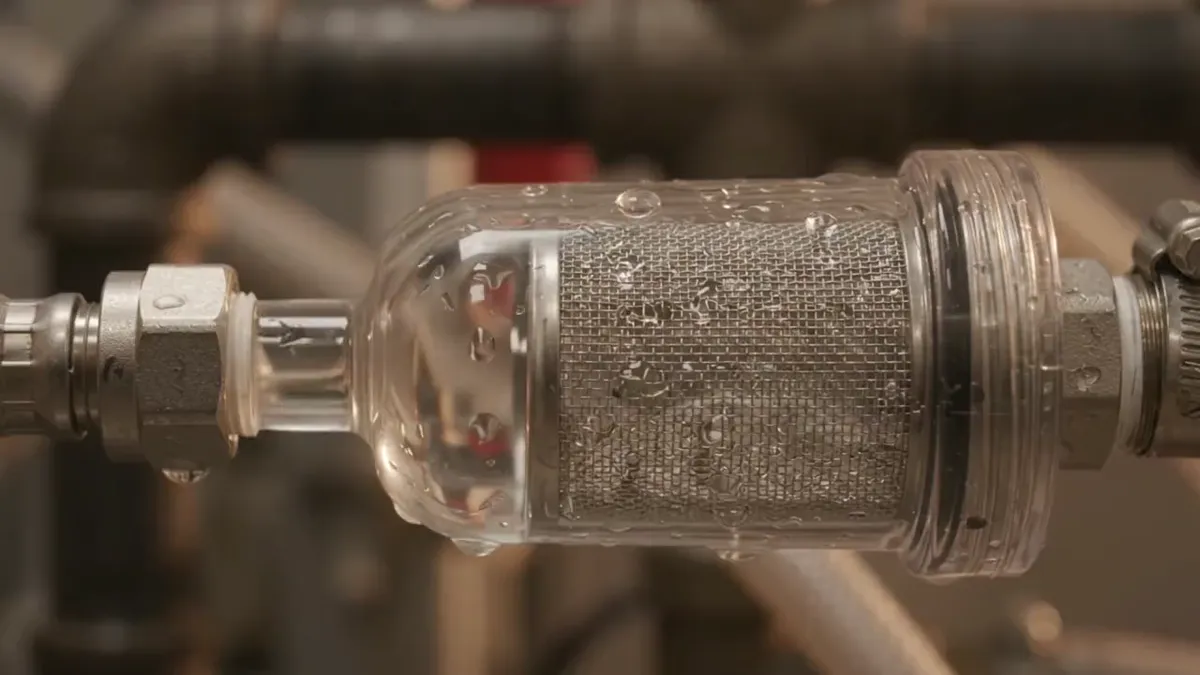
A fish fertilizer that plugs tips is almost always telling you one of four things: the product settled and was not mixed back in, something in the tank reacted with it, the water was cold and the mix was rushed, or diluted product sat in the lines. Fix those, and set your strainers coarse to fine with the tip screen sized to the nozzle, and most plugging stops.
Why do fish fertilizers plug sprayers?
- They settle. Many fish-based fertilizers are suspensions, not true solutions, so they can settle out if they sit in a tank without agitation. Settling in a jug or tote is normal; the fix is to mix it back in before it goes in the sprayer.
- Calcium reacts. Phosphorus in a tank can react with soluble calcium and form insoluble calcium phosphate, and once that forms it will not rinse out. Calcium can come from a tank partner or from hard well water, which carries calcium and magnesium.
- Cold water slows mixing. Purdue Extension's Avoid Tank Mixing Errors (PPP-122) says dry products and flowables take longer to disperse when the water is cold, about 42°F, and that undissolved material is what clogs screens and nozzles.
- Too little water. The same Purdue guide says incompatibility is more likely at low water volumes and high product rates.
- Diluted product left standing. The TNT Super Salmon+ label says the diluted product is highly biologically active and should not be left in equipment. Any mix that stands still in a boom or a row-unit line has time to settle.
What mesh goes where on the sprayer?
Filter in stages, coarse at the tank and finer toward the tip, so each screen only catches what the last one let through. Sprayers101, run by Ontario's application technology specialist, puts it this way: each level of filtration gets progressively finer, ending with nozzle strainers slightly finer than the nozzle orifice. A suction strainer and line strainers are the bare minimum.
| Location | Typical mesh | Source |
|---|---|---|
| Tank fill (basket) | 16 or 20 mesh | NDSU Extension AE73 |
| Line strainer, roller (positive displacement) pump | 40 or 50 mesh on the pump inlet | NDSU Extension AE73 |
| Line strainer, centrifugal pump | 50 mesh on the outlet side | NDSU Extension AE73 |
| Tip screens, small nozzles | 24, 50 or 100 mesh | NDSU Extension AE73 |
| Nozzles over 1 gallon per minute | Tip screen not usually needed | NDSU Extension AE73 |
Mesh is the number of openings per inch, so a higher number is a finer screen. As a rough guide from a strainer maker's mesh-to-micron chart: 16 mesh is about 1,190 microns, 30 mesh about 590, 50 mesh about 297, 80 mesh about 177, 100 mesh about 149 and 200 mesh about 74.
What do the TNT labels say about strainers?
- The TNT HEF 2-0-0, HEF 2-3-0 and HES labels call for twinjet flat fan tips with proper strainers. TNT's guidance is to size those strainers to the tip's delivery rate.
- TNT advises 50-mesh or coarser screens for its products, not very fine screens such as 180 mesh. NDSU notes that a product label can set a minimum like this, and the label wins.
- TNT Super Salmon+ is filtered to 120 mesh at the plant. Its label still says to filter it to the specifications of the equipment you are using, to avoid plugging.
- The TNT Activator label says it is filtered at manufacture, and that critical systems need separate filtration to avoid plugging very small orifices.
- For how finely HEF, HES or Trash Buster is screened at the plant, check the label or call us at (574) 532-6201. We do not publish a number we have not confirmed.
How do you set up a low-rate in-furrow system so it does not plug?
Run more water through a bigger hole. On a planter kit every row has its own small metering orifice, and the smaller the orifice, the finer the screen it needs and the easier it plugs. One nozzle maker's fertilizer catalog pairs its numbered orifice plates with tip screens like this: plates numbered 15 and smaller get 200 mesh, 16 to 39 get 100 mesh, 40 to 70 get 50 mesh, and 72 and larger need no tip screen.
The flow each row needs comes from a standard formula: gallons per minute per row = gallons per acre × mph × row width in inches ÷ 5,940. At 5 mph on 30-inch rows:
| Total liquid per acre | Flow per row | Screen that chart calls for |
|---|---|---|
| 3 gal/acre | about 0.08 gpm | 100 mesh |
| 5 gal/acre | about 0.13 gpm | 100 mesh |
| 10 gal/acre | about 0.25 gpm | 50 mesh |
| 20 gal/acre | about 0.51 gpm | No tip screen (plates numbered 72 and up) |
The chart figures are for water at 20 psi, so catch each row for one minute and check it. If your orifice lands in a band that wants a finer screen than 50 mesh, that is the sign to add carrier water and move up an orifice size, not to put a finer screen in front of a fish product. Call us if your kit will not get there.
For TNT HEF in the furrow, the label rate is 1-3 qt/acre, with at least 10 parts water to 1 part product. As an example, 2 qt/acre of HEF in 10 gallons of total liquid per acre is 1 part product to 19 parts water. TNT Super Salmon+ goes in-trench at up to 2 gal/acre, diluted at least 1:3, and TNT Activator in-trench is diluted at least 1:2. Rates for each product are on the label. For calibrating the kit row by row, see an organic in-furrow starter for corn.
How do you mix the tank so nothing drops out?
- Mix the product first. Stir or agitate the jug or tote until any settling is gone. Do not mix TNT Super Salmon+ with air; its label says so. For how to agitate a settled tote, call us.
- Jar test with your own water. Use the water that fills the sprayer, the same ratios and the same loading order. See how to jar test a fish fertilizer tank mix.
- Fill at least half the water first. Purdue PPP-122 says the tank should be at least half full of water before the first product goes in, with agitation running.
- Add one product at a time. In cold water, Purdue says to give each tank-mix partner three to five minutes to disperse before adding the next.
- Keep agitation on. Biological products need constant agitation, all the way through the field. NDSU says a jet agitator usually needs 5 to 6 gpm of flow for every 100 gallons of tank, or 2 to 3 gpm with a venturi agitator.
- Top up and go. Spray what you mix. Do not let a diluted mix sit.
On a foliar pass, TNT HEF and TNT HES go on at 0.5-4 qt/acre in at least 10 gallons of water per acre, and HEF and HES together never over 4 qt/acre. TNT Super Salmon+ foliar is up to 2 gal/acre, diluted at least 1:10, so 2 gallons needs at least 20 gallons of water.
Which mixes plug most often?
- Calcium. TNT HEF 2-0-0 mixes with calcium but needs agitation to stay blended, so jar test first with your own calcium source and water. Call us before you mix HEF 2-3-0 with calcium. The Super Salmon+ label says it is not likely compatible with calcium inputs.
- Humates. Watch the jar for curdling. Soluble humates are not all alike, so test the one you have.
- Liquid fertilizer as the carrier. Purdue notes liquid fertilizer is a concentrated salt solution with less free water, so dry products may need to be premixed in water first.
When in doubt, the jar decides. If it curdles, layers or leaves sludge, do not load the sprayer.
How do you clean up after a fish fertilizer pass?
- Flush the same day. Penn State Extension says not to leave spray solution in the boom lines overnight. For TNT Super Salmon+, the label says not to leave diluted product in equipment and to flush lines that will stand more than 4 hours. Use TNT Activator and TNT Trash Buster within 8 hours of mixing.
- Run clean water through everything. Flush the tank, hoses, boom and nozzles, and open the boom ends if your sprayer has them. Ohio State Extension suggests circulating clean water a few minutes with the nozzles off, then flushing it out through the nozzles.
- Pull the tips and screens. Penn State says to remove nozzles, screens and strainers and clean them separately. Sprayers101 adds that nozzle strainers have to be scrubbed, not just rinsed.
- Use a soft brush, never a wire. NDSU says to clean tips with a soft-bristled nozzle brush or compressed air, and never with a small wire or a knife point, which damages the orifice.
- Do the in-furrow kit too. Flush the planter's tank, pump, lines and row-unit orifices with clean water, and check each row's flow before the next field.
What about end of season and storing product?
For the sprayer, Ohio State Extension says to drain all liquid so the pump does not freeze, remove the tips and strainers, dry them and store them dry, and keep the sprayer in a dry building if you can.
For the product, the TNT HEF and HES labels say freezing generally does not damage it. TNT Super Salmon+ must be kept from freezing. Every TNT label asks for storage out of direct sunlight, and the fermented products need their containers vented above 40°F. Cold product is thicker and harder to pump, so give it time to warm up, and mix it thoroughly before use. The details are in storing fish fertilizer over winter.
What is a good first step?
Before the next pass, pull one tip screen and one line screen, look at what is on them, and write down the mesh of each. Then run a jar test with your own water. If you are setting up a planter kit or a sprayer for TNT for the first time, call us at (574) 532-6201 and we will go over the rate, the water and the screens with you, or request a free sample to try it on a few acres. Every TNT label is on our Reports, Certifications & Labels page.