Set your corn population from the hybrid’s recommended range, not from the fact that you added biology. A biological program works on the plants you already have, and extension trials show the yield curve is flat across a wide range of stands.
Why does this question come up?
It came up in our Coffee Shop session, Coffee Shop (Dec 15, 2022): Lessons from 2022, Part 1. A grower who runs fish fertilizer, calcium and microbes had been seeing bigger, fuller plants. He asked whether that opened the door to planting a few thousand more seeds per acre. It is a sensible thing to wonder. If the program grows more root and leaf per plant, maybe the field can carry more plants.
The answer from the group was practical. Population depends on the variety. Some hybrids are bred to take a crowd, and some are not. That advice lines up with what the universities have measured.
What do extension trials say about corn population?
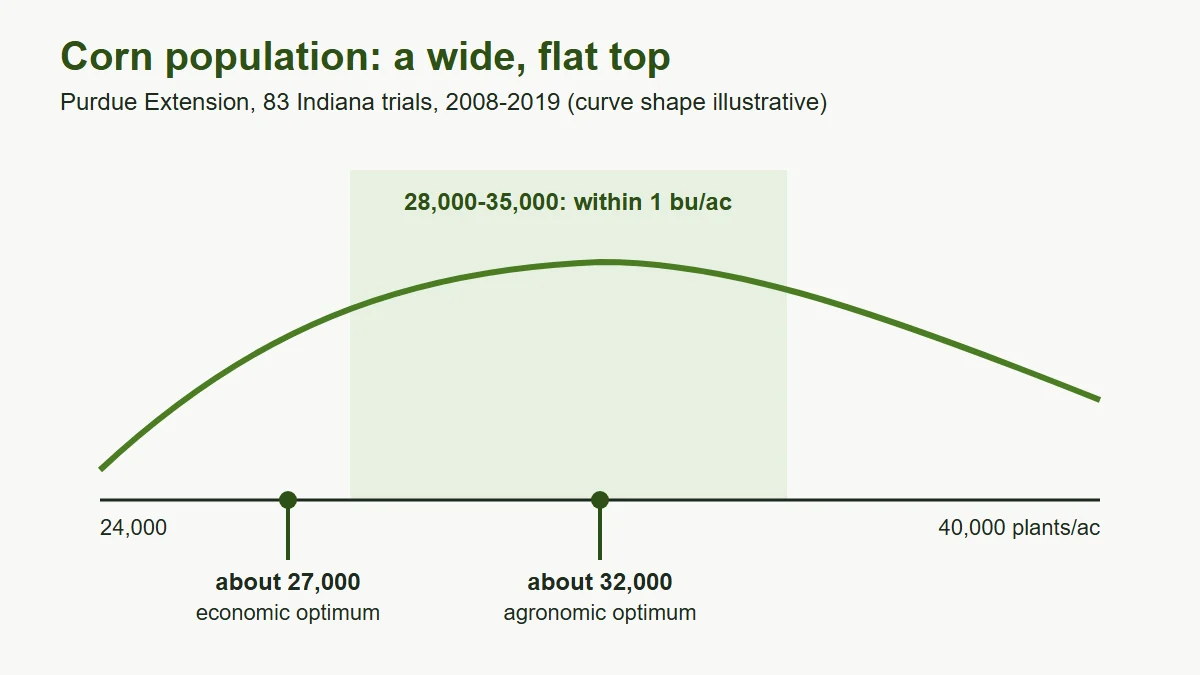
Purdue Extension (Nielsen, Camberato and Quinn) summarized 83 Indiana trials run from 2008 to 2019. The agronomic optimum, where yield is highest, was about 32,000 plants per acre. The economic optimum, where profit is highest after paying for seed, was closer to 27,000. The authors describe the top of the curve as flat: final stands anywhere from roughly 28,000 to 35,000 plants per acre changed yield by only about 1 bushel either way.
The same team reports that they have rarely seen consistent, repeatable differences between hybrids in how they respond to population. What does change is the price of seed, and the economic optimum moves with it.
| Number | Value | Source |
|---|---|---|
| Agronomic optimum | about 32,000 plants/ac | Purdue Extension, 83 Indiana trials, 2008-2019 |
| Economic optimum | about 27,000 plants/ac | Purdue Extension |
| Yield response, 28,000-35,000 plants | within about 1 bu/ac | Purdue Extension |
| Average stand in the trials | 95% | Purdue Extension |
| TNT HEF in-furrow rate | 2-4 qt/acre | TNT crop chart |
The take-away is that most of the benefit is already captured inside a broad band. Pushing past it mostly adds seed cost. A flat curve is good news for a grower: it means you have room to choose a population that fits your hybrid, your soil and your seed budget without worrying about a cliff on either side.
What does a biological program actually change?
It changes how the plant starts. TNT HEF 2-0-0 is made from naturally fermented whole saltwater salmon in a cold process, with over 70% volatile fatty acids. It feeds both fungi and bacteria, draws beneficial microbes from the surrounding soil toward the seed trench, and supports faster crop establishment and early root development. We often describe it as colostrum for the seedling: the early relationships get set up before emergence.
Growers who use it in-furrow tell us about consistent emergence and stronger stalks. Those are stand-quality benefits. They make a given population work harder, which is a different thing from a license to add plants. HEF 2-0-0 is also fully compatible with calcium blending programs.
For US certified organic corn, TNT HEF 2-3-0 is OMRI Listed (NOP, tna-16447, expires 1 March 2027) and carries the added phosphate used for cool-soil starts.
How do you work out the right seeding rate?
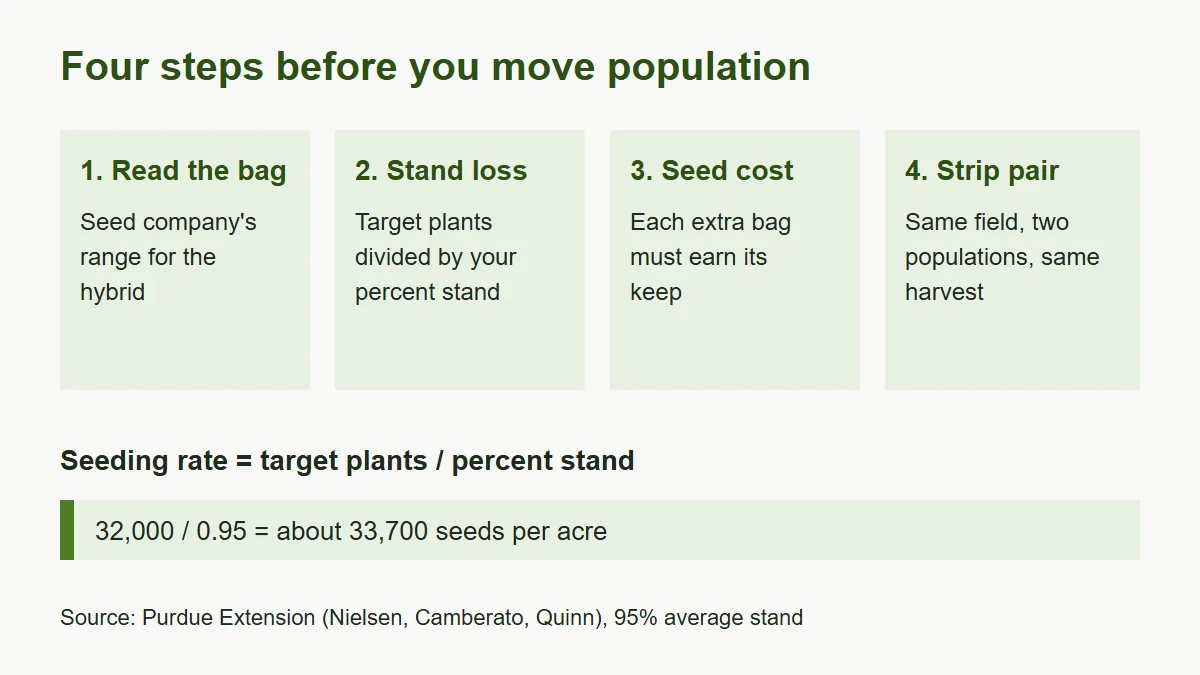
Population is what you want standing at harvest. Seeding rate is what goes in the planter. The gap between them is your stand loss.
- Start with the hybrid’s recommended range from the seed company.
- Pick a target final population inside that range.
- Divide by your typical percent stand. For 32,000 at 95%: 32,000 / 0.95 = about 33,700 seeds per acre.
- Compare the cost of each added 1,000 seeds with what you can actually expect it to return on your soil.
Extension programs in several states publish seeding-rate calculators for step four. Use the one for your state, since soil and rainfall change the answer.
Why does early stand quality matter more than extra plants?
Every plant in the row has to compete for light, water and nutrients with its neighbors. Plants that come up on the same day, at the same size, share those resources evenly. Plants that come up late sit in the shade of the early ones. That is why growers who use an in-furrow program watch emergence closely. An even stand is the base for everything that follows, and it is set in the first few weeks: ear placement, uniform pollination and a clean harvest pass. A biological program that supports early roots is working on that base, and it does so at whatever population you choose.
When would a higher population make sense?
Some hybrids are bred with upright leaves and a fixed ear, and are sold to handle thicker stands. If your seed company’s range for that hybrid runs into the mid-30,000s, planting there is within the recommendation. Staying within the range keeps the decision simple. In our session, a dealer put it this way: the bag’s range is usually the safer place to be, and going above it can mean more ears that are smaller.
Row spacing, weed control method and planter quality also matter, and each is a management call on your own farm.
How do you test it on your own farm?
Run a strip pair. Pick one uniform field and one hybrid. Plant a strip at your usual population and a strip at the higher one, side by side, then repeat the pair at least twice. Harvest all strips in the same direction with the same combine and correct yield for moisture. Compare the pairs, and keep your own seed cost in the math.
We set up TNT product trials the same way. Our 2025 corn trial compared two treated strips with their controls on one Ohio farm in one season, and results vary; you can read every number on our reports page. For a trial of your own, ask for a free sample, and see the full program by stage in the corn guide.
What should you keep in your program?
- Label rate in-furrow. 2-4 qt/acre of HEF, 2 qt on 20-30 inch rows and 4 qt on 8-20 inch rows, diluted at least 1:10 with water.
- Clean filtration. 50 mesh or coarser and steady agitation in the tank.
- A recorded plan. Write down hybrid, population, rate and date so next year’s comparison is easy.
- Certifier sign-off. For NOP acres, confirm the listed product with your certifier before it goes in the planter.
TNT has 20+ years of experience helping growers set up fish fertilizer programs. If you want a second set of eyes on your plan, call (574) 532-6201.