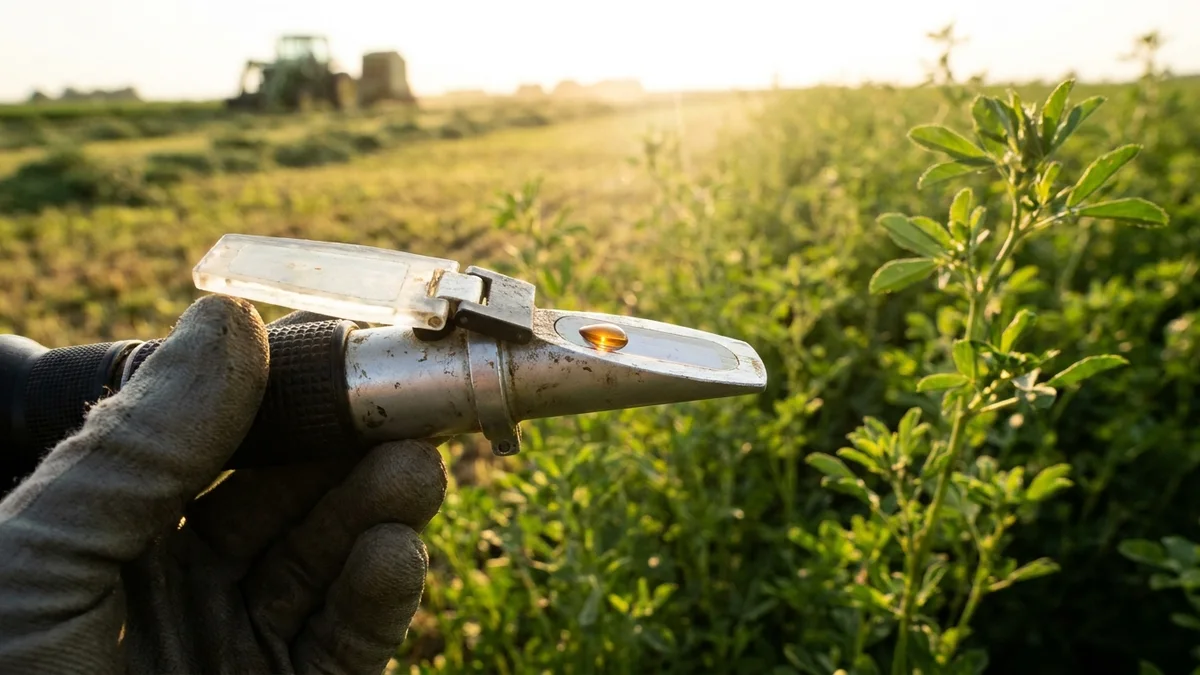
A Brix reading is a quick sugar check you take yourself: press a few drops of juice from the youngest fully open leaf, put them on a hand refractometer and read degrees Brix. There is no single target number for hay, corn or vegetables, so the useful habit is to read the same way every visit and compare each field with itself.
What is Brix, and why do growers read it?
Brix measures the dissolved solids in plant juice. In a 2020 paper in the Journal of Animal Science, Soder and colleagues describe it as total dissolved solids measured by refractometer, using a hand-held garlic press to extract the juice from fresh herbage. The leaf is where photosynthesis happens, so the juice from a healthy, well-fed leaf carries a lot of sugar.
That is why we talked about it on a July 2026 community call on hay, photosynthesis and home gardens. The idea the guest speaker laid out: a plant that makes plenty of sugar can send some of it down to the roots, where it feeds soil microbes, and those microbes in turn work on making nutrients available to the plant. The meter gives you a number to watch while that cycle runs. The same logic applies to hay, cash crops and garden vegetables.
The same paper found that Brix alone does not stand in for a forage-quality lab test, and that alfalfa and orchardgrass behaved differently. So treat Brix as one tool in the kit, best used to compare like with like, and pair it with a tissue test or a forage test when quality is the question.
What Brix should hay, corn and vegetables show?
Pick your own baseline. Published figures for a "right" reading do not exist across crops, and the number moves with leaf age, time of day, sunshine and moisture. What works on the farm is a short log you build yourself.
| Crop | Leaf to sample | How to get the juice | What to log |
|---|---|---|---|
| Hay and alfalfa | Youngest fully open leaf | Garlic press, or a crusher with nested channels; fold and re-squeeze | Days since cutting, time, weather |
| Corn | Youngest leaf with a visible collar | Garlic press on a leaf section | Growth stage, time, weather |
| Vegetables | Youngest fully open leaf | Garlic press | Fruit set, watering, time |
Read at about the same hour each time, and write down the field, the crop stage and the weather. After three or four readings you have a trend. After a season you have a baseline for each field, and that is worth more than any number from somewhere else.
How do you take a Brix reading step by step?
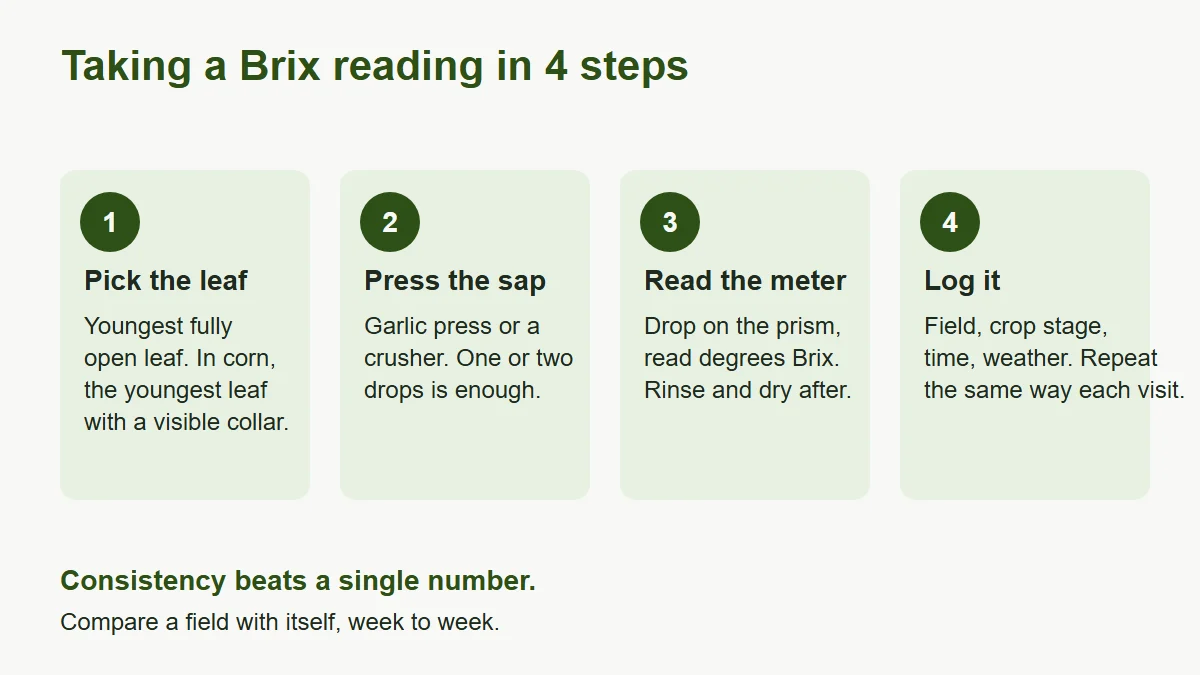
- Pick the leaf. Choose the youngest fully open leaf, one that is at or near full size. Skip the very young leaves coming out of the whorl and skip the oldest leaves. In corn, take the youngest leaf that shows a full collar.
- Press the sap. Fold a piece of leaf into a garlic press and squeeze. You only need one or two drops. Alfalfa and other tough leaves take a few passes: squeeze, open, fold the leaf over and squeeze again.
- Read the meter. Put the drops on the prism, close the cover, face a light and read where the line crosses the scale. Rinse and dry the prism between samples.
- Log it. Field, crop, stage, time and weather. Take several leaves across the field and average them, because one plant can mislead.
How do you check that sugar is reaching the soil?
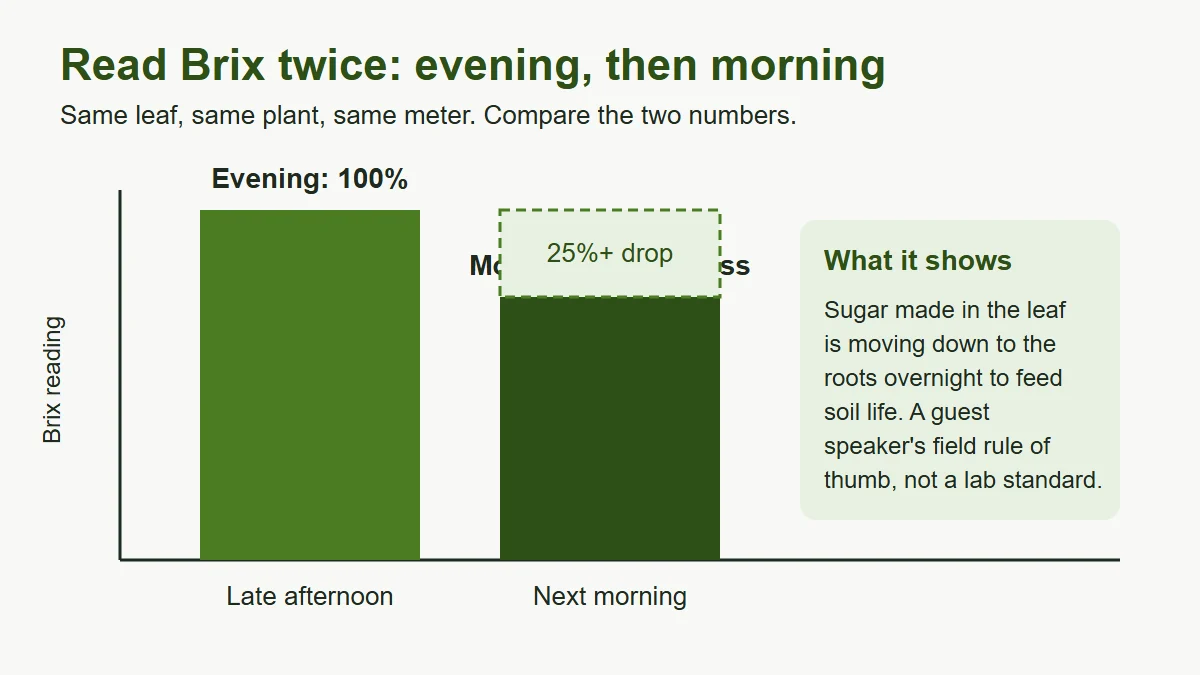
Read the same crop twice: late in the day, then again the next morning. If the plant is moving sugar down to the roots overnight, the morning number comes in lower. The guest speaker looks for at least a 25% overnight drop, and said drops of up to 75% are possible depending on the crop. It is a field rule of thumb from his own work, not a lab standard, so use it as a trend line on your farm.
If the evening number is high and the morning number barely moves, that is the field to look at more closely with a tissue test, so you know what the plant has to work with.
Should you run a tissue test alongside the meter?
Yes, and do it before you plan a foliar or a nitrogen pass. The meter tells you what the leaf is carrying today. A tissue test shows which nutrients are short before a symptom shows up, which is why the speaker called them hidden hungers: by the time a deficiency is visible, it is already well along.
- Ask for nitrate on the report, not just total nitrogen. TNT's corn notes add molybdenum to the foliar once tissue nitrate runs over 1,000 ppm.
- Retest after rain if the weather was dry. Nitrogen needs water to move into the plant, so a low reading in a dry spell may only mean the plant cannot reach it yet.
Testing tissue before deciding on nitrogen is how TNT ran its 2025 corn strips with HEF in-furrow: the tissue reports said the crop had enough, and the planned side-dress stayed in the tank. That was one Ohio farm in one season, with two treated strips each compared against a control, and results vary with soil, weather and program. The yields, input costs and soil-biology data are on the 2025 corn trial page.
Where does a foliar program fit with Brix readings?
A Brix log tells you what your own crop does through a season, so it makes a good companion to any foliar pass. Take a reading before you spray, another a few days after, and keep the same leaf, time and meter.
- Hay, forages and pasture: TNT Hi-Energy Spray (HES) 1-0-0 goes on at 1 gal/ac after each cutting or grazing, at least two weeks before the next one. It is a blend of TNT Hi-Energy Fish and other natural sources made to support healthy growth and photosynthesis. Read before and after to see what it does on your fields.
- Corn: TNT's corn notes add HES at 1-2 qt/ac to a foliar pass, and HES can go on in both vegetative and reproductive stages. Jar test any new tank mix first.
- Other crops: HES can be applied to non-forage crops every two weeks at a lower rate.
- Home gardens: use the Gardens row for TNT HEF, which gives soil and foliar rates per 1,000 sq ft. Read the meter every couple of weeks and log it.
HES is made from organically approved ingredients, but it is not OMRI Listed. Only TNT HEF 2-3-0 and TNT Super Salmon+ are OMRI Listed for US organic (NOP). If you farm organically, check your certifier before you add anything.
What are the common reading mistakes?
- Changing the leaf. A young leaf and an older leaf from the same plant read differently. Fix your rule and stick with it.
- Changing the hour. Sugar builds in the afternoon and falls overnight. Compare morning with morning and evening with evening.
- Reading one plant. Take several leaves along a Z or W across the field and average them.
- Skipping the log. A reading you did not write down is only a story. Keep a notebook in the truck.
How can TNT help you get started?
The TNT team brings 20+ years of experience to questions like this. Call (574) 532-6201 and we will help you lay out a before-and-after Brix check on one field beside an untreated strip. A free sample covers the treated side, and the pasture and hay page lays out the label rates for hay.