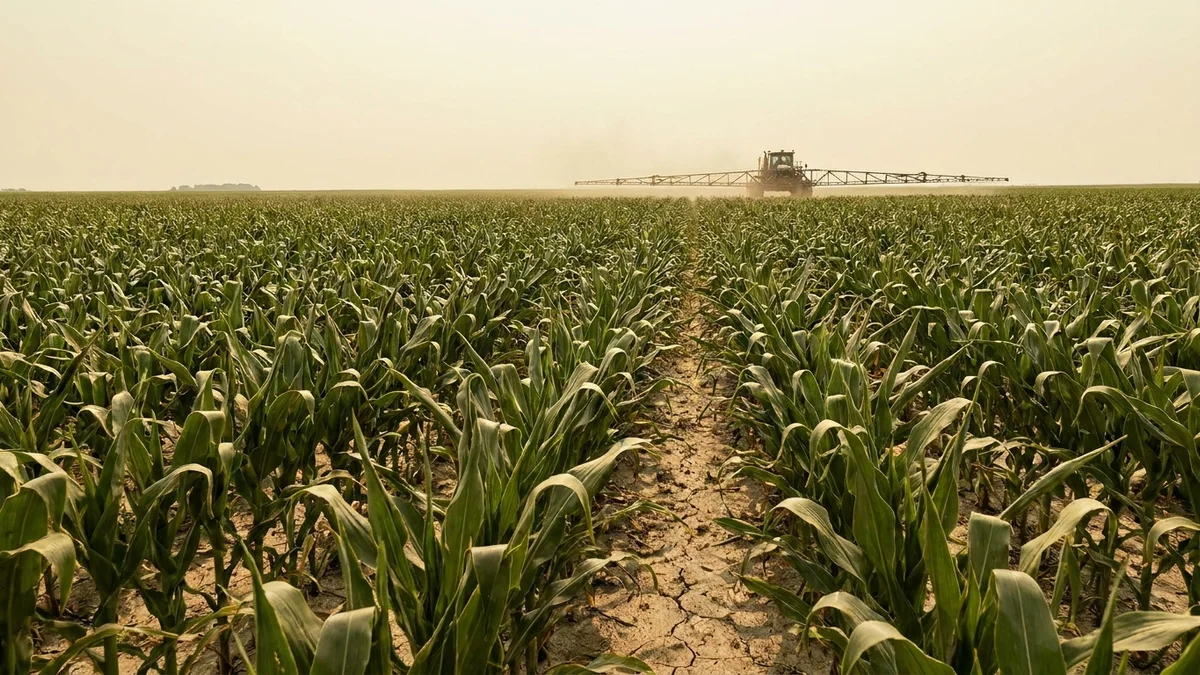
Biostimulants may help corn handle water stress, but the evidence is mixed and the effect, when it shows up, is usually small compared with rain, soil and hybrid. If you want to try one, apply it before the stress arrives and test it in a replicated strip trial on your own ground.
What is a biostimulant, exactly?
The word covers a lot of ground. University of Illinois crop scientists Fred Below and Connor Sible, with Juliann Seebauer, point out that what farmers call "biologicals" is what the scientific literature and regulators call biostimulants. They describe the group as living microbial inoculants plus non-living, naturally derived chemicals and extracts, applied to soil, seed or plants to improve fertilizer effectiveness, reduce plant stress, or support soil health.
In practice, four families come up most for drought talk:
| Family | What it is | Why people try it for water stress |
|---|---|---|
| Seaweed extracts | Liquid extracts of kelp or other algae (Ascophyllum, Kappaphycus and others) | Sold for stress tolerance; results vary by product and season |
| Protein hydrolysates and amino acids | Broken-down protein from plant or animal sources, including fish | The 2020 review cited below links amino acids such as proline to drought tolerance in maize, wheat and barley studies |
| Humic and fulvic substances | Carbon compounds from decayed organic matter | Claimed to support root growth and nutrient uptake |
| Microbial products | Bacteria or fungi applied to seed, soil or leaf | Aimed at root growth and nutrient access |
What does the research say?
There are two honest answers, and both are true.
Reviews find promise. A 2020 review in Frontiers in Plant Science by García-García and colleagues, "Pure Organic Active Compounds Against Abiotic Stress: A Biostimulant Overview," looked at amino acids, polyamines, biopolymers and other organic compounds. It reports protective effects across several crops and stresses, including drought, but says many of these results have little practical value for farmers yet. One example it gives: a compound raised wheat's tolerance to soil drying but did not change grain yield. The authors say field trials are needed to confirm that a product actually increases crop yield.
Extension field trials are less excited. University of Minnesota Extension educators Anne Nelson and Paulo Pagliari wrote that in their research, products expected to raise enzyme activity rarely did compared with untreated plots, and those expected to boost yields did not show improvements over untreated. Their advice is plain: run a replicated strip trial before putting a product on your whole operation. Fred Below of the Illinois team put it this way in the university's news release on biostimulants: "Very often, marketing exceeds the actual research."
Put those together and you get a fair summary. Lab and greenhouse work shows plausible mechanisms. Field results swing with the product, the crop, the season and the kind of stress. Nobody can promise you a response on your farm.
Why would a biostimulant help in a dry spell at all?
The mechanisms in the literature are modest. The 2020 review discusses compounds that act as antioxidants inside a stressed plant. In general terms, a plant with a larger or more active root system has a better chance of reaching water and nutrients in a dry profile. None of that creates moisture. It only changes how the plant uses what is there.
When should I apply one if I am worried about a dry year?
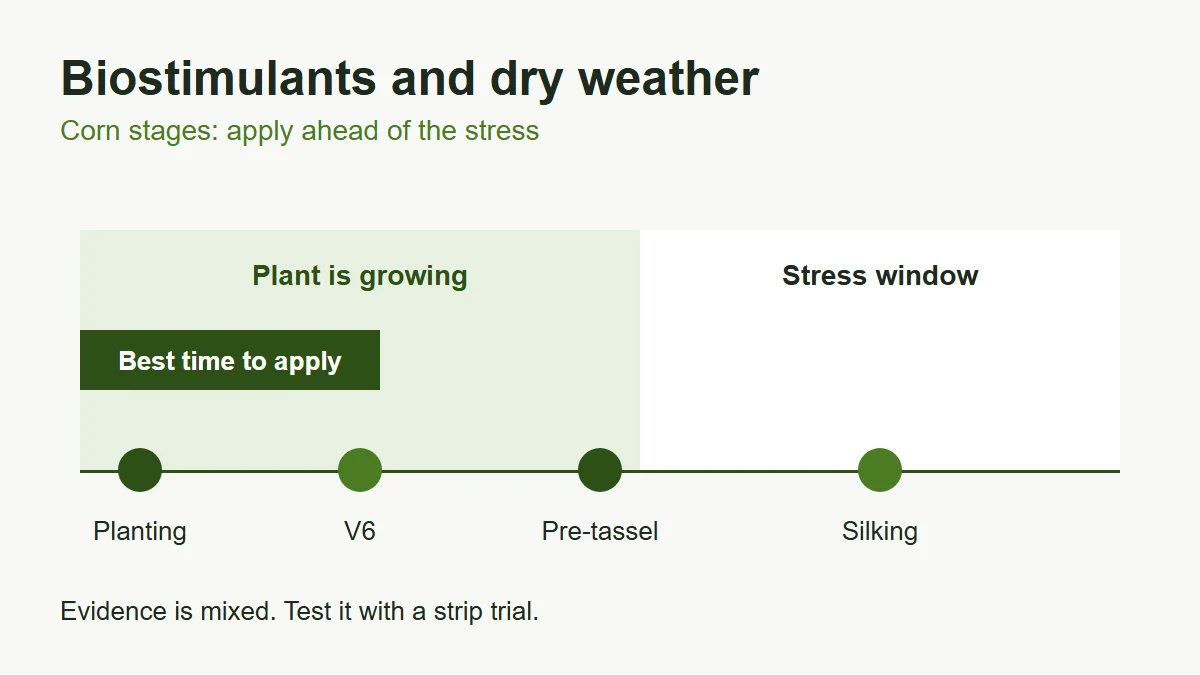
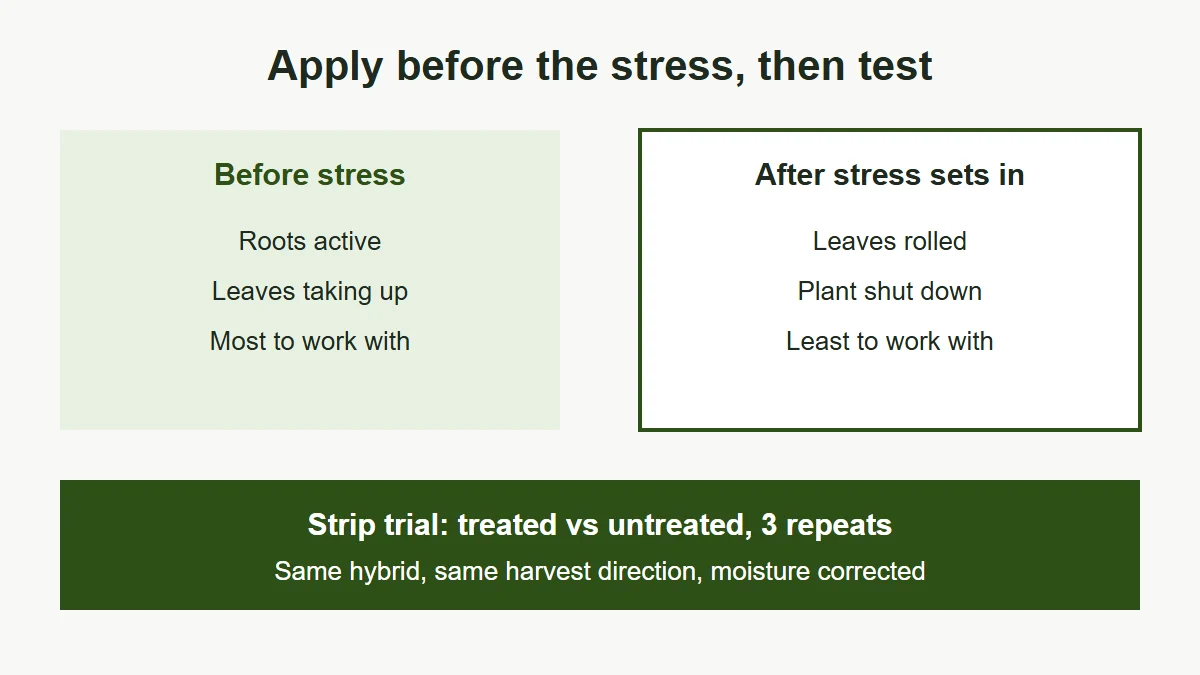
Ahead of the stress. A plant that is actively growing can take up and use a foliar or in-furrow product. A plant that has already shut down in afternoon heat has little reason to respond.
- At planting. In-furrow is where a root-zone product goes. TNT HEF is used in-furrow at 2-4 qt/acre; read the label for your equipment.
- Vegetative growth. A foliar pass during active growth, at label rate, on a cool morning or evening, with the tank filtered to your equipment.
- Before tassel. If the forecast and your soil moisture say a dry July is coming, this is the last easy window.
Always follow the label for rates, tank mix and timing. If you are not sure how a product mixes with your program, jar test first.
Where do TNT products fit?
TNT Super Salmon+ (2-2-0) is made from naturally fermented whole saltwater salmon with kelp and chitin, so it spans two of the families above: a fish protein hydrolysate and a kelp product. It is OMRI Listed for US organic (NOP). TNT HES (1-0-0) is a foliar product sold mainly for forages and pasture, and it is not OMRI Listed. We have no TNT trial that tested either product under drought, so we will not tell you they fix a dry year. What we can say is that they are worth a strip next to your normal program if you want to see for yourself.
How do I test it on my own corn?
This is the step that matters most. The Minnesota Extension advice and the reviews above both land in the same place: confirm it locally.
- One question. Treated or untreated. Change nothing else.
- At least three repeats of each strip, side by side, in a random order.
- Same hybrid, planting date, soil type and harvest direction.
- Weigh each strip and correct for moisture. Compare strips next to each other, not a strip to the field average.
- Write down the weather. If the year turns out wet, the test says little about drought. Repeat a second year if you can.
One of the harder lessons from our own work: a result from one farm and one season is just that. Our 2025 corn trial was on one Ohio farm for one season, and results vary with soil, weather and program. You can read the write-up at our trial report, and see the full corn program by growth stage on the corn page.
What should I do first when drought is in the forecast?
Before any jug, look at the things that decide most of the outcome: water, rooting depth, compaction, residue cover and hybrid maturity. Biostimulants sit at the bottom of that list. If a strip trial is a cheap way to find out whether one helps on your farm, it is worth doing. If it will stretch the budget, spend on the fundamentals first.
Want a small amount to try? You can request a free sample from our sample page.