TNT trial program
How to run a strip trial that gives you a real answer
Everything a grower needs to test a TNT program on their own ground and trust the result: how to lay out the strips, what to measure and when, how to weigh the harvest, and how to tell a real difference from field noise. The same steps drive the checklist and reminders in your trial console.
Ask one question and change one thing
A trial answers a yes-or-no question. Write it down before you plant. Good ones sound like:
- "If I put 2 qt/ac of TNT HEF in-furrow, can I drop my 60-gallon side-dress and keep my yield?"
- "Does a V5 foliar pass of HEF change my soybean yield?"
- "Does HES after each cutting change my hay tonnage?"
The control is your normal program. Everything else stays the same on every strip: hybrid or variety, planting date, population, tillage, herbicide, fungicide, fertility. If you change two things at once, you won't know which one did it. If you want to compare two whole programs, that's fine, but list every difference so you can read the result honestly.
Make the goal SMART
- Specific: one clear goal, and you know what you will test for, how, and when you will record it.
- Measurable: a number you can compare between trial and control, such as yield, Brix, plant height, root mass or a tissue nutrient level.
- Achievable: there is a way to test it, and the result you hope for is within reach. A 1,000-bushel corn goal is not.
- Realistic: it fits your time, your equipment and what the testing will cost.
- Timely: take samples when planned and get results back fast enough to act on them, for example a tissue test that leads to a corrective foliar pass.
Source: Iowa State University Extension, "Conducting On-Farm Trials"; Practical Farmers of Iowa Cooperators' Program; TNT Talk Time, "Trials: Yours and Ours" (2025).
Pick the field
- Use a field you know. Old feedlots, manure history and high soil-test spots will swamp a fertility trial.
- Run the strips across the variability, not along it, so every strip gets its share of the good and the poor ground. If one end is sand and the other is clay, every strip should run from the sand to the clay.
- Never split a field in half. One half is always different from the other, and you will be measuring the field, not the product.
- Long, straight fields with uniform drainage make the easiest trials.
Source: Iowa State University Extension; Oregon State University, "Experimenting on the farm".
Lay out the strips
- Replicate. At least 3 strips of each treatment; 4 is better. One trial strip next to one control strip is a demonstration, not a trial.
- Mix up the order. Don't always put trial then control. Flip a coin for each pair: T C, C T, T C. Otherwise a wet corner or an old fence line can line up with one treatment every time.
- Width: one planter pass, and a width your combine header divides into evenly. Corn is usually easy; soybeans often aren't (a 40-ft planter and a 35-ft head won't line up), so plan the harvest passes before you plant.
- Length: the whole field length if you can, and never under 100 ft. A yield monitor blends about 13 seconds of grain flow, so short strips smear into each other. Practical Farmers of Iowa typically runs strips of about 2 acres each.
- Border rows for foliar products. Spray drifts and roots reach sideways. Plant 8 rows and harvest only the center 6, or leave an untreated pass between strips.
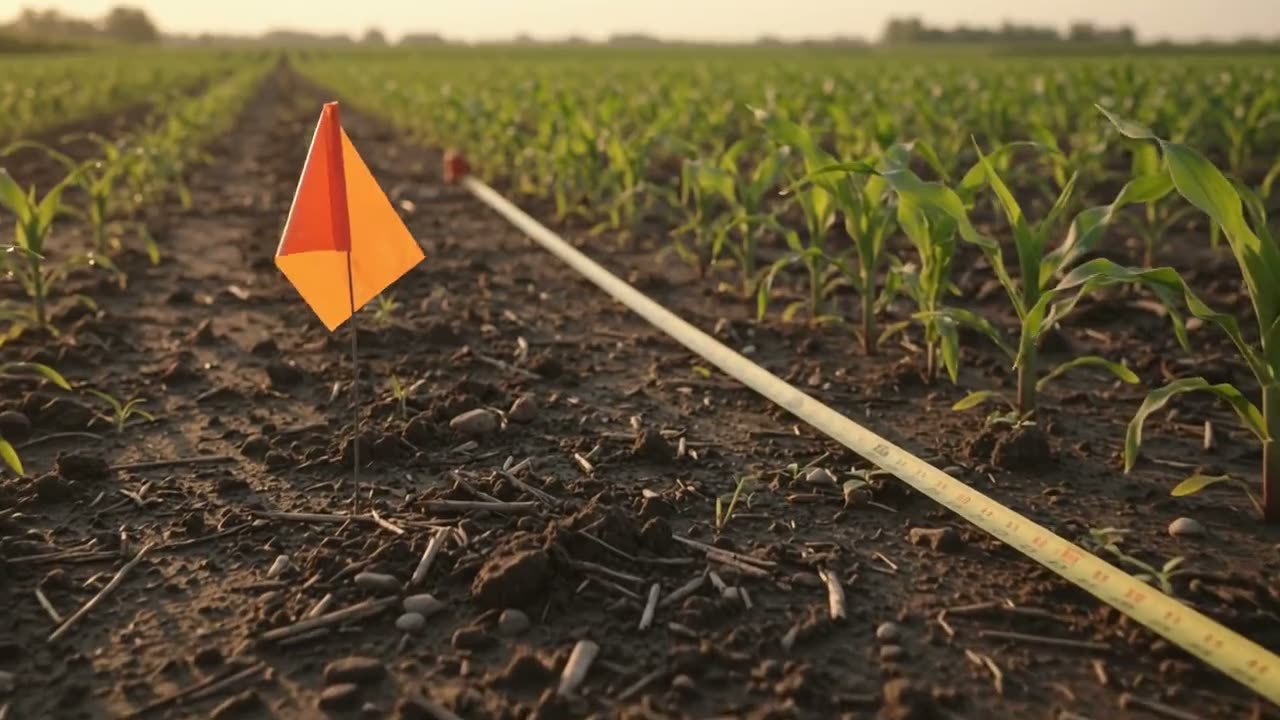
- Mark everything. Save the A-B line and as-applied map in the monitor, and push a flag in at both ends of every strip. Write the strip order on the record sheet.
- Harvest the way you applied. Same direction, same passes. Never harvest on a diagonal across the strips.
Source: Iowa State University Extension; Practical Farmers of Iowa; University of Nebraska-Lincoln, "On-farm trials using the randomized complete block".
Write it down
The trials that fall apart are the ones nobody can reconstruct in October. Keep one sheet for the trial (print ours, or use your trial console) and record, for every pass on every strip:
- Product, rate and the date and time
- Crop stage when it went on
- Tank-mix partners and the order you added them
- Water volume per acre and nozzle
- Weather: temperature, wind, last rain, next rain
- Equipment settings and speed
- Anything odd: a plugged nozzle, a wet spot, a redo
- The strip order and where the flags are
Jar-test every tank mix first. Put a quart of your water in a jar, add each product in the order you'll add it to the tank, shake, and look at it after 15 minutes. If it separates, gels or settles, change the order or the partner before you fill the sprayer.
Source: Iowa State University Extension; TNT application guidance.
In-season checks
Yield is the answer, but the in-season numbers tell you why. Do each check on trial and control the same day, at the same spots, and log both.
Stand count (about 3 weeks after planting)
Count the plants in 1/1000 of an acre of row and multiply by 1,000.
| Row spacing | Count plants in | Then |
|---|---|---|
| 7.5 in | 69 ft 8 in of row | × 1,000 = plants/acre |
| 15 in | 34 ft 10 in of row | × 1,000 = plants/acre |
| 20 in | 26 ft 2 in of row | × 1,000 = plants/acre |
| 22 in | 23 ft 9 in of row | × 1,000 = plants/acre |
| 30 in | 17 ft 5 in of row | × 1,000 = plants/acre |
| 36 in | 14 ft 6 in of row | × 1,000 = plants/acre |
| 38 in | 13 ft 9 in of row | × 1,000 = plants/acre |
| 40 in | 13 ft 1 in of row | × 1,000 = plants/acre |
- Pick 5 spots in each strip, spread down its length, and push a flag in at each. Use the same spots every visit.
- Measure the row length for your spacing from the table and count every plant in it.
- Multiply by 1,000. Average the 5 spots for each strip.
- Log trial and control as "Stand count" on your trial page. Do it on the same day for both.
- Soybeans in 15-inch rows: use the 15-inch length, or count a 30-inch length and double the count.
Know your stages
Corn: count leaf collars (a leaf counts when its collar shows). V6-V11 sets kernel rows, V12-VT sets ear size, and the two weeks either side of silking (R1) are when stress costs the most yield.
Soybeans: R1 is the first open flower anywhere on the plant; R3 to R6 is pod set and seed fill, the window that decides yield.
Tissue samples
- Corn under 12 inches (V4-V5): the whole plant, cut ½ inch above the soil. Later: the newest fully developed leaf (collar showing); at silking, the ear leaf. 10-15 plants per sample.
- Soybeans: the newest fully developed trifoliate without the stem, 20-25 plants per sample, at R1-R2.
- Alfalfa and grass: the top 6 inches at late bud, from 5 spots per strip.
- Pull trial and control the same day and hour, bag and label them separately, and send both to the same lab. Log the lab numbers as "Tissue test".
- Take tissue ahead of the big uptake windows so you still have time to act on it, for example with a corrective foliar pass.
Brix readings
- A handheld refractometer reads the sugar in a drop of leaf sap in seconds, so it is an easy in-season number to log on trial and control.
- Sample the youngest fully open leaf: on corn, the youngest leaf with a full collar showing. Use the same leaf position, the same time of day and the same spots every visit.
- For a second look, read the same plants late in the day and again the next morning. The overnight drop shows the plant moving sugar to its roots and the soil microbes.
- Hard-to-squeeze crops such as alfalfa need a firm crush; one or two drops is enough.
Soil samples
10 cores per sample, 6-7 inches deep, from the same spots each time, trial and control kept separate. A pre-season sample from every strip tells you whether the strips started equal. Nitrate (PSNT) samples at V3-V5 are taken 0-12 inches between the rows.
Photos and notes
- Photograph each flagged spot from the same place every visit, trial and control. Root digs (one plant per strip) at V8 and again at tasseling show more than the canopy does.
- Note hail, wind, drought, standing water, insects and disease the day you see them, and which strips they hit. A storm that hits two of your six strips changes how you read the harvest.
- "No difference today" is a useful note too.
Source: University of Wisconsin-Madison Extension, "Crop staging, stand counts, and soil and tissue sampling"; AgriGold corn tissue sampling guide; Iowa State University Extension; Brix method from a TNT grower call on hay and photosynthesis (July 2026).
Harvest: weigh every strip
- Best: harvest each strip on its own and weigh it on a weigh wagon or a grain cart with scales. Record weight and moisture per strip.
- Yield monitor: fine if it's calibrated on this field, this crop, this moisture. Run a multi-point calibration (several loads across the yield range) and recalibrate if the error is over 3%. Check the impact plate, elevator chain tension and moisture sensor first; a worn sensor makes the whole trial unreadable.
- Moisture is the biggest error. A 2.5-point moisture difference between strips can swing yield 5%. Record moisture for every strip and correct everything to standard moisture before you compare (corn 15.5%, soybeans 13%, wheat 13.5%).
- Skip the end rows and any border rows; compare only the treated center rows.
- Harvest in the direction the strips were applied, never on a diagonal, and keep combine speed steady inside the calibrated range.
- Hay and pasture: bale each strip separately, count bales and weigh at least 5 per strip, record moisture at baling, and compare on a dry-matter basis. Forage-test trial and control at the same lab.
Moisture correction
Dry bushels = wet bushels × (100 − wet %) ÷ (100 − standard %). Or weigh a strip and let the calculator turn it into bushels per acre.
Enter the numbers above. Formula: wet bushels × (100 − wet %) ÷ (100 − standard %).
Source: Iowa State University Extension, "Tips for harvesting test plots and trials"; Purdue Extension, yield monitor calibration.
Read the results
- Correct every strip to standard moisture, then average the trial strips and the control strips separately.
- Look at the pairs. Did the trial beat the control in every replication? A treatment that wins 4 of 4 pairs by a few bushels is a stronger result than one that wins by 20 in one pair and loses in two. If it flips back and forth, you're looking at field noise, not the product.
- Size the difference against the noise. With 3 or more reps a simple statistic (the LSD, which any extension agronomist or TNT can run for you from your strip numbers) tells you how big a difference has to be before it's real at 90-95% confidence. Raw averages alone often hide the answer.
- Zero is an answer. "No yield difference, $X less nitrogen" is a result you can use.
- One field, one year is a start. Repeat it next year, or on a second field this year. Weather does more to yield than any input, and you want to see the product through more than one kind of season.
| Pair | Trial (bu/ac) | Control (bu/ac) | Difference |
|---|---|---|---|
| 1 | A1 | B1 | A1 − B1 |
| 2 | A2 | B2 | A2 − B2 |
| 3 | A3 | B3 | A3 − B3 |
| Average | Same sign in every pair? |
Source: Iowa State University Extension, "Conducting On-Farm Trials" (LSD, confidence levels); SARE, "On-Farm Research" fact sheet.
Common mistakes
- Splitting the field in half instead of replicating strips
- Changing more than one thing between trial and control
- No border rows on a foliar trial
- Harvesting on a diagonal, or with a header that doesn't fit the strips
- Trusting a yield monitor that was calibrated on another field or another moisture
- Strips under 100 ft
- Comparing wet weights at different moistures
- Judging by the averages without looking at the pairs
- Not recording what the control actually got
- Deciding after one season
Season timeline
What to do and roughly when. Your trial console turns this into real dates from your planting date and emails you as each step comes due.
Days count from planting. Set an expected harvest date and the last three steps follow it.
| When | Stage | What to do | How |
|---|---|---|---|
| day 1 | planted | Planting record | Guide |
| day 21 | about V3-V4 | Stand count | Guide |
| day 30 | about V4-V6 | Foliar window (V4-V6) | Guide |
| day 48 | about V8 | Tissue sample and photos | Guide |
| day 66 | about VT-R1 | Tasseling photos | Guide |
| day 95 | about R3-R4 | Ear check | Guide |
| 14 days before harvest | drydown | Get ready to weigh the strips | Guide |
| expected harvest | harvest | Harvest and enter results | Guide |
| 14 days after harvest | after harvest | Write your conclusion | Guide |
TNT product timing
| Product | Where it goes in a trial | Notes |
|---|---|---|
| TNT HEF 2-0-0 / 2-3-0 | In-furrow at planting, 2-4 qt/ac; foliar passes V4-V6 on corn, V3-V5 on soybeans | Naturally fermented whole saltwater salmon. HEF 2-3-0 is OMRI Listed (US); 2-0-0 is listed for Canadian organic. |
| TNT Super Salmon+ | In-furrow with HEF, or foliar ahead of heat and drought stress | OMRI Listed (US). Used in-furrow in Trial 2 of TNT's 2025 corn trial. |
| TNT HES | Foliar on hay and pasture after each cutting (6-8 in regrowth); on corn at VT in the 2025 trial | Not OMRI Listed. |
| TNT Activator | In-trench at planting, 2.5 gal/ac diluted at least 1:2 | Use diluted Activator within 8 hours. Not OMRI Listed. |
| TNT Trash Buster | On residue after harvest, 2 gal/ac | For a residue trial, measure residue cover or breakdown in spring, strip against strip. |
Jar-test every mix. Labels and application charts are on the reports and labels page; call (574) 532-6201 to set rates for your acres.
Worked example: TNT's 2025 corn trial
In 2025 TNT ran exactly this kind of trial with RhizeBio on one Ohio farm: triplicate strips, one question (can HEF in-furrow replace the side-dress?), tissue tests mid-season, and every strip weighed. The write-up shows the setup, the numbers, how the dollars were worked out, and what went the wrong way as well as the right way.
Read the 2025 corn trialReady to set it up?
Your trial console walks you through these steps, times them from your planting date, and emails you instructions as each one comes due.